


Between 1999 and 2015, errors in the UK Post Office’s Horizon accounting software resulted in more than 900 sub postmasters being wrongfully accused of theft, fraud and false accounting
The Post Office, which privately prosecuted most of these cases, refused to acknowledge the software’s faults, leading to wrongful convictions, loss of livelihoods and even suicides.
Earlier this year, The Police Federation, which represents officers in England and Wales, disclosed that more than half of officers who have died by suicide since 2022 were under live investigation.
And, while under or after the conclusion of an investigation into their fitness to practise, 16 nurses and midwives are known to have died by suicide since 2018 according to a report by the Nursing and Midwifery Council.
Employee investigations are causing harm
These are three extreme examples of an underlying problem which needs greater attention. Employee investigations are causing harm.
They can harm an employee professionally, reputationally and financially. They can cause emotional, social and family harm. And the stress can lead to mental illness.
Most of us will go through our working lives – thankfully – without any reference to an organisation’s disciplinary policy. Even though we probably all know of someone who has been investigated, we probably won’t have opened the HR policy document governing discipline. Because there won’t have been any need.
However, for those who do, the impact can be devastating.
And yet, if you look at the content of the leading HR magazines and conferences or at the subjects high on the agenda of HR directors, the harm associated with disciplinary policy is rarely featured.
As researchers working on this issue, it’s as though the subject is invisible.
Where is academic HR?
There is limited research on the management of disciplinary practice in HR’s academic journals at all levels. Could there be a lack of interest or curiosity as to what good policy looks like? Or how to deliver the related processes well? Or what the impact is of both on the employees being put through them?
Yet, we do know that about 43 per cent of UK employers took disciplinary action in 2024 and that around 10 million people have experienced conflict at work. More than half of these suffer stress, anxiety or depression as a result, 900,000 took time off, 500,000 resigned and more than 300,000 were dismissed.
It is estimated that the cost of workplace conflict in the UK is £28.5bn and we reckon that a large part could be saved if we took a different, more informal approach in many disciplinary cases.
Given the all-party consensus on the need for economic growth and improved productivity, it’s difficult to understand why changing the way we manage disciplinary issues isn’t higher up the political agenda.
Mitigating the harm
It’s important to say at this stage that no one is challenging the need for disciplinary policies and processes. They have an essential role in managing issues in the workplace.
However, we need to consider whether these processes cause harm – and, if they do, that the harm should be acknowledged, and mitigated wherever possible.
We first identified the issue five years ago when we discovered that many employees were being harmed by disciplinary investigations in our own organisation. Our employee wellbeing service was consistently receiving referrals from people who were subject to investigations.
When we looked into it further, we discovered a systematic problem. We also discovered that a different approach is both possible and beneficial.
Our organisation tried a change in approach so that disciplinary investigations were only used as a last resort, when really needed. The number of investigations fell from 4.2 per month to 1.2 per month. And the consequences were significant. It is estimated that more than 3,300 sick days were prevented in a year with savings just short of three quarters of a million pounds in the same timescale.
Working with experts in a range of disciplines, we have also discovered that the harm is not limited to employees. It affects the people conducting the investigations and the culture of the teams and organisations in which they work, and it also hits the reputation and bottom line of businesses and organisations.
The harm can be avoided or at least mitigated. Every business and organisation can take practical steps to make employee investigations a last resort. They can change their policies and processes so that informal, more compassionate approaches consider the individuals involved.
The HR profession itself needs to lead the change, promoting employee wellbeing and improving organisational culture, reputation and finances in the process.
Our book Under Investigation: Transforming Disciplinary Practice in the Workplace discusses these arguments and the evidence. Twenty experts in different fields have contributed and we believe provide a compelling case for doing things differently.
PODCAST: When HR hurts: Why workplace discipline needs a rethink
In this episode of our Transforming Business podcast series with Martin Parker, Andrew Cooper and Adrian Neal, editors of Under Investigation: Transforming Disciplinary Practice in the Workplace, discuss the issues with these processes. Listen here.
Andrew Cooper is Head of Programmes for Employee Wellbeing at Aneurin Bevan University Health Board in NHS Wales.
Adrian Neal is Head of the Employee Wellbeing Service at Aneurin Bevan University Health Board in NHS Wales.
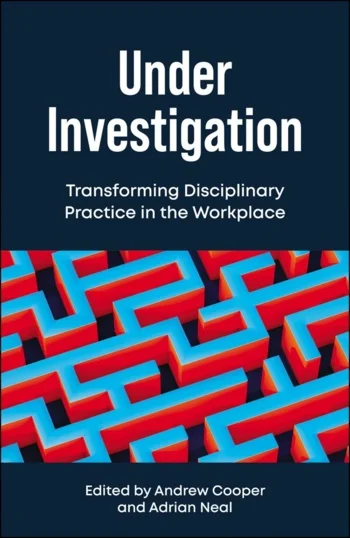 Under Investigation, edited by Andrew Cooper and Adrian Neal is available on Bristol University Press for £19.99 here.
Bristol University Press/Policy Press newsletter subscribers receive a 25% discount – sign up here.
Follow Transforming Society so we can let you know when new articles publish.
The views and opinions expressed on this blog site are solely those of the original blog post authors and other contributors. These views and opinions do not necessarily represent those of the Policy Press and/or any/all contributors to this site.
Image credit: Riztio Novianda via Unsplash