


Whether we like to admit it or not, we’re all growing older. However, the experience of growing older at work remains surprisingly overlooked and under theorised in management and organisation studies.
In this Transforming Business podcast, Martin Parker speaks with Kathleen Riach, author of Working through Ageing, about her groundbreaking 10-year longitudinal study that offers fresh theoretical and empirical insights into how ageing is experienced in the workplace.
They discuss how this fascinating study grew from a conversation in a pub, the way ageing is both universal and unique, and the importance of providing, if not answers then, alternative paths when presenting research.
Available to listen here, or on your favourite podcast platform:



Kathleen Riach is Professor of Organizational Studies at University of Glasgow and Visiting Professor at the Monash Centre for Health Research and Implementation at Monash University.
Scroll down for shownotes and transcript.
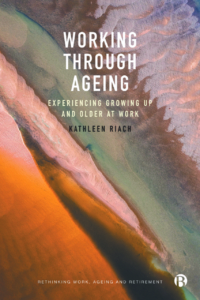 Working through Ageing by Kathleen Riach is available for £24.99 on the Bristol University Press website.
Bristol University Press/Policy Press newsletter subscribers receive a 25% discount – sign up here.
Follow Transforming Society so we can let you know when new articles publish.
The views and opinions expressed on this blog site are solely those of the original blog post authors and other contributors. These views and opinions do not necessarily represent those of the Policy Press and/or any/all contributors to this site.
Image credit: Dave Hoefler on Unsplash
SHOWNOTES
Timestamps:
00:33 – Why are you interested in ageing and work?
03:03 – Do you think ageing at work is a more important topic than it used to be?
08:14 – Can you talk about your study and how it came about?
14:08 – Can you talk about how ageing is universal, but also unique?
16:17 – What is the relationship between your work, Simone de Beauvoir and the idea of phenomenology?
20:36 – Did this research make you think differently about your own ageing?
23:13 – What effect does talking about bodies at work have on policies in organisations?
27:55 – Is it difficult to move from critique into a place of action?
30:29 – What are your plans next?
Transcript:
(Please note this transcript is autogenerated and may have minor inaccuracies.)
Martin Parker: Hello, my name is Professor Martin Parker and I work at the University of Bristol Business School. And it’s my enormous pleasure in this Transforming Business podcast to talk to Professor Kathleen Riach who has written a wonderful book for Bristol University Press called ‘Working Through Ageing: Experiencing Growing Up and Older at Work’. Kat, thanks ever so much for joining us today.
Kathleen Riach: Thanks for having me.
MP: A pleasure. So can we start off then, just by kind of opening up for our listeners the kind of the broad topic of ageing and work? I know that this is something you’ve been interested in for a very, very long time. I think you did your PhD in, in this area. So could you just give us give us some kind of insight into why you’re so interested in this particular topic?
KR: I think ageing’s always really, really fascinated me. And it kind of it started very early on. And I do actually remember when I was when I was younger, having a conversation with my dad and we were on the train and he was talking about, “Oh, I’m going to have to change jobs, and I might not get a job because I’m a bit older”, and I must’ve been about 14.
And I remember just thinking it was really odd that why would someone, you know, like your dad, who seems to be a grown up and able to know what he’s doing, not be able to get a job because of something like, like age, surely that’s a good thing. And I think that really, that was quite pivotal for me because it really piqued a curiosity about why, despite something that happens to everyone, it’s so ubiquitous and, you know, and we all want it to happen because let’s face it, the alternative isn’t that attractive either.
And why despite that, there is such an aversion against it and such a hostility towards it as a process. And I guess that curiosity has carried me through the last quarter of a century, really. And it still not dampened in terms of my sense of of wanting to find out. But I think I’ve been really privileged to be able to explore that and to discuss it with a lot of people and to be able to think really deeply about the implications of that.
And hopefully, and what I’ve tried to do in this book and what I’ve absolutely loved exploring in this book, is really thinking about what if we pause and think about what are the processes through which we experience ageing, and more specifically, what are the particular dynamics that happen in contemporary organisations and ways that we think about organising that influence and shape that experience?
And as I said, I don’t think I’ve given the answer in the book, but it’s really the avenue through which I’ve started to think about these ideas and how we can start to have conversations around this in ageing spaces, in academia, but also more broadly in workplaces and in society more generally.
MP: Okay. And do you think there’s something particularly important about the present moment when we’re discussing these questions? Because, well, soon as you start talking about these things, I kind of think about some sort of era at some point in the past where ageing happens to people in organisations, and then they get their gold clock and they retire. Yeah?
And it’s kind of like almost a kind of a simple process of getting older and then retiring. Now it seems to me we live in a society in which we talk about an ageing workforce and, a much more fragmented set of careers and assumptions like, you know, the fact your dad had to get a new job and so on.
Does that make ageing at work more of a kind of policy topic, perhaps, than it used to be?
KR: I think ageing has always been a complex experience. I think what’s changed is that previously there has been more socially and institutionally sanctioned markers that we’ve had. So if we look at, for example, the United Kingdom, we used to have a retirement age. We don’t have that anymore. That was kind of ruled as ageist.
And what’s really happened is we’ve had this vacuum. So we have a perhaps a de facto retirement in terms of our eligible pension age. But there’s there’s a vacuum in terms of thinking about that hard stop that we have. At the same time, we have extended working lives, but I think we have to be careful in terms of thinking about celebrating, celebrating that necessarily, because we know whilst the pension age is increasing, the pension eligibility age is increasing, our healthy working age is decreasing.
So for men, for example, at 62 years old, you’re kind of healthy working age where you can expect to have no comorbidities and a kind of quality of working life. So we have all these competing and compounding aspects. At the same time I think socially and by extension in organisations, we’ve been notoriously bad about thinking and talking about ageing and growing older.
And I don’t think that’s specific to the current climate. I think it’s always been a case, and that’s as a result of tensions in terms of associating ageing with the ultimate destination of death. So there’s kind of those broader existential challenges and and silences, but also we’re not really great at talking about changing bodies and changing experiences in the workplace.
That’s, you know, that’s part of a broader conversation around, working capitalism, expecting an ideal worker who is static and stable and never changing and, never impacted by biological or organic experiences. So there’s all these kind of compounding tensions that come together in terms of a hesitance and a resistance to talk about ageing at work that has historically been there and culturally been there, that has been compounded and perhaps rendered visible or surfaced by the broader narratives, the policy narratives around.
You know, no, no default retirement age and an ageing population and all those kind of all those media friendly tropes that we become familiar with in contemporary society.
MP: So the kind of distinction you’re making there and, you know, to generalise this out later is sort of between experience, which you’re suggesting kind of implicitly is, you know, people have always experienced ageing, right? It’s not, this isn’t a new thing, but the way in which we’re kind of becoming able to surface some of those questions, now when we couldn’t previously, yeah, something like that?
KR: I think so, and I think the key thing is that experience aspect. So, you know, it’s it’s a truism that we all age in terms of that, you know, organically our bodies biologically move along and they start at one point and they end at another point. And then we die, so, so we all, you know, we don’t have to take a course in ageing because our bodies know how to do it.
And they do it, albeit in uneven ways depending on our socioeconomic position or or where we are in the world. But I think the key thing is that experience aspect. And I think the really what really came through when I was undertaking this study over ten years, was that we we lack a language to talk about it.
But even more than just being about a language, we lack a way of accessing what it really means to to age in terms of our identity and a sense of self and, an ontological process. For want of a better word, it’s often it’s not just hidden from view in terms of a lack of language.
It’s we can’t really access that experience. We do not have the kind of the ontological toolkit to allow us to make meaning to it. And just when we think we get closer to it, it gets snatched away from us. And I think that’s really the, the, the really experience, the really interesting experiential aspect of ageing.
MP: Now you mentioned the study there. So let’s talk a little bit about that. Because the core of this book is a pretty amazing study that you do over ten years I think, which comes about in something like 2010 or 2012 through an accidental conversation in a pub with somebody. Can you talk a little bit about that?
KR: That’s right. So, so it started in, in 2010. And I think, you know, it’s important to position where I was in my career at that time, and in life. So I’d finished my PhD was out of my PhD for a few years. So, you know, you’re thinking about that, that second project, what’s the what’s the next, next thing you’re going to look at?
And I was really fascinated just to, I’d looked on undertaking my PhD, looking at age discrimination legislation because I finished my, my PhD at the time when age discrimination legislation came in for the first time in 2006, in the UK. And, and I was interested in that broader kind of landscape of how people experienced and talked about ageing in the workplace.
So I was speaking to a friend in a pub, and my idea was to go into a couple of organisations and just see what’s happening there and, you know, be the kind of the nosy ethnographer, the nosy participant, field worker that goes in. And I was speaking to a friend of, a friend of my partner, and he said, oh, I work in a hedge fund, and we’re kind of a bit unusual.
We’re not your usual hedge fund. And and that’s not unusual because everyone who works in hedge funds wants to work in an unusual one. They don’t want to be seen as working in a typical hedge fund because of all the negative connotations around it. They said, well, why don’t you know? Why don’t you come in? My my boss collects interesting people.
He likes to engage in interesting people. So I was like, great, didn’t know what hedge fund was, you know, did my kind of homework and off I went. And the interview because effectively they were kind of vetting me. The interview I had with the, the manager of the hedge fund was a really excruciating experience, because what came out there was he was asking me questions, and it was very clear that I was a sociologist of work, an organisational theorist.
I didn’t have a clue about what hedge funds did. The questions he was asking me, it was it was embarrassing to display my ignorance. And I came out of it thinking, well, he just thinks I’m an absolute fool. There’s, you know, I’m never going to get access to it. Turns out, you know, next day I get an email saying, oh when do you want to come in for your first visit?
And actually, what I found was that, you know, my ignorance was exactly what they were wanting, because it turns out, you know, when you go into a hedge fund, they’re highly secretive. There’s a lot of kind of intellectual capital there. And they wanted to make sure that I didn’t know anything that I was going to pass on to someone.
You know, it’s one of those fieldwork tales that shows, you know, you go in, you be yourself and actually you don’t know what they’re looking at. So just, just, and it can work out. And in the end, what happened was we initially said, let’s have 12 visits. I just stayed on, hung about for for six months.
And in the end, I went in a couple of days a week and, you know, did a report at the end of it. And then two years later, the opportunity came up, I stayed in touch with people, to come and revisit the hedge fund, and I thought, oh, there’s quite a lot of people left here. Why don’t I get in touch with them as well?
And what transpired was getting in touch with those original group of people every two years over the course of ten years to to talk about their, their lives as they experienced growing up and older in work and in their lives more generally.
MP: That’s fabulous and quite rare, I think as well, isn’t it? You know, we do have longitudinal studies in the social sciences, you know, particularly the kind of kids growing up stuff and so on. But the idea of having the opportunity to talk to this cohort of people over a decade, and my understanding is that some of them had left the hedge fund by the point, and you were still talking to them about ageing and so on. Yeah?
KR: That’s right. I mean, I think I decided very early on to use a kind of rather than follow the organisation I’ve called it in the book, you know, follow the people approach because I was interested in experience. So of course, you’re going to follow the people. And, you know, some of them stayed in the financial services, others went into completely different jobs.
There was someone who went to be a postman. There was someone who became a diving instructor. There was someone who went into investment, you know, there were some who retired. There were some that struggled to get other jobs. So a real kind of richness from this original group of experiences of working lives, which actually reflects the reality of working lives more, more broadly, we very rarely actually stay in one occupation and one expected trajectory anymore in terms of in terms of our careers.
And I was incredibly privileged to be, for them to let me into their lives and be so open and honest about it. It’s an incredibly generous exchange, isn’t it, that we that we have with our, that we have with our respondents over time. And only latterly, you know, it’s really interesting because one of the receptions I’ve had, I’ve had some great feedback on the book and one has been, oh, what a really important political act towards what we would call slow research.
You know, the idea that you’re not just quickly going in there, grabbing, grabbing it and publishing it in that article that perhaps six people and a dog read, you know, what a great what a great political act. And it wasn’t it wasn’t intended like that. It was just a really great opportunity to have some wonderfully rich exchanges with people where you go into their lives every two years, you have this really beautiful conversation, really quite intense and emotionally raw experience, and then you leave again and then you see them in two years.
So quite a quite an exceptional experience for, for me.
MP: Yeah. It’s marvelous and I was going to say something about that too, in terms of the, you know, the imperatives within university research now are very often to, you know, relatively short projects and some sort of impact or output, whatever it is, you’re documenting something over a much longer period of time. It’s something that both you and the respondents could be quite intensely involved in. Just to sort of riffing off the, the study itself then.
Because we started talking about the kind of the universality of the experience of ageing. Right. But one of the things that comes out in the book is also something about its uniqueness, its particularity. Can you say a little bit more about that, because you’ve got a whole bunch of different stories from different people with different sorts of accounts in there?
KR: Absolutely. I think that’s one of the I think that’s one of the enduring fascinations that I have with ageing. And that I guess I want everyone to have with ageing is that it’s it is, of course, a differentiator. It’s a kind of axis of power. It’s an experience very much like gender or race, but it has uniqueness. And I think and we’ll probably go into this, I think that’s why it’s really important to have particular theorisations and social theories around ageing.
We don’t just, you know, adopt the ones used in gender or other, other, other places. But one of the reasons for that, as you said, is because on the one hand, ageing is a universal experience, but not a universalised experience. It is so ubiquitous, yet unique and intimate and and special to to one person. And I guess that’s one of the challenges as researchers, how do we actually tend to and give voice to that individual uniqueness, whilst also recognising and starting to extrapolate and analytically theorise patterns that we can see happen that are, relevant to other to other groups. And, and other people. And I think the way that we do that is, of course, we have to have an extended study.
I mean, you know, we can’t simply do that by talking to people one off for for an hour. But also we have to think about what is it about ageing that really, and the process of ageing, that enables or constrains that uniqueness? And how can we use that to think about ageing as a, as a universal experience that isn’t universalised or universalising?
MP: I like that universal but not universalised that works quite nicely, doesn’t isn’t? Just a brief excursion into theory then. So. So one of the authors that you rely on quite heavily is Simone de Beauvoir. And you, you kind of rest on her in terms of opening up very often, what you’re calling a phenomenology of ageing. Yeah. Could you unpack that a bit for the listeners?
So why de Beauvoir and what, what what’s the idea of phenomenology doing for you there?
KR: So Simone de Beauvoir and I think it would be fair to say I had a kind of intellectual love affair with Simone de Beauvoir during the course of writing the book and researching and researching the book. I mean, I think Simone de Beauvoir was in some ways a natural person to land on because she’s, of course, known and most associated with, you know, being the kind of founding godmother of, of feminism, of modern feminism in the global north.
And, you know, her book ‘The Second Sex’ is, you know, the book of the century, I would say, of last century in terms of feminism for the for the global north. But she’s also and lesser well-known, she wrote a book called ‘La Vieillesse’, so basically old age. And that was her kind of second book after ‘The Second Sex’, where it’s an extended treatise on older age, on old age, and she’s one of the few feminist scholars and, social theorists more broadly, who’s undertaking this extended study of, of ageing in this way, which is also complemented by an extended biographical account she gives in her memoirs.
She wrote a number of memoirs, and in her fictional work, as well, we can see ageing come through. So for me it was such a rich treasure trove that will, you know, I’ll be engaging with probably for the rest of my life in terms of how we how we can start to think about ageing. So, so in some ways, she was the natural person to land on who did this work, because ageing has really been not tackled theoretically or philosophically by by many compared to, for example, age or other or other experiences.
So how does she help us start with a phenomenology of ageing? So I guess you know, what we mean by phenomenology is a kind of attention to an embodied, lived experience where corporeality or kind of embodied lives are neither singular nor diffused into the collective. So we’re interested in that ongoing open relationality between the self and the world.
And that’s how the self and the world are constituted in that ongoing exchange. And Beauvoir, Simone de Beauvoir talks about the idea of, you know, by necessity as a kind of as an ontological imperative to, to kind of use the fancy words we, we cast, we have to by nature of being human in the self, we have to cast ourselves into the world and lay ourselves at mercy for that vulnerability of what may come back to us as a condition of self. But I think what’s really so that’s kind of a phenomenal, a kind of general idea of phenomenology. What’s really fascinating for me is, well, how does that work in terms of ageing, where we not only have this dynamic and unpredictable and constantly changing world that we’re thrust into and must engage with by a condition of our ontology, but also ourselves.
Our situated selves are, by the nature of ageing, dynamic and unpredictable and constantly changing as well. And I think what I try to work with in conversation with de Beauvoir is think about what are the conditions through which that happens. How can we understand that happening? And then, of course, how can we understand it that happening as an organisational and organising phenomenon for people and and workplaces, more more broadly.
MP: So there’s a kind of powerful sort of existential thing in there, isn’t there? Obviously, because one of the other things we might say about de Beauvoir is the way in which she feeds into and off 20th century existential thought as well. So the idea of being kind of thrown into a situation that you then need to somehow cope with or account for or deal with or something is quite a quite an existential notion.
One of the things that I want to kind of note here is that, of course, that’s the case for you, too. And you are you’re in this book as well, of course, aren’t you? Because, you know, we’re talking about the, you know, the, the, the ten years or so that you were studying, during that time you’re ageing as well, you know, and, you know, having having children and partners and, and older people getting older and all the rest of it. Did that, did this research process make you think about your own ageing in some rather different ways, too.
KR: I mean, I think, I think part of the experience of writing the book, and I know, I know that you, Martin, write, write books, but actually not a lot of people in business schools do write books and monographs, you know, kind of thorough researched monographs. And so part of the experience of learning how to write a book was how you set yourself within the book.
And that’s not probably something I was initially comfortable with because I’d been trained within, you know, a school of writing technocratic and highly precise academic journal articles where you’re a kind of ghoulish, you know, a ghoulish name on the front cover and and that’s it really. So, so part of it was that. So what made me to be kind of decide to be in the book?
Well, I think given it’s about a phenomenology of ageing, it would be disingenuous at best, and perhaps unethical at worst, that I’ve decided to engage so deeply with other people’s lives without giving part of myself as part of that story. I think that that would be that’s really important, theoretically and also ethically. But I think the other aspect is that it is a condition of ageing, I can’t simply step out of my own ageing and be the researcher.
You know, when when you see people, they comment or, you know, when I started this everyone when I talked about ageing they’re like, oh, but you’re so young, why are you interested in ageing? I mean, no one says that anymore. You know, it’s it’s you know, they’re like, oh, right. Okay. So I think there’s there’s that aspect as well.
But there were it’s also, you know, if we can’t use our own experience, our own lived experiences when, particularly when we’re committing to a phenomenological approach in research, then we’re we’re doing something wrong. Right? There’s there’s something amiss there. And I think it was really important for me to strike the balance because, of course, I didn’t want it to be, you know, an autobiography of Kat Riach over, over 10 to 15 years and her life, whilst at the same time making sure that there was a generosity in sharing how this related to both the theoretical development of the paper and also the development of those conversations that I had over ten years with, with the respondents.
MP: Yeah. And there’s a lovely parallel there anyway, isn’t there? So, you know, one of the very kind of general changes, I suppose, we’ve seen in writing about organisations over the last ten, 20 years or so, is that a lot more stuff about bodies, whether it’s kind of menopause or gender or ethnicity or sexuality and so on, is now being articulated within writing and research about organisations in a way that sort of allows or is beginning to allow conversations that wouldn’t otherwise take place about people’s own standpoints or embodiment or whatever else.
And what I’m pointing to here, I guess is a kind of similarity there with the way in which we might say that, you know, large formal organisations of various kinds, whether hedge funds or anything else, have tended to be places where human bodies are kind of policed or effaced or imagined to exist somewhere else or something. So, you know, the idea of breast feeding at work or something like that would be, you know, almost a kind of a category mistake of some description, yeah, that the, you know, the body would come into work in quite that way.
So it’s almost as if the university is going through intellectually is going through kind of these processes too. Do you think that that sort of development, and I’m asking you to speculate here, the idea of, you know, talking more explicitly about, say, the menopause at work, for example, is a way of then opening out the possibility of more sensible and sensitive policies when we’re talking about work organisations.
KR: For me, there’s very much an intellectual buyer beware when we talk about bodies at work at the moment. And I think I say that because and I’ve done research elsewhere on on menopause as well. It’s not in this book, but it’s part of a broader interest of those kind of ageing, ageing related and age related experiences.
I think one of the challenges we have is that we have to be thinking about when we talk about the body, what are the conditions in which we’re talking about about the body in particular, and how do we make sure that we’re not setting up any kind of straw men sec, you know, in terms of what we’re doing. And I think one of the challenges we’ve seen when we’re talking about menopause is that what are we exposing or leaving vulnerable that we are not fulfilling with rich and robust theoretical and conceptual frameworks that allow people to live on sustainably.
So so we can all talk about menopause, we can all kind of out the menopausal body at work, and we can say that, you know, that’s de facto a good thing. But what are we doing next? Like, what are we leaving on the table there. And I think one of the challenges and we see it come with EDI equality, diversity and inclusion more broadly.
But in menopause specifically, we’re seeing, yes, this is a great thing. Yes, we’re we’re giving voice to women. But actually what are we then putting in place to actually really tackle and to dismantle all those problematic structures and ways of thinking in everyday ways of working that we know are going to problematise this? And are we actually laying prey to, to something that in a way that perhaps was even worse than when it was just repressed and not talked about?
Now I’m not saying necessarily that that’s, it’s a bad thing to start talking about the body. But I think as social theorists and organisational theorists and researchers, we can’t simply say, here’s something that we’ve not discussed before. This is important to discuss. Full stop, okay? Because we have a duty and a responsibility to actually say what’s happening here, what are the dynamics and what can we actually what can actually be done around this?
I mean, I think what’s been really interesting is that I do quite a work, quite a lot of work with policymakers and, you know, organisational practitioners. And they’re like, okay, so we know we’ve got to acknowledge this, but what do we do now? What kind of what language do we use? What ways of thinking, like what what are the kind of hidden or latent dimensions that we have to think about?
And it’s not really enough for us as academics to say, oh, that’s, you know, give me five years and I’ll think of a paper to, to talk about that. You know, we when we put something out there, there has to be some not answer, but there has to be some alternative path that we’re putting on the table that we’re saying is a way that we can make, you know, lives more sustainable and and meaningful in some way.
I don’t know if that answers your question or or goes off on another tangent, but you know.
MP: It kind of does I mean, I was just thinking about sort of what we might very broadly call critical work more general. So both of us, I guess, are indebted to a whole series of critical traditions and, you know, thinking about ways in which they might be applied within the context of business and management and markets and so on. But there’s a sense for me, and I don’t know, I suppose I’m asking you whether this echoes, that it’s relatively easy to stay at the level of critique, whether that’s giving voice to particular kinds of theories or particular kinds of people.
And then imagine that your job is done. You know, that that’s kind of it then. But it’s much, much harder then to step into the kind of this space of action, isn’t it, you know, so to say, in your case, when you talk about being involved in policy development of different kinds, that kind of what would you do then, Kat, in that position, which is a really difficult one, it is much easier to stay in our book lined studies.
KR: Yeah, absolutely. It’s much easier to set up the, your average practitioner as the boogeyman, right. And the article that we write than to actually kind of engage in and try and enact change and I think, you know, and part of my engagement with de Beauvoir and kind of ongoing interest was, I mean, you know, what does it actually mean to to be, if we were to kind of look at a tagline, what does it mean to be a public intellectual in critical management studies in this day and age?
And that’s a really interesting question for us all and a bit of reckoning, I think. What I would actually say is, you know, we’ve got we’ve got people in history that we can look at who have done this. I mean, you know, Simone de Beauvoir’s own work as a public intellectual is absolutely fascinating. You know, the way that she engaged publicly, the way that she engaged in public debate, the way that she used that kind of rigorous theorising.
I mean, there are there are problematic, there are problematic elements of de Beauvoir’s biography that I talk about in the book. But in terms of that idea of like, what does it mean to really be a public intellectual? We’re not talking about just, you know, your thought leaders who kind of put something out. What does it actually mean to be a public intellectual in a way that fits within that critical management tradition?
I think is is really, really interesting. And it’s something that was at the forefront of my mind when actually writing, writing this book, because whilst it is a monograph, it’s also I would like to hope that others can engage with it beyond, you know, that that kind of critical management studies or age and employment academic community.
MP: And I think you’re absolutely right. This isn’t just a kind of CMS text or something like that, is it. We’re coming towards an end but I want to I wanted to just ask another question. And it’s it’s sort of related to the two kind of challenges that this book provides, I think one of which is methodological in terms of the idea of longitudinal slow research and so on, but also in terms of its engagement with with time and the inevitability of time and so on.
And that’s really what what are your plans next? I don’t usually ask this in an interview, but it seems kind of appropriate, you know, like, are you carrying on talking to these people? Are you imagining that that this is in itself a kind of snapshot that you might look back at in a decade’s time and, and wonder about its position in their and your lives?
KR: I think that’s a really open question. I mean, it was really interesting, the “final”, and I put it in speech marks, you know, the final, the last interview we had at that kind of at that decade point, because there was a sense of kind of saying goodbye and real, real sadness and, and in some ways, I chickened out of it.
I don’t know if that’s the right phrase, because I was like, oh, I’ll be in touch with a book if you want a copy of the book. Or and they were like, oh, yes let’s catch up next time you’re in, you know, in the area that I’m in so so we didn’t I think neither side of us wanted to say goodbye to this, in part because it was a really quite a unique space that both of us entered into.
You know, how often do you get to kind of go and talk to someone, you know, no holds barred every, every two years about everything and then just go off again with no kind of accountability or responsibility for the actions, they could tell me anything. Right? And then and then and then leave again. So I think what I would say is, I, I don’t think this will be the end of talking to those individuals, whether that’s true or not as the case.
But I can’t consciously think about, I can’t bear the thought that I don’t ever see them again because their stories are just so rich. And, you know, there wasn’t a, that’s the thing about ageing. There’s never there’s never, ever the end. Even when when you die, there’s never the end of a person is there. And that’s what makes ageing just so, so fascinating, fascinating to me.
So yes, I think I’ll probably continue annoying these individuals and and I’ll be I’ll hopefully be a welcome annoyance to them.
MP: They’ll still stay on your Christmas card list. Thanks ever so much, Kat. That was a really fascinating conversation. So my name is Martin Parker, University of Bristol Business School, and I’ve been talking to Professor Kathleen Riach, who’s written a lovely book for Bristol University Press called ‘Working Through Ageing: Experiencing Growing Up and Older at Work’ and I can heartily recommend it.
Kat, thanks for spending time with me.
KR: Thank you so much. That was fantastic.