


Each January, the Bulletin of the Atomic Scientists adjusts the hands of its Doomsday Clock to signal how close humanity stands to catastrophe. At the end of the Cold War, the clock was set at 17 minutes to midnight. Today, it is at just 89 seconds – its closest-ever setting.
In this episode of the podcast, George Miller speaks to Patricia Shamai, Principal Lecturer in International Relations at the University of Portsmouth and author of What Are Nuclear Weapons For? They discuss why nuclear weapons have drifted from public consciousness since the 1990s, even as thousands of warheads remain in existence, major powers modernise their arsenals, and new technologies make the strategic picture yet more complex.
The conversation also touches on Vladimir Putin’s nuclear posture during the war in Ukraine, the challenges posed by strategic ambiguity, and whether – despite all this – there are any grounds for cautious optimism.
Available to listen here, or on your favourite podcast platform:



Patricia Shamai is Principal Lecturer in International Relations and Associate Head of School in the Faculty of Humanities and Social Sciences at the University of Portsmouth.
Scroll down for shownotes and transcript.
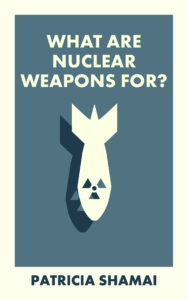 What Are Nuclear Weapons For? by Patricia Shamai is available for £8.99 on the Bristol University Press website.
Bristol University Press/Policy Press newsletter subscribers receive a 25% discount – sign up here.
Follow Transforming Society so we can let you know when new articles publish.
The views and opinions expressed on this blog site are solely those of the original blog post authors and other contributors. These views and opinions do not necessarily represent those of the Policy Press and/or any/all contributors to this site.
Image credit: Ilja Nedilko on Unsplash
SHOWNOTES
Timestamps:
02:33 – What prompted you to write the book?
08:33 – Did reading testimonies of people who experienced the detonations in Japan in 1945 enhance your understanding or change your perception?
14:01 – Why is the nuclear weapon picture always changing?
23:41 – What is the current climate among nuclear powers more broadly?
28:52 – Are there any signs of hope that we can begin to pull that second hand back from midnight?
Transcript:
(Please note this transcript is autogenerated and may have minor inaccuracies.)
George Miller: Hello and welcome to the Transforming Society podcast from Bristol University Press.
My name is George Miller and I’m the editor of What is it for?, a series in which each book tackles a deceptively simple question whose answer is usually anything but.
Today, I’m talking to Patricia Shamai, a Principal Lecturer in International Relations at the University of Portsmouth, about nuclear weapons.
Each January, the Bulletin of the Atomic Scientists adjusts the hands of its Doomsday Clock to reflect how close the scientists believe the world is to catastrophe.
At the end of the cold war, the clock was set at 17 minutes to midnight. It is now at just 89 seconds to midnight. That’s a stark reminder that, even if nuclear weapons feel like relics of the Cold War compared to more immediately pressing problems such as climate change, the danger hasn’t gone away.
Thousands of warheads still exist, nuclear powers are modernising their arsenals, and new technologies are reshaping the strategic landscape, making it ever more complex, ever more dangerous.
The war in Ukraine brought that home sharply. Vladimir Putin’s threats about possible nuclear use made clear that the option was not off the table, a stark reminder of how fragile the nuclear order can be. Was it sabre-rattling or a genuine escalation of the nuclear threat level? Ambiguity and uncertainty have always been part of the nuclear question.
Far from the battlefield in Ukraine, Patricia Shamai describes sitting in a café in Winchester, surrounded by students who seemed barely aware that nuclear weapons remain part of everyday geopolitics, and realising the nuclear question deserved much greater public attention.
In our conversation, we talk about the ever-changing nuclear landscape, about why so many states are choosing to modernise, and whether there are solid grounds for optimism.
But I began by asking Patricia to go back to that quiet moment in the café: what had prompted her to write the book?
Patricia Shamai: I think the events in Ukraine, for me, were really quite shocking. I’d spent most of my time in academia studying nuclear weapons with the impression that the international community… I suppose secretly I thought that the international community would prevail and that nuclear weapons would no longer be a threat to the world.
And when I started my studies, there was a lot of feeling towards a new kind of world. It was quite a long time ago, but a new kind of world where you would have more involvement from international organisations and more of a consensus to try to promote initiatives, which eventually led to peace or a better way of life for people.
I held on to that belief and I’ve always been a proponent for non-proliferation. And when the war happened in Ukraine, the rhetoric about nuclear weapons from Russia was really quite shocking to me because I really thought, my goodness, all of that work, all of that time … And we’re talking about the possibility of the use of nuclear weapons.
I know what these weapons can do. I just couldn’t bear the possibility that nuclear weapons had become so normalized that we could talk about them and we could face the prospect of them being used without an enormous reaction. So my feeling was, well, we’ve got to think differently and we’ve really got to have more awareness about what these weapons do and why we’ve got to the point that we’ve got to today.
So I really wanted to inform people about what nuclear weapons are and give them an opportunity to understand the key issues associated with nuclear weapons.
GM: Because you’re in the cafe and you’re surrounded by students and you’ve got this sense that nuclear weapons aren’t really something that has impinged very much in their consciousness. You might expect them to be much more concerned about climate change, for example, or other political issues that certainly seem more pressing today.
But the Ukraine war brings back to you and brings back on the agenda, I guess, the reality of nuclear weapons, that they’re not something that has been sort of gradually and quietly put in a dark corner of a dark warehouse. They’re something which retain a terrible power. And here, suddenly, it seemed Putin was brandishing the possibility of some limited nuclear use in what was otherwise a conventional land war.
PS: Yeah, when I was thinking about how we understand, how people understand nuclear weapons, how did the young people in the cafe and the parents and I watched them with their children. And it was really that, we think about nuclear weapons and certainly, you know, if I tried to take myself out of my own knowledge, nuclear weapons were associated with the Cold War or with science. And if you wanted to understand nuclear weapons, you were either blinded by the science or steeped in the history of the Cold War without anything saying, well, what’s next? OK, that was the Cold War, but what’s today? What are nuclear weapons today?
And for myself, I’m not naturally science related or numerical. If I see anything that’s too detailed, I automatically veer away from it. Naturally, I understand people. I understand how people work, not necessarily scientific facts and figures. And so often when you try and pick up something about nuclear weapons, it’s steeped in that.
When I did my PhD, I remember talking to a two-star general and naively I went up to him, you know, at a conference and I said to him, what is the difference between a nuclear weapon and a thermobaric bomb? So essentially a bunker buster, a bomb that can travel deep underground. And he looked at me and he laughed and he said, well, one is nuclear and one is conventional. He said, you’d really know if you came across a nuclear weapon because of the sheer power condensed in the bomb.
And he sent me a book which was very scientific, which was really kind of him to do. But it made me again think, well, you know, what are these weapons? How do we understand them? And I think the greatest misunderstanding and the greatest fear I have is that we normalise nuclear weapons. We’re in a society which we see explosions, we see war, we have the term massacre, and we’re almost distanced from what those things mean. But actually, if a nuclear weapon were to be used, the consequences of it would be so dreadful that it can’t be used.
And I think when I teach, I think young people, students, don’t necessarily understand that because we just use the terminology without understanding the reality.
And it’s the same with war. We don’t understand the reality of war. And the Ukraine war was war in Europe. And when I thought about people around me, I was thinking about them involved in a war. And so I really wanted to try to provide some understanding about what that really means and what was the attitudes of people and the decision makers and the scientists towards the nuclear threat, essentially so people can make up their own minds as to what these weapons are for.
GM: And I think you’re talking about the sort of terrible reality of war and of the use of nuclear weapons. I think I remember a conversation we had when you were writing the book and you were going back and reading testimonies of people who had experienced those detonations in Japan in 1945. So do you feel that that enhanced your understanding or changed your perception in some way?
PS: I think it did. I read about that while I was doing my PhD. My PhD was looking at the stigmatisation of chemical, biological and nuclear weapons. Essentially, why these weapons stand out as different from other methods of warfare. And I’d read the accounts of the soldiers in the First World War who’d been exposed to chemical weapons. And I read the accounts of the survivors from Hiroshima and Nagasaki. And I think rereading those accounts now, having completed my PhD and worked in the field for a long time, I re-understood the human element and the human cost, the reality of what these weapons can do. And I think those personal accounts are vital for us. We should never forget them. They’re vital to understand the reality of what we’re looking at. So, yes, they very much did. And I think it’s important for anyone who has an interest in the politics of nuclear weapons and understanding of what they’re about and what they’re for is to dip into those accounts.
GM: Because I think otherwise it might be quite easy to be seduced into thinking about it in grand geostrategic terms, game-playing brinksmanship. There’s a lot of that. Obviously, that’s very important. But it can be perhaps too easy just to see it in those terms. And, you know, Cold War power politics.
I grew up in the Cold War. I came of political age in the late 70s and the early 80s. And it was the reality of a nuclear threat seemed, you know, in a way that climate change might seem to a teenager today, or maybe Islamist terrorism 25 years ago might have seemed like the most pressing threat. When I was growing up, it was very much the potential for a genuine nuclear war. And I guess what you want to do by rounding out the picture is say, of course, the geostrategy is really important. But also we’ve got to think that these are not counters on a board – these warheads are actually capable of bringing destruction on a truly abhorrent scale.
PS: Yes, definitely. And I think what I tried to do in the book is to highlight, again, the people angle. What were the scientists who were developing the weapon? What was their understanding? What was the understanding of the politicians who sanctioned the use of the weapon? And then following on from that, having seen the consequences of that use, what were the attitudes of the decision makers during the Cold War and the protesters in CND and protesting for nuclear disarmament? Why were they doing that? What were their attitudes? What were their beliefs? And I hope that that comes through in the book.
That’s what I’ve tried to do, is to move away from looking at nuclear weapons, just as you say, as a geostrategic tool, where you can sort of think about it in the sense of numerical impact, strategic stability, if they’ve got five, and we’ve got five, we’re balanced, we won’t use them, or the traditional notions of deterrence of mutually assured destruction.
I wanted to delve a little bit deeper to say, well, what does that mean? If we’re deterred from using these weapons? Why? What’s our understanding about what they can do? And to try to provide a bit more insight into the response of the general public, of the political leaders, of the scientists towards these weapons.
And I think in doing so, I found that it was a very complex picture. It isn’t clear cut. It’s not just political. It’s not just strategic. It’s not just moral. It’s a combination of all three together under the circumstances of the time.
And I think when we look at the history of nuclear weapons, it’s really important to understand the context of the time. The people in the 1950s and the 1960s, they’d lived through the horrors of the Second World War. And as you say, during the Cold War, people had lived through that possibility of nuclear weapons being used again and the knowledge of what that could do. Again I think there’s that knowledge and there’s that publicity and there’s that concern today my fear was that we’d become distanced from that because we’d lived through quite a long period of sort of hope that that would never happen again and I think in today’s world we face a whole new set of challenges where we’re very interdependent we have a huge amount of communication and there’s an awful lot of ambiguity about the circumstances in which nuclear weapons could be used, which increases the possibility of misunderstanding, and almost intensifies the possibility that these weapons could be used. So even more a need for us to understand what they’re for, and how we’ve got to the point that we’ve got to today.
GM: You know, to go back to that example, from the start of the book, Putin was deploying, playing with that ambiguity, which it seems to me has always been built into the whole notion of having nuclear weapons, of suggesting that there might be some limited battlefield deployment of a tactical nuclear device.
But not coming out and saying it overtly, saying, you know, these are my intentions, but just dangling the possibility and therefore changing the picture. So that’s something which comes across, I think, from the book, that the picture is always changing. As you say, nuclear weapons are not a stable entity. And the circumstances in which they are possessed and in which they are moved around or developed or whatever, it’s always a changing picture.
And that’s something inherent in the whole nuclear story is never being quite able to confidently say, well, this is what they are for. These are the circumstances in which we would contemplate their use. This is how far we’d be prepared to go if these conditions are met. So there’s always ambiguity and it’s an intrinsic part of the whole nuclear story.
PS: Yes, definitely. There’s ambiguity to the circumstances and to the picture, but where we don’t have ambiguity is our knowledge of what nuclear weapons will do if they’re used. That really is the key point when we’re looking at the nuclear dilemma, the puzzle.
What we do know for sure is what nuclear weapons will do if they’re used. And even if they’re used on a very small scale, they will cause significant harm. There’s some discussion about this idea of limited nuclear weapons. But even if you were to use a small nuclear weapon, you will know it will destroy a whole vicinity. And I think that that in some ways is the key point about nuclear weapons is the harm that they cause, then promotes international action, they cannot be ignored.
Now that action could be to develop bigger, to counter and to develop bigger and bigger weapons or to diversify how those weapons are used. But essentially, once you’ve reached that point, you at some point have to stop and work together and find some way of addressing what these weapons are, because they will cause, if they’re used, significant harm and the world won’t go back to the way it was should they be used.
And I think that that’s really the key with them. The circumstances change and the politics changes, but fundamentally these weapons are what they are. That’s a trigger for international action. So whilst they are unbelievably terrifying, they are also, in a strange way, a tool that forces states together and forces discussion and hopefully forces some kind of effort towards peace and making the world a better place.
GM: And they’re, I’m not sure if historical anomaly is the right way to express it, but they exist on quite a considerable scale. there’s quite a substantial, there’s enough warheads in the world to eradicate civilization. There are not comparable arsenals of chemical or biological weapons, as far as we know. And we haven’t seen cyber attacks, which could cause massive devastation. We haven’t seen a cyber attack on a scale that would stand comparison of nuclear weapons. So are they a case apart? Or is it that humanity learned a lesson, even if they didn’t learn it entirely from nuclear weapons, and pulled back on biological and chemical weapons? Were they sort of like a test case, and the disaster of their use or the impact of their use on Japan was so great, that that kind of put a break on other types of weapons, but we had still the momentum of nuclear development carrying us into the Cold War?
I realise that’s probably quite a lot of elements to try to tease apart. But I’m interested in the fact that there is a category of weapons we regard as abhorrent, but that nuclear weapons seem to remain primus inter pares. They seem to have a special status. And I’m wondering if you think that is purely a historical accident because they were the ones which were developed and deployed at the end of the Second World War, or how you, because you mentioned earlier your research, looked at various weapons which have been stigmatised.
So I wondered how you situated nuclear weapons today in that wider landscape.
PS: Well, I think that the point, the first question you had about does the development, did the development of nuclear weapons sort of delay responses, particularly chemical and biological weapons? Yes, I think it did. And I think the knowledge of the effects of the use of nuclear weapons has been very significant. When you look at chemical and biological weapons, I would still argue that they are stigmatised alongside nuclear weapons. Historically, that was because, again, of this realisation of the impact of the use of each of them.
So for biological, it’s always been hypothetical, But the idea of disease as a form of warfare was utterly abhorrent. And the use of chemical weapons, poison, as a form of warfare has been the same. But the trigger was really in that interwar period when scientists investigated how they could protect against the effects of these weapons. And they found that they couldn’t. There’s no total protection against a chemical attack. You can protect the population. You can protect the troops on a battlefield, but you can’t protect the vegetation, the ground, the areas that are covered by a chemical attack.
So that elevated the two weapons into a similar category as nuclear weapons. The focus has always been on the perception of states using these weapons. What’s different today is that when we look at the threat from chemical and biological weapons, we are looking at, particularly with chemical, the context has changed, the possibility that non-state actors may acquire these weapons. If that were to be the case, then the rules and the norms associated with chemical weapons use changes.
It’s much harder to deter a non-state actor than it would be to a state. So the traditional approaches towards these weapons and the traditional efforts to control them have changed, and the international community needs to adapt to that.
Would a non-state actor be deterred by the threat of the use of nuclear weapons? That’s debatable, because the issue is associated with attribution. How do you find these organisations? How do you find these actors? So the traditional concepts and approaches to deterrence have changed.
The challenge now is for the international community to respond. And even more so, there’s a need for awareness about the effects of these weapons and an awareness that the international community must act to prevent their adaptation and essentially their use.
So I think the stigma does still exist, but it isn’t a given. It isn’t a set in stone. It’s dependent upon the attitudes and the beliefs of people. And those change. And there needs to be a continuous effort to work together to try to address the threats that we face today. And the responses need to adapt in the way that they did in the past. They have to adapt today.
And the nuclear threat has changed. Again, we are not just looking at one or two large powers that had these weapons and we’re essentially looking at deterring each other. Luckily, we don’t have a huge number of states with nuclear weapons, but there are some states still trying to acquire them. And as long as they have the power that they have, then they will be desirable. That strategic prowess makes them very important.
Something we haven’t mentioned is that it’s not easy to acquire a nuclear weapon. It requires a huge amount of cost. You need to have the right facilities to develop, to put the pieces in place to develop a weapon. And you also need some mechanism to test, to know that what you’ve developed has worked. So it’s not something that can easily be done and hidden. It requires a huge amount of effort. And today we only have what I would call a handful of states that have nuclear weapons. And that’s because of that difficulty in acquiring them.
And also it’s because of the challenge and the concerns of the response of the international community should states seek to acquire them. And again, that needs to be maintained. They cannot be normalized. There needs to be a reaction to the possibility of a state acquiring nuclear weapons. Otherwise, we will have more states with them, and that intensifies the possibility that they may be used.
GM: We talked at the beginning, Patricia, about Putin and his rhetoric surrounding his nuclear weapons. But I wondered, what do you make of the climate more broadly among nuclear powers? I’m thinking of things like the efforts that China is currently putting into modernising its nuclear arsenal. I’m thinking also about the UK, which I learned from working on your book, is being much more secretive about its own nuclear holdings.
So examples like that, to me, don’t seem to be pointing strongly in the direction of non-proliferation. They suggest to me an effort to modernise, very much to hang on to, to upgrade what these countries already have, which suggests there’s no diminishment of their view of the importance of nuclear weapons.
PS: And I think it comes back to this, to the points that we identified, the properties of nuclear weapons, the political significance, the strategic importance and the normative. You have this dilemma where you have to keep modernising and you have to keep up to date. And I think when you have an environment of distrust, that intensifies that need. And the nuclear powers, as they are, have this element of distrust.
Now, one can’t modernize without the others. It’s essential that they keep up. So if you think of the case of the United Kingdom, the United Kingdom needs to keep up with the threats and the issues that it faces. Nuclear weapons only deter when there’s a possibility and a recognition that the power that has those nuclear weapons may use them. If you take that away, then deterrence is weakened.
Now, if you don’t back that up with international consensus and international efforts to control these weapons, then you’re left with a vulnerability. And I think what we’ve seen is a breakdown in the consensus towards non-proliferation, which is a constant need to keep up to date with that and to maintain that alongside rapid developments in technology. And those rapid developments in technology are not immune when they’re related to nuclear weapons.
So as we’ve seen developments in conventional warfare, we will also see developments within nuclear. So I think it’s a constant struggle. Of course, states are going to modernise because they need to maintain their security. But at the same time, there also needs to be an international push and a reminder, essentially, of the challenges associated with these weapons. And we’ve seen a weakness in one area and a push in the other.
The current policy of peace through strength is to try to go back to that enhancing the capabilities, enhancing the threat, and then promoting diplomacy and international efforts. Now, peace through strength is not just applied to military forums, the sanctions and the economic are also methods to try to sort of promote some kind of form of diplomacy. It’s a constant balancing act. And unfortunately, the risks are very high if you don’t keep up with that balancing act.
So I think today we’re in a challenging situation where we have a heightened technology, which is creating advances in nuclear capability, which we highlight in the book, and also massive advances in conventional weapons, types of ballistic missiles, hypersonic weapons, AI and drone technology. And you’ve got the perfect storm of the two together, nuclear and conventional. And there’s a race to keep up to date with those changes in technology.
But there will have to be also a recognition that there needs to be some sort of stop. Much like we had during the Cold War with the arms race, there has to reach a point where the world just goes, hang on a minute, like if we carry on like this, we’re going to have more and more conflicts, and they’re going to be worse and worse. And I think what we’ve seen in Ukraine where we’ve seen ballistic missiles being used on a civilian population, and you saw that in the Middle East earlier in the year as well, that’s almost a game changer. You know, the possibility of that is truly terrifying.
You may be able to protect a population against the use of a drone, but when you’ve got ballistic missiles coming towards you, you then start to rely on new forms of technology, on missile defence. And it just raises the tension, escalates the possibility of disaster higher and higher. So again, in a strange way, it’s brought nuclear weapons to the fore. And it’s once again presented that conundrum of strategic superiority, but at the same time, a need for states to work together. And it’s that dreadful balance all the time.
GM: It’s a story full of paradoxes, isn’t it? And I guess that’s why it makes for an interesting book, but also it’s so challenging to try and pin down because there are so many complex interconnected parts. You say near the beginning of the book that each year the Bulletin of Atomic Scientists publishes its calculation for how close we stand to midnight on the Doomsday Clock, this kind of imaginary clock that assesses how close to catastrophe humanity is. And we’re currently at its closest, 89 seconds to midnight, whereas at the end of the Cold War, it was 17 minutes, I think, from midnight. And I guess maybe to finish, I could ask you, I’m not asking for a sort of false optimism, but do you think we’re just going to keep creeping towards midnight? It certainly seems there are lots of factors that might be pushing us in that direction. Or do you see some signs of hope that we can perhaps begin to pull that second hand back from midnight?
PS: Oh, that’s the eternal question, isn’t it? I’m an optimist, so I think there is hope. And I think there’s hope because of the recognition of where the world will be if we don’t pull back. I think it depends on the leaders and it depends on how we respond to the issues that we’re facing today. I do truly think that there needs to be a response to the Ukraine war. If we cannot find a solution to that, then that’s a dreadful precursor for what could follow next. And I think there has to be international efforts and consensus to try to stop the escalation of conflict. I think the technology, we’ve reached such an advanced level with the technology that there’s a possibility of causing mass harm, mass devastation in multiple ways through conventional means and nuclear.
Nuclear still stand out as distinct, but there has to be a realisation that we have to work together. You know, I think there has to be a point. Somebody, I’m not sure who, needs to stop and just say, hang on, stop the clocks here. This is we’re on the route to disaster. So I’m an optimist. And I think our desire for human survival will prevail and that we won’t get to midnight. Let’s hope I’m right.
GM: That was Patricia Shamai, whose book What are Nuclear Weapons For? is available now.
You can find more details about it, and all the other titles in the What is it for? series, on the Bristol University Press website, bristoluniversitypress.co.uk. The other two new titles this season are what is drug policy for and what is truth for.
That’s it from me for now — thanks for listening, and goodbye.