


For those of us who grew up in the 20th century, what is most remarkable about the events of 3 January 2026 is not Donald Trump’s abduction of the Venezuelan president, Nicolás Maduro, and his wife, but the lack of international outcry and institutional condemnation. If committed by a powerful enough country, it seems, illegal military action can face almost no consequences.
Trump’s coup de main is, I suggest, exemplary of a century in which global instability has become the norm rather than the exception.
That instability is, I think, the result of three threats to humanity in the new century, each of which is dangerous in itself but the combination of which may already have produced what Norbert Elias called a decivilizing process in his corrective to The Civilizing Process, which he had the misfortune to publish in 1939.
Political instability and the erosion of international norms
The first and most obvious of these threats, courtesy of the media attention it receives, is political: the precarity of the geopolitical situation when compared to the second half of the 20th century. With two power blocs competing for control of the Third World, life in First and Second World countries was considerably safer than it is now; the threat of mutually assured nuclear destruction was sufficient to deter any NATO country from going to war with any Warsaw Pact country.
This safety did not extend to the Third World, where countries like Korea, Vietnam, Algeria, Angola and Afghanistan became both playground and battleground for the neocolonial ambitions of the US, USSR, China and their many proxies.
Unfortunately, what is now the Global South is little better off than the Third World was, with the significant difference being an increasing likelihood of war in the Global North as well.
Instead of a world with two power blocs of roughly equal size, there are three global powers (China, Russia and the US), regional powers with nuclear capabilities (Iran, North Korea and very likely Israel), and a divided European Union whose members are for the most part focused on internal problems.
Digital technology, big tech and social transformation
The second threat is technological: the digitisation of everyday life, by which I mean the combination of world wide web, social media and handheld devices that has made the 21st century unrecognisable from the 20th.
If that sounds like an exaggeration, think back to the 1990s (if you can) or ask someone what education, employment or entertainment looked like 30 years ago.
It’s important to be clear that the issue is not advances in technology – from the internet itself to readily available artificial intelligence – but the speed with which it has been introduced and embraced.
Technology is simply moving too fast for our brains and bodies to cope, as studies such as Jonathan Haidt’s The Anxious Generation show. My own assessment is that what Ludwig Wittgenstein referred to as our ‘form of life’ has transformed almost completely in the Global North (and perhaps elsewhere).
In the UK, for example, most people either had no internet access or work-based access only in 1995. By 2015, most of the population carried a mini-computer that was connected to the internet with them all the time.
Aside from impacts on everyday life with which the educational and criminal justice systems (to take just two) have not been able to cope, the rapid transformation has placed unprecedented power (and wealth) in the hands of a tiny super-elite.
Was anyone surprised, I wonder, when Elon Musk made it clear that he would rather work for himself than be Trump’s right-hand man in June 2025?
The climate crisis, capitalism and global inequality
The third and most serious threat – in the long term, at least, although ‘long’ seems to be approaching all too quickly – is of course ecological.
The climate has been subject to anthropogenic change since the Industrial Revolution, but the change was initially slow and didn’t have much impact until the Great Acceleration in the second half of the 20th century.
While ‘climate crisis’ was coined in 1981, very little mitigating action has taken place since, in spite of the regular and rigorous reports published by the IPCC.
Jason Moore regards global warming (and the related problem of waste disposal) as an inevitable effect of global capitalism, whose origins he traces back to 1450 in Capitalism in the Web of Life. World economy is inseparable from world ecology, but we continue to prioritise the former over the latter, widening the gap between the Global North and South as we go.
With more parts of the planet becoming uninhabitable by human beings in consequence of either rising temperatures, rising oceans or extreme weather events, more pressure is placed on those areas that can support human life comfortably and the migration of refugees from one to the other is handled by a legal system that was established to deal with the depredations of Nationalist Socialist Germany on Europe.
The IPCC is a UN panel and where, for the First and Second Worlds, the organisation was largely successful in keeping the post-war peace, it seems unsuited to deal with either climate change or the politics of Trump, Vladimir Putin or Xi Jinping.
The convergence of three threats: Political, technological and ecological crises
My point is first that each of these threats is extremely – existentially, even – dangerous to and for humanity as a species and either not being addressed or being addressed by systems, institutions and practices that are unfit for purpose.
Second, as dangerous as they are individually, their confluence – in, for example, the role of Big Tech in all three – increases instability exponentially.
For social scientists, the complexity of the causal links among the political, technological and ecological also makes the control, reduction or prevention of the mass harms they produce very difficult to identify, let alone ameliorate.
The 20th century was the world’s most violent. No one can be sure what the 21st holds, except that change is happening faster than ever before, faster even than Trump can topple a regime or start a civil war.
Rafe McGregor is a Reader in Criminology at Edge Hill University.
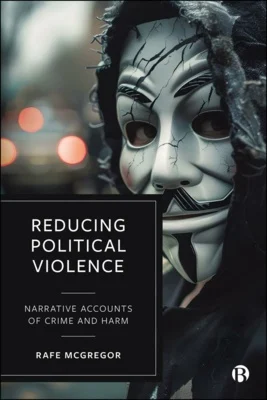 Reducing Political Violence by Rafe McGregor is available for £80.00 on the Bristol University Press website here.
Bristol University Press/Policy Press newsletter subscribers receive a 25% discount – sign up here.
Follow Transforming Society so we can let you know when new articles publish.
The views and opinions expressed on this blog site are solely those of the original blog post authors and other contributors. These views and opinions do not necessarily represent those of the Policy Press and/or any/all contributors to this site.
Image credit: Egor Komarov via Unsplash