


Victims of the Post Office scandal went through the most unimaginable torment as they were wrongly accused of fraud and false accounting based on computer evidence known to be flawed. Many were convicted and subsequently jailed, while others went through bankruptcy, family breakdown and homelessness, and at least seven people have died by suicide.
Remarkably, even once the faults of the Horizon IT system were exposed, and convictions started to be quashed, the victims’ ordeal was not finished yet.
The Post Office and effectively the government, which is the single shareholder in the corporation, set up several schemes under which claimants could seek financial redress. These include the Horizon Shortfall Scheme for those whose convictions were quashed, and the Group Litigation Order Scheme, for those who were involved in the group claims. But these settlements were significantly eaten into by legal costs and reimbursing litigation funders.
The Post Office has consistently stressed its commitment to ensuring victims of the scandal are compensated as fairly and as swiftly as possible.
In January 2024, with public fervour high following the emotive ITV drama catapulting the scandal into public awareness, then Post Office chief executive Nick Read told the Business and Trade Committee his role was to ‘speed up, as much as we can and as quickly as we can, the compensation that is being paid’.
Around six weeks later, Read was before the committee again, explaining how the Post Office needed to ensure that the redress process was complete in order to move forward as an organisation, and that it was ‘continuing to try to lower the evidential bar so that people can and will put their claims in and ensure they get the right compensation’.
From promise to practice: Inside the claims process
The reality was somewhat different.
Former sub-postmasters were required to produce evidence of losses from decades before and initially denied access to legal advice to judge whether settlement offers were fair.
They were subject to a painstaking back-and-forth process and made to feel as if they were back on trial. Jo Hamilton, who ran a branch in South Warnborough in Hampshire before she was wrongly convicted, said the overturned convictions scheme had been ‘painfully slow’.
She told the BEIS committee in 2024: ‘They have to drill into the minute details of everything they think you might be claiming. It’s almost like you are a criminal all over again. You have to justify everything.’
Alan Bates, the founder of the Justice for Subpostmasters Alliance, whose story was at the centre of the ITV drama, said the process was ‘frustrating, to put it mildly’.
In his evidence to the Post Office Inquiry, barrister Paul Marshall, a key figure in exposing the scandal, said victims remained ‘locked in adversarial litigation’ in a quasi-inquisitorial process which was insupportable in justice and fairness.
Rhetoric versus reality: A widening disconnect
In July 2025, the incoming Post Office minister Gareth Thomas accepted the redress schemes had not worked properly, saying: ‘We inherited a compensation process which was widely seen as too slow, adversarial and legalistic. Well over four years after the first High Court case exposed the scandal, only 2,500 postmasters had had final settlements.’ For context, by the end of 2025, it was estimated by the government that more than 13,000 claims had been made in total.
The disconnect between what the Post Office claimed to be putting in place to support victims and what the victims themselves were experiencing was stark.
While the public relations message was one of empathy, collaboration and fairness, in reality the claimants were subject to suspicion, antagonism and confrontation. While the Post Office spoke of wanting schemes to be user-friendly, the people using them encountered belligerence.
This has echoes of the Post Office approach to the group litigation. In public, the Post Office insisted it wanted to listen to the concerns of individual sub-postmasters and for all sides to work towards resolving those concerns.
The ill-fated mediation scheme was the prime example of a public commitment to resolution, without the actions to back up this promise.
Fighting the claimants: Litigation strategy and escalating legal costs
During the litigation itself, the Post Office fought so hard that the claimants had to allocate around £46m to the costs of bringing the legal action.
Its legal team had spoken in private of trying to ‘thin the herd’ of people involved in claims and discussed whether ‘attrition’ was the best possible strategy.
The disconnect between the Post Office’s PR message and the experience of victims leaves a convenient scapegoat for the organisation: the lawyers. The Post Office can hide behind statements about conciliation and trying to help those affected, while in private instructing its lawyers to fight every request for compensation.
As of 31 March 2025, a total of £98.8m had been spent in legal costs to administer the various compensation schemes. Such spending suggests the organisation required significantly more of its legal advisers than simply rubber-stamping redress applications. The evidence of claimants suggests that the Post Office has penny-pinched and fought hard, taking an adversarial approach which runs contrary to its public message.
Who is ultimately responsible?
Sir Wyn Williams, chair of the inquiry, was wise to this use of lawyers as a shield. He wrote in the first volume of his final report that he accepted that the approach of instructed lawyers and, by extension, the Post Office, to the assessment of appropriate offers was too legalistic and failed, too often, to give the postmaster the benefit of the doubt.
But Williams added: ‘The Post Office cannot escape all responsibility for this legalistic approach. At all material times the Post Office was the client and its lawyers must act in accordance with its instructions.’
For legal commentators, this goes to the heart of how we assess the culpability of lawyers in the wider Post Office scandal. To what extent can we blame lawyers for taking an adversarial approach when this was their specific instruction from the client? This question is sharpened by the fact that the England and Wales legal system is itself predominantly adversarial.
Lawyers cannot act as a ‘hired gun’ and must not mislead or ignore their duties of disclosure, but must also act in the best interests of the client. Disclosure failings during the prosecution phase and the later group litigation were commonly raised during the public inquiry.
If the Post Office wanted to fight sub-postmasters, that would have been their instruction. Working within the bounds of their wider duties, lawyers were required to act on those instructions.
For those of us outraged at the continued deeply troubling treatment of victims, we should reserve most of our anger for those calling the tune, as well as those playing the notes.
John Hyde is one of the foremost legal journalists in the UK, with more than 15 years’ experience in reporting on the legal industry. He was a leading commentator on the Post Office scandal and live blogged daily from the inquiry. He started his journalism career in local news and is a regular speaker on radio, podcasts and at conferences.
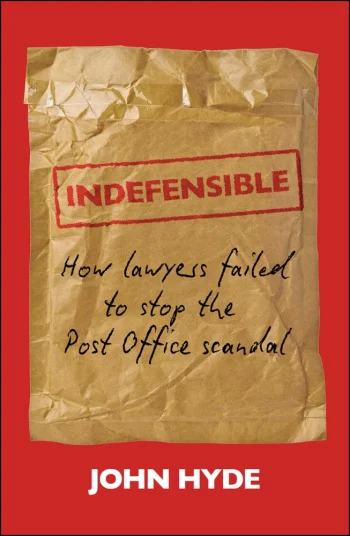
Indefensible by John Hyde available on the Bristol University Press website. Order here for £14.99.
Bristol University Press/Policy Press newsletter subscribers receive a 25% discount – sign up here.
Follow Transforming Society so we can let you know when new articles publish.
The views and opinions expressed on this blog site are solely those of the original blog post authors and other contributors. These views and opinions do not necessarily represent those of the Policy Press and/or any/all contributors to this site.
Image credit: Mylo Kaye via Unsplash