


As of 2026, the mission of nurturing and expanding queer spaces of resistance remains a difficult objective to achieve for activists around the world, particularly as far-right and anti-gender movements continue to cast their ominous shadow over the world of politics, the media, popular culture and the law. LGBTQIA+ visibility can unexpectedly morph into vulnerability when volatile and discriminatory political feelings are left unchecked.
What’s the role of Pride events against this worrying backdrop? In my recently published book The Politics of Pride Events: Global and Local Challenges, I documented – building on primary research and existing literature – the meteoric rise of Pride events across global, rural and peripheral locations around the world. Pride events are no longer confined to the global metropoles perceived to be the privileged sites for exploring one’s identity and feelings. Rural and peripheral locations, both across the Global North and South, are now increasingly hosting small, and often elusive, Pride celebrations, to reclaim local queer histories as well as to question the inherent heteronormativity of peripheral spaces.
And yet, while Pride events have grown exponentially around the world, they are also experiencing the effects of the rise of the far-right and the consolidation of anti-gender politics in both local and global settings. On the one hand, these effects are felt directly, as Pride events are increasingly put under pressure and scrutiny by political opponents, and ‘securitised’ as damaging to the social fabric of the nation, the ‘innocence’ of children or the sanctity of the heterosexual family, to the point of being targeted or banned by specific governments, as happened to Budapest Pride in 2025. On the other hand, Pride events have been suffering the effects of the growing anti-Diversity, Equality and Inclusion (DEI) crusade initiated in 2025 by US President Donald Trump which has influenced many corporate sponsors, particularly multinational companies, to withdraw their financial support for explicit LGBTQAI+ initiatives.
Is pinkwashing at Pride events dead?
For a long time, corporate sponsors resorted to practices of ‘pinkwashing’ at Pride events to curate their reputation and appear as socially responsible and engaged with social justice issues. This has not just meant offering discreet financial contributions to organisers in order to support LGBTQIA+ visibility, but has also been configured as a true form of colonisation of these events with their unsightly and obnoxious commercial floats used to encourage participants and onlookers to buy vodka, eat fast food and buy insurance products.
However, the presence of corporate sponsors at Pride events has recently been reshaped. Firstly, the COVID-19 pandemic forced the almost complete cancellations of all Pride events across the globe for two consecutive years. During this time, as participants to my research discussed, companies that were normally sponsoring specific events started either to withdraw their annual contribution or, in some cases, went as far as requesting already paid-up sums to be returned, given the cancellation of the events. For many organisers, this represented the first signal that corporate support for LGBTQIA+ causes was conditional at best and performative at worst.
However, it was when Trump obtained a second term as US President in 2025, and soon launched an all-out war against any DEI initiatives, that corporate sponsors’ support for Pride events around the world completely changed. In the summer of 2025, Pride organisations, such as those organising San Francisco Pride, saw their corporate contributions dramatically plummet. One year on, the situation seems to have worsened, as more Pride event organisations are publicly disclosing their financial issues, often due to a drop in corporate sponsorship. In the UK, the most tangible example is that of Manchester Pride, which saw the former managing company going bust at the end of 2025, replaced by a newly formed not-for profit company. As of 2026, all over the country, several Pride event organisations have now announced the cancellation of their annual celebrations, often citing financial difficulties. Rural and peripheral Pride events, at least in the UK, seem to have been hit the most. This does not mean that ‘pinkwashing’ is dead when it comes to Pride events, but it certainly signals a more cynical phase in the weaponisation of diversity enacted by corporate sponsors, as Pride organisers need to rethink their financing and fundraising strategies and priorities.
Anti-gender and anti-Pride? When political support for Pride events disappears
Against the backdrop of this worrying trend, one could wonder where Pride organisers should seek their allies. Can other actors, such as local administrations, governments or, in some cases, even foreign embassies represent a more stable source of support – even in financial terms? When it comes to political actors, support for Pride events has been similarly volatile, as a changing administration, both at the local and national level, can often mean for LGBTQIA+ activists the end of a fruitful relationship with those in power.
In my book, some Pride organisers, discussing the complexity of the financial challenges faced, expressed distrust towards both corporate and political actors, when seeking monetary support for their events. I have described this position as wedging activists between a rock and a hard place: even when the organisers turn to political actors rather than corporate sponsors to obtain financial support, they often feel at the mercy of the political whims of the forces in power and treated as expendable pawns.
The rise of far-right and anti-gender actors in positions of power around the world has undeniably had a chilling effect. In 2024, Argentinian liberticide President Javier Milei promptly withdrew his support for the local Buenos Aires Marcha del Orgullo LGBT once he took office. Fast-forward to the first months of 2026, when Florida’s Governor Ron DeSantis signed a local bill that prohibits local government from supporting DEI initiatives and has intimidated local activists. Backlashes against Pride events are also happening in small peripheral settings, as in the case of the right-wing mayor Brice Lauret in the small Northern French town of Faches-Thumesnil who cancelled the local 2026 Marche des Fiertés and withdrew the progress flag from the municipal building, citing questions of ‘political neutrality’.
There are, however, also reasons for cautious optimism when it comes to the attacks levelled against Pride events by far-right and right-wing actors in the last few years. In Hungary, far-right ex-Prime Minister Victor Orbán lost the latest parliamentary elections held last April, just one year after formally banning Pride celebrations in Budapest in 2025; a few days later, the Court of Justice of the European Union found that in banning Budapest Pride, Orbán and his government had acted in contravention of the EU’s fundamental rights, specifically Article 2 TEU. The judicial route, of course, may not be open to all Pride organisers and across all jurisdictions, both within Europe and beyond, but it certainly represents one strategy to halt the dismantlement of the rights to freedom of expression, assembly and association that seems to be at the core of far-right and right-wing contemporary politics.
Protecting Pride events beyond politics and pinkwashing
Pride events undeniably represent a unique site for building an alternative social and political project built on intersectionality, solidarity and liberation, even if they are often riddled with their own internal rivalries and factional divisions. As the most visible element of LGBTQAI+ politics, they easily become the target of far-right and right-wing attacks towards some of the most marginalised people in society, particularly when thinking across personal intersectional positionings. Activists can try to escape the logic of feeling trapped ‘between a rock and a hard place’, between hostile political actors and opportunistic corporations, by turning back to their communities, engaging with what these very communities need and exploring how financial and logistical support can be garnered from within. This turn towards grassroots policy cannot fully insulate Pride events from the structural problems generated by the rise of illiberal politics and ruthless neoliberal destruction, but will certainly make LGBTQAI+ individuals feel at the centre of a political project that can be built together in solidarity.
Francesca Romana Ammaturo is Senior Lecturer in Sociology and International Relations at London Metropolitan University.
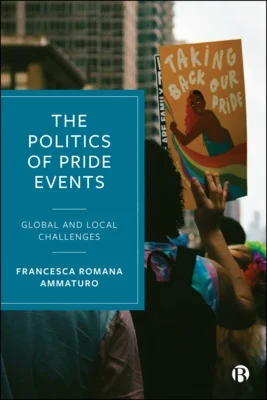 The Politics of Pride Events by Francesca Romana Ammaturo is available on Bristol University Press for £27.99 here or Bristol University Press Digital.
Bristol University Press/Policy Press newsletter subscribers receive a 25% discount – sign up here.
Follow Transforming Society so we can let you know when new articles publish.
The views and opinions expressed on this blog site are solely those of the original blog post authors and other contributors. These views and opinions do not necessarily represent those of the Policy Press and/or any/all contributors to this site.
Image credit: Raphael Renter via Unsplash