


“You can learn how to speak, but you might never feel completely yourself.”
This remark, from an executive in a top-tier firm, captures a tension we heard repeatedly while researching our book Cracking the Class Code. On paper, these individuals were the winners in life’s opportunity race. And yet, they felt they were performing a different version of themselves. Many spoke of the emotional toll of concealing their roots, changing their accents or battling imposter syndrome.
We like to believe that modern workplaces are meritocratic. The best ideas rise to the top. Hard work pays off. The most capable people succeed. But our research reveals a more complicated reality. Behind the glass facades of the world’s leading corporations, success is shaped not only by talent but by a set of hidden rules. We call these ‘class codes’: they influence how people look, speak, relate and advocate for themselves – and how people are judged by others as credible or not. They are usually formed long before we get a job.
We interviewed professionals working in global banks, professional services firms, law firms, consultancies, tech giants and multinational corporations. The firms are potentially powerful engines of social mobility. Entry-level salaries can catapult young people into the highest income brackets. Many will become future business and government leaders who shape all our lives.
In our book, we show how, instead, firms can act vehicles of social reproduction. We document 11 class codes – a shared global repertoire of cultural capital that governs career progression and a key component of today’s global class system. The following five myths of meritocracy are the stories we tell ourselves to justify that system.
Myth 1: Hard work speaks for itself
The belief that rewards naturally flow to those who keep their head down and put in the long hours is deeply ingrained. China’s ‘small town swots’ sacrifice years to excel in the gāokǎo university exam, only to struggle with elite campus life. India’s lower caste graduates discover that their credentials only get them so far amid the cultural barriers in corporate settings.
As one employee told us: “Visibility and networking is what matters most for progression. Often it is colleagues in the background who do the work.” Another observed that “eloquence and confidence often drive visibility and faster growth, while equally talented colleagues may be overlooked”.
Progression frequently depends on an entirely different set of skills: cultivating sponsors, managing upwards, building networks and learning how to make your contributions visible. Hard work remains essential, but it is rarely sufficient. In many workplaces, visibility matters as much as value, and relationships matter as much as results.
Myth 2: Just be your authentic self
Modern employers increasingly encourage people to bring their ‘whole selves’ to work. Yet many employees quickly discover that only certain kinds of authenticity are truly rewarded.
In the United States, research found that employers favoured candidates who tell polished stories of self-discovery, passion and personal growth, forms of self-presentation typical of individuals from more advantaged environments. Professionals from less advantaged backgrounds described constantly monitoring how they spoke, dressed and behaved to fit dominant workplace norms. In the UK, regional accents were softened in front of senior leaders. In India, stories about family or upbringing were carefully edited. One employee described eventually questioning whether professional progression was worth the continual effort of monitoring how they sounded and presented themselves.
It’s a universal dilemma. Learning the codes can open doors. But performing them is emotionally draining. Authenticity, in practice, turns out to be conditional: some people are free to be themselves, while others must perform a version of themselves that feels acceptable to those in power.
Myth 3: Small talk is just small talk
One senior banker remembered being asked a seemingly innocent question during her first months in the profession: “Do you ski?” On the surface, it was harmless conversation. But for her, it landed like a test she already knew she was failing. As Deborah explained: “I get that building relationships is important, but when so much of career progression relies on these kinds of social rituals, it can feel really tough.” Elite hobbies matter because they signal membership of a particular social world.
Many professionals described the exhausting self-monitoring involved in workplace small talk: wondering what to say, what not to say, whether they sounded confident enough, too quiet, too eager or simply out of place.
Small talk is rarely just small talk. It’s how people assess whether someone is a member of the ‘in-club’ long before technical competence enters the picture.
Myth 4: Talent trumps looks
We like to believe that workplaces reward talent whatever someone’s appearance. Yet firms routinely read certain bodies as evidence of ambition and discipline. Employees are assessed through clothing and bodily appearance before a word has been spoken. Athletic bodies are equated with having ‘the right stuff’. As one executive said: “If you can’t take care of your own body, what kind of trust do you instil in others?”
Fitness is often treated as evidence of discipline, resilience and drive. Yet access to sport, healthy lifestyles and leisure time is unequally distributed. What appears to be merit is often accumulated advantage. The athletic body has become the modern equivalent of the business suit: an unspoken badge of belonging in elite workplaces.
Myth 5: Clear communication is all that matters
Most organisations claim to value clear communication. Yet success often depends on something more subtle: sounding credible, confident and familiar to those in positions of power.
People form judgements about competence and leadership potential within milliseconds of hearing someone speak. Certain accents still sit at the top of a status hierarchy. A cosmopolitan ‘neutral’ English or Anglo-American accent has become the default standard in many global firms. In England, equally capable professionals with Scouse, Brummie or Cockney accents may be overlooked not because of what they say, but because of how they sound. In the United States, Southern accents and African American vernacular English are similarly looked down upon.
In countries such as India, fluency in English often acts as a baseline test of professional credibility. One interviewee explained: “If somebody’s not able to speak well, it’s assumed by default that they’re not good with their capabilities, even if the job doesn’t need that skill.”
The challenge extends beyond language itself. Career success often depends on cultural fluency: understanding the references, humour and conversational norms that signal belonging. One Chinese employee described sitting in meetings with European colleagues and struggling not with the English, but with knowing when to laugh at the jokes. We call this the ‘humour test’.
The myth is that workplaces reward communication alone. In reality, they often reward those who already speak the cultural language of the professional class.
Building fairer pathways to success
Taken together, these myths reveal that top-tier workplaces do not merely reward talent. They also reward a series of powerful class codes that are remarkably consistent across the globe. Through our work with firms, we are helping make these hidden rules more visible, creating fairer pathways to success. Our book offers a practical guide for navigating these hidden rules and a roadmap for employers seeking to build more productive organisations.
Lee Elliot Major OBE is Professor of Social Mobility at the University of Exeter.
Anne-Marie Sim is the lead of the South-West Social Mobility Commission at the University of Exeter.
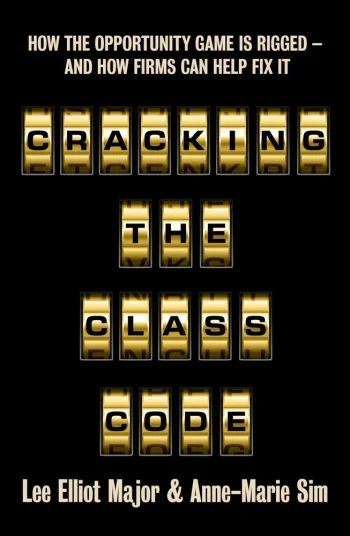 Cracking the Class Code by Lee Elliot Major and Anne-Marie Sim is available on Bristol University Press for £14.99 here.
Bristol University Press/Policy Press newsletter subscribers receive a 25% discount – sign up here.
Follow Transforming Society so we can let you know when new articles publish.
The views and opinions expressed on this blog site are solely those of the original blog post authors and other contributors. These views and opinions do not necessarily represent those of the Policy Press and/or any/all contributors to this site.
Image credit: Erik Mclean via Unsplash