


The election of Andy Burnham as MP for Makerfield and the resultant prospect of an imminent challenge to Keir Starmer’s position as Prime Minister has opened up an overdue debate about ideas for tackling the UK’s deep-seated problems. In its two years in power, the government has taken a number of cautious steps to implement its promise of ‘change’ – but not enough to meet the scale of the challenges. Quite simply, tackling the UK’s social and economic problems needs far deeper changes than the current policies on offer.
In my book, Impoverished – How to Fix Britain’s Poverty Problem, I examine why levels of hardship and deprivation are so high. In doing so, I go beyond the benefit cuts of the austerity years – significant as those are – to examine the more deep-rooted causes. These are wide ranging and cover the sharply widening economic inequalities that arose in the last decades of the 20th century and have not been reversed, the move to a low-paid economy, the underfunding and outsourcing of public services, the sharp decline in social housing, and the rise in the costs of basic utilities following their privatisation. To fix the problem, we need to tackle these multiple causes in a way that is long term and sustainable.
Since the 1980s, anti-poverty policies have tended to concentrate on the adequacy of household incomes, supporting those with the lowest earnings through means-tested benefits. But we need to think about it differently, not just because this approach has failed but because it ignores factors that are crucial to tackling poverty. In seeing households as separate economic entities whose personal and household incomes should be sufficient to meet their needs, it neither asks whether some necessities are better met through collective provision rather than individually purchased, nor challenges why the costs of many of those necessities have risen so fast. Tackling poverty needs a three-pronged approach that looks at ways of controlling the price of essential goods and expanding the provision of free or subsidised key services, as well as ensuring that household incomes are adequate.
For most goods that are purchased, governments have, in the main, relied on there being a competitive market to set the price. But in recent years, this has failed to control the price of many essentials. This is partly because of external factors, such as the rising cost of oil, but it is also because for many of these items there is not a competitive market at all, either because of monopoly power or lack of competition. This lies behind the current cost-of-living crisis, which affects not just those in poverty but many more households going up the income scale to those on middle or even higher incomes.
There are a number of reasons why the situation is now worse. The privatisation of basic utilities, from the mid-1980s onwards, promised improved efficiency and greater investment. But many of these utilities were natural monopolies and the result has been an extraction of profits at the expense of costs for consumers. For these utilities, there is a strong argument to move them back into some form of public or local ownership, at least over the longer term. In the meantime, the pricing structure needs to be adjusted to provide a reduced rate for a set level of use to guarantee that everyone has affordable access to such utilities, with increased costs for higher levels of use to ensure the resource is not wastefully consumed.
At the same time, there has been a lack of regulation. Deregulation has been pursued by all governments in the name of lifting the burden on industry. But well-designed regulation is key to protecting the most vulnerable customers and keeping prices down. And then, there has been a chronic failure of the housing system, which has led to ever rising property prices, a collapse of social housing and the growth of private renting. Building more social housing is an important part of the solution to the housing crisis, but while the government has promised to build more, its ambitions are limited and progress has been slow. In the meantime, there need to be moves to control the costs of private renting at the bottom end of the market, particularly in areas of high rental pressure such as London.
Moving on to services, there needs to be more emphasis on free, or subsidised, public services – what’s been termed a Universal Basic Services guarantee. This approach is rooted in a more collective view of needs and responsibilities than income-based methods, aiming to strengthen the bonds within a community and participation in it, as well as enabling people to meet their needs. It seeks more collective ways of providing services than an approach based on consumer sovereignty and the market. Its ideas fit in with those developed to renew what’s seen as the ‘foundational economy’ – the network of services and provisions that underpin our everyday lives.
It could include, for example, expanding free or subsided public transport to new groups and making school meals free for all pupils. But, above all, it would include the creation of both a National Care Service and a universal child care system. Under current policies, for both these services, the state subsidises private suppliers to provide places – in the case of those needing social care – to those with assets under £23,250, and for child care for a set number of free hours to parents of children over nine months – in England currently 30 hours a week during term time for working parents. For both services, it is a system that has become dominated by large private, international suppliers and provides poor value for money. What’s needed is a diversity of tightly regulated suppliers. For those with long-term care, it needs to ensure that everyone has access to quality care regardless of means, and for parents, sufficient hours to enable those who can and choose to work full-time to do so without incurring the currently exorbitant child care costs.
And, of course, there needs to be income security for all. Pensioners have done relatively well in recent years. The state pension has been protected by the triple lock, and the new state pension (for those who retired after 2016) is now above the level of pension credit, making saving even for a small private pension worthwhile. But the picture for many households of working age has been bleak. While Starmer’s government has made moves to improve both job security and pay, its misguided plans to reform benefits backfired, leaving a system that still desperately needs remodelling.
Since the 1980s, the welfare system has been transformed from one in which the majority of benefit payments to those of working age were either universal or contributory to one where the majority are means tested. This has been done on the basis that means testing directs money to those most in need and at the cheapest cost to the Exchequer. It’s a minimalist view of social security limited to the relief of poverty rather than the collective sharing of risk in an uncertain world. It fails to protect people from falling into poverty, nor does it provide routes out of hardship. It means that the stake in the system for those with household incomes above this means-tested level is low, perhaps explaining its lower levels of public support than for universal services. But most importantly, it has failed to provide even a bare minimum of support to poorer households.
In Impoverished, I set out ways in which the benefit system could be transformed into one that supports everyone, at different stages of their lives and with different needs. It would include targeted basic income schemes aimed at vulnerable groups, raising child benefit and other universal benefits already in place, and creating a modern insurance-based unemployment scheme. Such moves would protect people from falling into income poverty and lay the foundations on which to build a better life.
I argue that the upfront costs of paying for this should come from changes to the tax system that would result in a redistribution of income and wealth from those with the highest incomes and assets. Over the long term, such reforms would likely bring savings to the Exchequer as those currently trapped in poverty would be better able to participate in society, to work and to lead healthier lives.
Taking a new and bold approach to tackling poverty would be a big task for whoever leads the Labour government. It would require political will and vision and a determination to challenge established thinking. But it would benefit us all.
Joanna Mack is author of Impoverished: How to Fix Britain’s Poverty Problem, published in March this year by Policy Press at £12.99. She has been involved in poverty research for over 40 years and is consulting editor of The Journal of Poverty and Social Justice and a visiting fellow at The Open University.
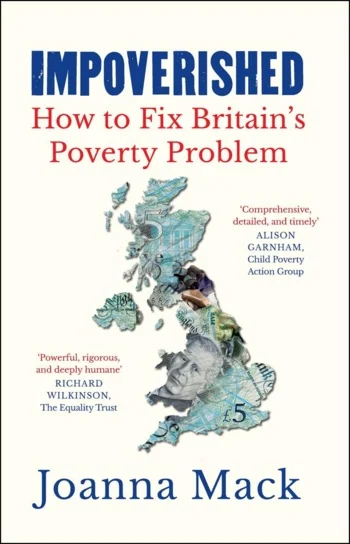 Impoverished by Joanna Mack is available on Bristol University Press for £12.99 here.
Bristol University Press/Policy Press newsletter subscribers receive a 25% discount – sign up here.
Follow Transforming Society so we can let you know when new articles publish.
The views and opinions expressed on this blog site are solely those of the original blog post authors and other contributors. These views and opinions do not necessarily represent those of the Policy Press and/or any/all contributors to this site.
Image credit: Department for Culture, Media and Sport via Flickr