


Elon Musk is now worth a trillion dollars. A number so large that it is impossible to imagine. A million seconds is equivalent to 11.5 days; a trillion seconds is more than 31,000 years.
The temptation is to treat it as a curiosity – a record for the books, a story about one unusually driven man. It is not. But while Musk is an outlier, extreme wealth is a rapidly growing issue. French superstar economist Gabriel Zucman points out that billionaires in the 1980s owned the equivalent of three per cent of global GDP, whereas today’s billionaires own 17 per cent, and this is still growing rapidly. And the issue is not just about a few billionaires; the huge recent increase in the absolute wealth gap between the top ten per cent and both the middle and bottom ten per cent of the distribution in the UK creates problems of its own.
But what is problematic about these increases in wealth, and thus in wealth inequality? When it comes to both extreme wealth and more run-of-the-mill wealth, the first problem is that it is hard to argue that very much of it is really earned.
With Musk, the argument is straightforward. He earns about 25 million times the average UK salary. Even if he worked three times as many hours as the average full-time worker (i.e. 24 hours per day), he would still have to be more than eight million times more productive, or deserving, per hour worked. Most people would agree that talent, contribution and inspiration should be incentivised and rewarded in some way, alongside hard graft – but who can seriously argue that the ratio should be up to eight million to one? It’s some way off Plato’s suggested wealth cap of four to one.
More broadly, a great deal of wealth is straightforwardly unearned. Wealth begets wealth; the Resolution Foundation has shown that most of the increase in household wealth in recent years came from passive gains such as property and pension revaluations, rather than from active saving or asset acquisition. This shift towards the passive accumulation of wealth through asset appreciation makes it ever harder for those without existing wealth to build assets. And this isn’t the only way in which unearned wealth accumulates. An increasing proportion of wealth in our economy is extracted, rather than created. Gains accrue not from adding value but from capturing it, by collecting economic rent on assets that others need, inflating the price of housing and land, or exploiting market power and monopoly positions.
The distinction between wealth creation and wealth extraction matters because the two have opposite effects. Wealth creation can be good for growth, but wealth extraction tends to hold back growth, because the energy of the very rich shifts from creating value to protecting and entrenching the gains that they already hold, shaping competition law, lobbying and locking in the rents they extract. Wealth extraction is also self-reinforcing: rents on assets generate yet more income to buy yet more assets, so the advantage compounds automatically and, when structured carefully, allows the very wealthy to largely avoid income tax (hence Zucman’s calls for a wealth tax on billionaires).
And this is the second problem with extreme wealth, and with wealth inequality more broadly – that it has enormous negative consequences, not just for those at the sharp end, but for all of us. Our review of the evidence in last year’s Wealth Gap Risk Register found 49 spillover impacts of wealth inequality on our society, economy, democracy and environment, from holding back growth and opportunity to damaging social cohesion and weakening both the functioning of our democracy and public faith in it (which very quickly become mutually reinforcing).
The work that we are doing at the moment is looking to tease apart the specific contributions of extreme wealth to these problems (in particular, how it damages democracy by buying influence and distorting decision making) as opposed to the impacts of the broader wealth gap between the top and the bottom ten per cent (where the evidence in The Spirit Level and the work of Sir Michael Marmot show the harm done to social cohesion and trust, mental health and so on).
But regardless of these nuances, the overall direction of the evidence is clear – that wealth inequality is enormously damaging to our economy, society, democracy and environment.
Let’s start with the economy. The claim that great fortunes lift everyone through trickle-down is not reflected in the data. The IMF’s work finds that raising the income share of the poorest fifth boosts growth, while raising the top fifth’s share lowers it; there is no trickle-down in their numbers. The OECD estimates that rising inequality knocked roughly 4.7 percentage points off cumulative growth across member economies over two decades. The mechanisms are intuitive. For example, when low- and middle-wealth households cannot borrow to invest in skills or a business, talent is wasted and demand is weak. Wealth inequality is not the price of a dynamic economy; in fact, it is a drag on one.
For society, the gradient is just as clear. Sir Michael Marmot’s work shows that life expectancy growth in England stalled for the first time in over a century in the 2010s, and actually fell for the poorest tenth of women. Children from disadvantaged backgrounds are 19 months behind their peers by the time they sit their GCSEs.
For democracy, the evidence is the most one-sided of all. When the policy preferences of the affluent diverge from everyone else’s, the wealthy win. Concentrated wealth flows into donations, lobbying, media ownership and think tanks, and the result is a politics that listens upwards. When people sense that the system answers to money rather than to them, trust erodes, and eroded trust is the soil in which populism and democratic backsliding grow. And this isn’t just a problem of billionaires or corporate lobbying; it’s also about the prioritisation of the interests of the wealthier 50 per cent of Britons (basically homeowners) over everyone else, a distinction that in recent years has acquired a distinct intergenerational dynamic.
Finally, looking at the environment, and climate in particular, the richest do not just consume more, they own more of the high-emitting economy. The top ten per cent of global emitters account for nearly half of all emissions, and when you separate investment emissions from consumption, the very top of the wealth distribution looks worse still. Concentrated fossil-fuel wealth has also captured climate policy directly, through funding denial and lobbying against reform. A trillion dollars is a very large carbon footprint, and a very loud political voice on whether we act on climate and if so how.
All of these impacts are set to worsen over time, as extreme wealth and the wealth gap continue to grow, as their intersecting consequences compound and exacerbate each other, and as other factors come into play, not least the rapidly escalating impacts of AI adoption. As Martin Wolf wrote in the Financial Times, “there is a good chance that AI will in time devastate the labour market, increase inequality and create an extraordinary concentrate of economic – and so political – power in the hands of a tiny number of businesses and people”.
None of this is to say that action to curb the spillover impacts of wealth inequality are inevitable, and the encouraging news is that we are not short of options. We divide them into three groups:
- Redistribution acts on the wealth once it has formed. The arguments for equalising capital gains tax with income tax alongside a broader package of reforms are well evidenced and broadly supported. Bolder ideas, such as Gabriel Zucman’s proposal for a minimum two per cent annual tax on the wealth of all individuals with more than $1 billion, are necessary purely to ensure that everyone pays a fair rate of tax on their income. A much higher tax rate would be necessary to make a dent in the level of wealth inequality; the baseline proposal would merely slow down its growth.
- Predistribution acts earlier, on how the market shares out rewards in the first place, and is a key part of the puzzle, given that redistribution alone will never get us far enough. The levers of predistribution include strengthening the power of workers to ensure that a higher share of profits goes to workers, introducing tougher competition laws to make markets work better and reduce the excessive power of monopolies, combatting other forms of wealth extraction and sharing wealth directly through mechanisms such as citizens’ wealth funds.
- Guardrails make wealth inequality less damaging, helping to interrupt some of the feedback loops. They act at the top of the wealth distribution by stopping concentrated wealth from rewriting the rules, for example, by overhauling lobbying regulation, reforming party funding and protecting media plurality. They can also act at the bottom of the distribution by reducing the negative impacts of not owning private wealth, for example, by investing in public services and in the social safety net.
A single trillion-dollar fortune is the clearest signal yet that the wiring needs fixing. The evidence on the harms of the wealth gap is increasingly compelling. The question now is whether we have the will to act rather than just marvel at the number.
Will Snell is the founding Chief Executive of the Fairness Foundation, which aims to change the debate about fairness in the UK and to encourage political leadership on tackling socio-economic inequality.
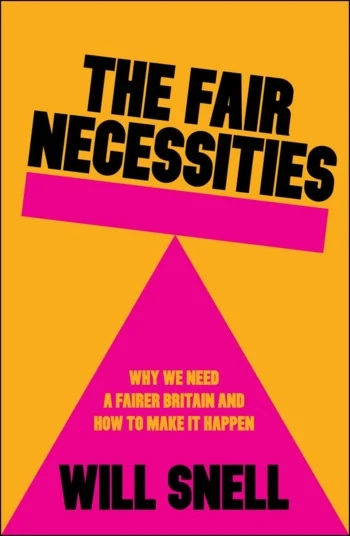 The Fair Necessities by Will Snell is available on Bristol University Press for £12.99 here.
Bristol University Press/Policy Press newsletter subscribers receive a 25% discount – sign up here.
Follow Transforming Society so we can let you know when new articles publish.
The views and opinions expressed on this blog site are solely those of the original blog post authors and other contributors. These views and opinions do not necessarily represent those of the Policy Press and/or any/all contributors to this site.
Image credit: Gage Skidmore via Flickr