


Reed Van Schenck, author of The Reactionary Web, argues that Truth Social’s paid Truth API gives wealthy traders advance access to Trump’s market-moving announcements, highlighting how the commodification of information can undermine economic fairness and democracy.
A lot can change in less than one second.
If you invest in stocks, you already know that prices fluctuate in the blink of an eye. Yet in recent years, this instability has affected everyone. If you drive a petrol vehicle, you’ll remember how quickly prices at the pump peaked when Trump attacked Iran. On both sides of the pond, we still feel the pain at the supermarket checkout as a result of Trump’s 2025 tariffs.
When the President of the United States shares news that might affect the cost of living for people around the world, one would hope that he would make that announcement in a free, open, public forum. After all, the United States claims to be a democratic republic. For a democracy to function properly, all citizens must enjoy equal access to reliable, high-quality information.
Unfortunately, since 2021, President Trump has preferred to make market-moving announcements on a digital platform owned by him, his family and his business insiders: Truth Social.
Worse yet, Truth Social just got way less free, open and public. On 16 July, Trump Media & Technology Group announced the launch of Truth API, ‘a new business-to-business data feed that provides licensed, real-time access to posts from the highest-ranking Truth Social accounts’.
The company has not disclosed which ‘highest-ranking’ accounts are included in the Truth API feed. The most highly followed accounts on Truth Social include those of President Trump, Vice President J. D. Vance, the White House, former Press Secretary Karoline Leavitt, and Transportation Secretary Sean Duffy. Newsweek hypothesises that other high-profile figures, like FBI Director Kash Patel and Health and Human Services Secretary Robert F. Kennedy, may be included.
For between $60,000 and $100,000 per month, Truth API subscribers receive posts from these leaders before they are released to the public. Interim CEO Kevin McGurn describes Truth API’s service as a ‘50 millisecond speed advantage’.
The world of high-frequency trading moves faster than the supermarket checkout line. Due to algorithmic trading software, 50 milliseconds can make the difference between boom and bust.
Even if Truth API customers enjoy only 50 milliseconds of head start, the consequences may be severe. In July, Donald Trump used Truth Social to announce a 20 per cent toll for crossing the Strait of Hormuz, one of the most important passageways for oil barges. Before Trump reversed the decision the very next day (also on Truth Social), the decision caused economic chaos: oil prices spiked, stocks dipped and ordinary people paid the price.
Imagine what could have happened if the Hormuz toll was announced to privileged clientele first. Armed with state-of-the-art algorithmic platforms that ordinary people cannot afford, Trump’s business partners would have had crucial time to adjust their investment strategies. Oil prices would have spiked even higher, leaving retail investors, small businesses and consumers in the dust.
For that reason, McGurn has bragged that one of the largest financial data and information distributors has already purchased access to Truth API, alongside at least ten other customers, mainly high-frequency trading firms. The service might target large language models and prediction markets in the future.
The National Public Radio of the United States (NPR) contacted 12 major investors, and none of them would speak about Truth API on the record, citing fear of retaliation by the Trump administration.
Democratic congressional representatives have opened investigations, and lawsuits have already been filed. Unfortunately, these legislative and judicial interventions are slow. Meanwhile, Truth API will continue to sell priority access to Donald Trump’s wallet-busting announcements, plans and midnight rants.
How did this happen in the first place? How can we make sure it never happens again?
In his defence of Truth API, McGurn claimed that the service is nothing new. Big Tech platforms have been selling priority access to information for a long time, including X’s (formerly Twitter) Firehose API. For $42,000 per month, the X Enterprise API offers a ‘full, unfiltered tweet stream’ for academic archives and financial signal aggregators like Bloomberg Terminal. Twitter’s API was once accessible for free. Free access ended in 2023 following Elon Musk’s acquisition of the platform.
McGurn’s justification misses the point. X is not owned by an elected official. In the case of Truth Social, a sitting president is enriching himself by offering premium access to his own announcements.
Despite this, McGurn’s argument forces us to confront an uncomfortable truth about digital platforms. He is right that platforms like X are offering premium access to information for elite, institutional customers, giving them an advantage. Truth API may be the most recent and shocking case, but it is only a symptom of a much larger problem plaguing the internet and all democratic societies.
Social media platforms have long advertised themselves as free, open and public. Yet the monetisation of information through paid content feeds shows that the richest few can use social media platforms to keep themselves better informed than everyone else.
The internet pioneer Stewart Brand famously said: ‘Information wants to be free because it has become so cheap to distribute, copy, and recombine… It wants to be expensive because it can be immeasurably valuable to the recipient. That tension will not go away.’
Information should be a public utility, not a commodity. The existence of a free API like Twitter’s before 2023 proves that information can and should be accessible to everyone. However, if private tech companies have their way, the best information will be the priciest commodity, and democracy will suffer the consequences.
Reed Van Schenck is Assistant Professor of Communication and Media in the School of Business at IE University, Spain.
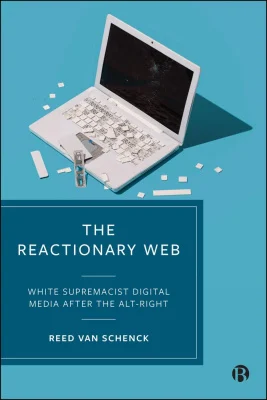 The Reactionary Web by Reed Van Schenck is available for £85.00 on the Bristol University Press website.
Bristol University Press/Policy Press newsletter subscribers receive a 25% discount – sign up here.
Follow Transforming Society so we can let you know when new articles publish.
The views and opinions expressed on this blog site are solely those of the original blog post authors and other contributors. These views and opinions do not necessarily represent those of the Policy Press and/or any/all contributors to this site.
Image credit: camilo jimenez via Unsplash