


Can we create a world where food banks are in the past and everyone can afford the essentials?
In this discussion with Jess Miles, Heather Buckingham, author of A Taste for Change, explains the importance of believing that everyone matters and making sure that everyone can live a healthy life without shame or stigma.
Available to listen here, or on your favourite podcast platform:



Heather Buckingham is Social Change Advisor at Trussell, a charity whose goal is to end hunger in the UK.
Scroll down for shownotes and transcript.
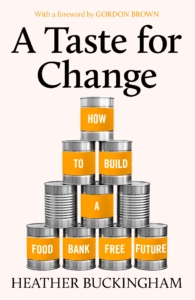
A Taste for Change by Heather Buckingham is available for £12.99 on the Policy Press website.
Bristol University Press/Policy Press newsletter subscribers receive a 25% discount – sign up here.
Follow Transforming Society so we can let you know when new articles publish.
The views and opinions expressed on this blog site are solely those of the original blog post authors and other contributors. These views and opinions do not necessarily represent those of the Policy Press and/or any/all contributors to this site.
SHOWNOTES
Download the discussion guide.
Timestamps:
01:21 – What is your background and why did you want to write this book?
05:14 – What do we mean by ‘the essentials’ and why is that a good starting point?
08:20 – How would society benefit if everyone could afford the essentials?
10:28 – How does the way society values different people relate to food bank use?
14:24 – Why is meritocracy problematic and what needs to change?
18:44 – Why is it important for change to be collective and relational?
23:33 – Why are social security changes slow and difficult?
28:17 – How can we engage with this issue in a helpful and productive way?
Transcript:
(Please note this transcript is autogenerated and may have minor inaccuracies.)
Jess Miles: Welcome to the Transforming Society podcast. My name is Jess Miles back after a little bit of a break and today I’m speaking to Heather Buckingham, who’s the author of a new book from Policy Press called ‘A Taste for Change’. The book brings together personal stories and statistics from across and beyond the Trussell community of food banks to offer insights into the challenges that people who find themselves turning to food banks for help are often facing.
Heather is undoubtedly well qualified to write this book. She is social change advisor at Trussell and was previously director of policy and research at the Church Urban Fund, and has held research fellow posts at the University of Birmingham and the University of Southampton, exploring civil society responses to social issues. In his foreword for the book, Gordon Brown highlights that in Britain today, there are more than twice as many food banks as there are McDonald’s restaurants. 2.5 million people in the UK live in households that have used a food bank in the last year.
Today with Heather, we will explore what kinds of change are needed if we are to become a society that treats everyone as if they really matter. Welcome, Heather.
Heather Buckingham: Thank you Jessica, thanks so much for having me on the podcast.
JM: That’s okay, thank you for taking the time to have a chat. I’ve read the book. It’s fantastic and I’m just really looking forward to talking to you about it a little bit more. But let’s start with what’s your background and why did you want to write this book?
HB: Yeah. So as you said in your intro, I work for Trussell, which is an anti-poverty charity that supports a community of about 1400 food bank centers across the UK and campaigns to end the need for food banks. So essentially, our vision is to do ourselves out of a job. I’ve worked in the charity sector for the last ten years, mostly in research, policy and impact roles.
Before that, I was working in academic research, looking at civil society and how civil society organisations of different kinds respond to social issues, whether that’s through providing services, building community, or advocating for change.
JM: And how did you kind of come to the point of writing this book?
HB: Well, I guess one of the reasons I wanted to write the book was because Trussell’s vision of a UK without the need for food banks is one that I really share personally, and I’ve noticed that when you work in the charity sector, a lot of the tools that are available to you for communicating with the general public require you to communicate in sound bite form, whether that’s a social media post or a media interview.
And yet, the problem that we’re trying to solve, which is people being unable to afford the essentials, is really complex and nuanced. And so I thought that writing a book would give me the opportunity to paint that more holistic picture of the kinds of change that we need to see in order to bring about a food bank free future.
JM: You do that brilliantly in the book, and one thing I really enjoyed about reading it is the way this is phenomenal. This is overwhelming, but you do explain it in a way that really kind of makes sense. And I’ve read quite a lot about food banks, and it doesn’t always do that, so I found that really helpful.
HB: Thank you. Thanks, Jess. And I think another thing that I wanted to do with the book was to try to go back to first principles. So charities like the one I work for spend a lot of time trying to persuade people that the Social Security system should be better, for example. But I felt like there was a need to take a bit of a step back and ask or remind ourselves why it is that we have a social security system in the first place, which has a lot to do with the unevenness of the way in which challenges of different kinds fall out across the population, and the unevenness of the resources that people have at their disposal to navigate those.
And I guess if you’re an academic working in social sciences or if you’re someone working in a job like mine, in a charity, that probably sounds very obvious to you. But when you hear people who’ve used a food bank describe themselves as failures, or when you hear people describing others who’ve used a food bank as lazy, I think it’s very clear that we’re not doing a good enough job as a society of kind of really narrating the layers of disadvantage and difficulty that some people have to contend with that others just don’t.
And so I wanted to see if I could bring some of that a little bit closer to audiences who might not normally pick up a book about poverty through ‘A Taste for Change’.
JM: Yeah. And I think even for audiences who do feel like they know quite a lot about this stuff. Yeah, your book makes those connections and acts as like a just a reminder of how it all comes together in a way that is potentially very, very useful. So you mentioned this idea of affording the essentials and the book starts from the premise that everyone in society should be able to afford to do this.
It feels like a very, very low bar. Right. But the book shows that we’re an incredibly long way away from it in the UK. So why start here? And what do we mean by the essentials?
HB: Yeah. So I would say that the book starts even further back than that. So it starts with this very simple idea that everyone matters. And then from that premise argues that if everyone matters, we should organise society in such a way that means that everyone can afford the essentials. I also argue that if you want a society where everyone can afford the essentials, then you actually need to aim for a society where almost everyone can afford a bit more than the essentials or a decent standard of living almost all of the time.
Partly because if you’re in a position where you could only just afford the essentials, then you have a financial shock of some sort and very quickly going to find yourself going without. But the reason I start with the essentials as you’ve said, and that is such a big focus in the book is because of what you alluded to in your question, the fact that we’re a very long way from it being the case, that everyone can afford the essentials, even though that does sound like a low bar in a country like the UK.
So, for example, Joseph Rowntree Foundation’s research found in 2025 that 7 million low income households were going without essentials, which is a huge number of households and an even greater number of individuals in those households.
JM: So what are the essentials?
HB: So by the essentials, I mean the things that we all need to subsist sustainably. So that would include sufficient food, energy, housing that’s of an adequate standard to keep us safe. The items we need to keep our homes and ourselves clean and safe, basic clothing, essential transport costs, that kind of thing.
JM: Okay. So it’s what we need to be able to participate in the world and be healthy, isn’t it?
HB: Yeah. Yeah. And I think we sometimes make this distinction between the essentials, which are kind of sort of the very basics, if you like, and then also what people need to afford a decent standard of living. And that’s really what, you know, I think we should be aiming for in society that everyone could afford a decent standard of living.
But the focus in the book is on really kind of that first step of everyone being able to afford the essentials. And the reason that’s so important, of course, is because of the level of harm that results from not having those kind of very basic needs met.
JM: Yeah, it’s shocking that 7 million households can’t afford the essentials, that’s such a big percentage of the people in this country. How would society more broadly benefit generally if everyone could afford the essentials?
HB: I think that’s a really good question, and I think it relates to the argument I make in the book around the fact that we should be aiming for people to be able to afford more than the essentials, because human beings are not, we’re not just physical beings that need to be kept alive. You know, we are relational beings as well, and both kind of being unable to afford a decent standard of living, but even more so, being unable to afford the essentials really compromises our ability to participate in society.
It makes it harder to keep in touch with friends and family. It makes it harder to stay in work or to get into work. And, you know, like we need people to be doing all kinds of different work, both paid work and unpaid caring work as well in our society. And so if people are unable to afford the essentials then both their physical and their mental health is likely to deteriorate, their social connections are likely to be diminished because so much of our interaction with one another costs money, even if it’s just getting a bus fare or something.
And I think also like relationships between different groups in society are really important and easily become frayed or worse when many people just aren’t experiencing the standard of living that most of us would take for granted. In terms of what society is giving them back. And so I think that that difference in experience, particularly across different income levels, can really play a part in the ease with which our society can then be divided along sort of ideological lines as well. So I think this has kind of much wider impacts for society as a whole, as well as just the individuals who are directly affected.
JM: Yeah. I think it’s so important to kind of remember that when we talk about it, it’s not just happening over there somewhere, is it? I love this thing that you just mentioned. It’s kind of at the heart of the book, which is that everyone matters, and it feels like we do have a problem in our society in that we value some people more than other people.
We value some types of jobs more than other types of jobs. I wondered if you could talk a little bit about how this kind of relates to food banks and food bank use.
HB: Absolutely. So I think it’s firstly important to be clear that there is a difference between a person’s value as a human being and what they get paid or what their income is. Those aren’t the same thing. But by the same token, having value as a human being and experiencing yourself as being valued aren’t the same thing either.
And so there are two main things that we see at food banks and in the data on food bank use that made me feel that it was important to emphasise this kind of very basic idea that everyone matters in the book, and then to argue, really, that we need to do a much better job of making sure that the systems and structures that make up our society treat people in a way that communicates or that tells them that they are valued basically.
Yeah, and so those two things were firstly, the number of disabled people or people with long term health conditions that we see turning to food banks, most of whom at the food banks in the Trussell community tell us that they’re not able to work. And I think the fact that people in that position are needing to turn to food banks in large numbers to essentially ask for emergency food, tells us that not only are we not providing for one another practically, but we are also just not doing a good enough job as a society of showing people that they are valued, especially through the mechanisms of the state and our social security system.
But the second group has to do with people who are really trying to make things work for their households, whether that’s through employment or through unpaid care and are just finding that whatever they do, they don’t have enough. They can’t afford the essentials, they can’t afford a decent standard living. And when people find that they consistently can’t make ends meet, no matter what they do, I think it’s not surprising that they sort of draw the conclusion that in society’s eyes, they don’t really matter.
JM: Or they’re not good enough. Something like that, yeah.
HB: Yeah, I think, you know, if it doesn’t work for you, I think that’s the kind of message that you can very easily end up hearing. And that’s a problem. And so I think we need to, that’s something that we really need to change.
JM: So when you are speaking to people like during the course of your research, that’s what comes over, is it? This sense that, I suppose they stop valuing themselves as well don’t they?
HB: Yeah, certainly for some people that that’s true. And one person who I, a woman I spoke to in the book sort of talks about. Yeah. Society doesn’t think I’m valuable.
JM: Yeah.
HB: And another man I spoke to talked about the feeling of being kept awake at night with the sense of being a failure and, kind of, what have I done wrong? Why can other people make ends meet and I can’t? So yeah, I think there is this sense of failure that people are carrying often, which is obviously unjust. But that doesn’t prevent people from kind of feeling, feeling that.
JM: Yeah. And it’s really important to show that and to, if we can afford the essentials and we are very comfortable, it is very easy to just forget or not think about these difficult things. And I really love how you like bring those stories through the book and they’re a really important reminder of how we need to see things from different people’s perspectives.
And I think it links to the idea of meritocracy as well, doesn’t it? Which has always been contested. But the book suggests that meritocratic thinking has quite a lot to answer for when it comes to food bank need in the UK. So thinking about meritocracy, why is the idea that you can make it if you try problematic? And what needs to change?
HB: Yeah, so I think there’s kind of a fine balance with this sort of idea of making it if you try. Because on the one hand effort and talent does really matter, like society needs people to really apply themselves to all kinds of things, whether that’s, you know, building infrastructure or providing really good quality health care or making sure our retail system works well.
And so I think in a healthy society, we do want it to be people’s experience that if you put some effort in, you’ll be okay, you’ll have enough. But what I think is not healthy is to live in a society where you have to be particularly successful, or where you have to be socially mobile in order to be okay or to have enough.
JM: Yeah.
HB: One of the things that the book argues is that’s kind of the direction that we’re heading in, and it’s not a good place to be. So I argue, really, that the problem lies where we buy too heavily into the idea that you can make it if you try or we sort of put too much weight on it.
And I think that there are two main challenges with that. One is that the relationship between effort and reward is not a linear one. And lots of the people I heard from in my research for the book spoke about situations where they’d been in work, sometimes in professional jobs, and then a succession of difficult things had happened to them, whether that was a relationship breakdown, domestic abuse, in some cases, a workplace injury, and the kind of impact of a succession of really difficult events sometimes being cut off from family support for different reasons, meant that those people were really trying, but their efforts were now having to be orientated towards coping with extremely difficult situations.
And then I think there’s also a problem that if we only focus on social mobility, which I would say social mobility in itself is an important thing. But if we get kind of preoccupied with that to the exclusion of other things, we can easily start to forget that like every single human being is important and deserves a decent quality of life, not just the people that are able to move up the income distribution.
So the people that don’t move anywhere, or the people that stay at the bottom, or perhaps even move down as others move up, matter just as much as the people at the top. So I think that’s those are some of the challenges with the idea that you can make it if you try. And I think when we buy into that too wholeheartedly as a society, people end up looking at the problem of food bank use and thinking, well, you know, if you were trying, you wouldn’t be in that position.
And that just doesn’t stack up when you look at the data and also hear people’s stories about what they’ve experienced, that’s kind of led to them needing to turn to that support.
JM: That’s so interesting. You can see how this idea of meritocracy and you can make it if you try, leads to these narratives around laziness and scroungers and all those old poverty tropes. I think as well, as you’re speaking, it’s like someone could be working a lot of hours but in a job that we don’t really value enough to pay a decent wage.
And so there’s value in that sense as well, it’s like what jobs pay enough to be able to have a decent standard of living? I think Andy Burnham was talking recently about kind of trying to change that perspective and that things like technical education and things. So yeah, and yeah, it’s such a complex, intertwined situation, isn’t it? And so I feel that the work you’re doing is a lot about pulling out the different threads and allowing us to see where those connections kind of happen, which is really helpful.
And what keeps coming through, like as I was reading the book, but also in speaking to you now, is this idea of humanness that you mentioned quite often in the book. I’m kind of, I’ve kind of thought about that before, but not necessarily in the same way that you do in the context of food banks. And it was a lot about change needing to be collective and relational and really like understanding that we are relational beings.
So I was interested to hear you talk about what that means in practice and how it changes how we think about food banks.
HB: Yeah. So I think this sort of relational side of how we respond to the problem of people being unable to afford the essentials is something that comes over really strongly when you talk to people who have used food banks. And they will often talk about how they’ve been treated by different organisations or individuals that they’ve interacted with as part of their kind of seeking of support and seeking to find help in the situations that they’re in.
And yeah, so I think we hear about that mattering a lot, both in the context of the voluntary sector and the services that civil society groups are involved in providing in communities and also in people’s interactions with the state, particularly through kind of universal credit and job centers, and the kinds of experiences people have there and the ways that they’re treated.
JM: Could you give an example or two of that? Because in the book I, the job center interactions felt really significant for people.
HB: Yeah, absolutely. And people’s experiences at job centers do vary. Only some of the people I spoken to in the book, one person talked about feeling really kind of talked down to by people at the job center being kind of made to feel a bit like a beggar and sort of a sense that people were acting as if it was their own money that they were giving out, which just created a sense of a lack of dignity, really, for people who were kind of receiving that treatment.
So that’s one side of it, of how are individuals, how do we create the space and the right sort of expectations and culture that people are treated well and in ways that actually support them to manage and to hopefully improve their circumstances where that’s possible. But then there’s also the kind of digital side of that as well.
So much of the administration of universal credit and people’s like the requirements that people have to fulfill as part of their receipt of that is done through a digital online platform. And for some individuals, that obviously works really well, but sometimes it’s people who are the most excluded or the most vulnerable for whom that doesn’t work well. Because actually, if you’re very socially isolated or indeed if you’re digitally excluded, which many people on very low incomes are, that kind of digital interface isn’t necessarily going to give you, you can’t really build trust through a platform like that, for example.
And so that’s another way in which the kind of relational side of how both the state and voluntary sector services work is really important. And, I think we learned a lot from an evaluation that was done, I think, a couple of years ago now by the University of Bristol, looking at the advice services that are often provided in food banks or through food banks.
And one of their findings was that those services were often able to achieve better outcomes for people because they were located in relational environments that people that were friendly, that were patient, so they weren’t as time pressured as some of the other environments where people could receive that kind of support. It had a strong emphasis on being nonjudgmental.
And so one of the learnings from that was sort of, how can we make sure that that becomes the norm, that when people are seeking this kind of support, that they don’t just get the transaction that they need, but they actually get an experience that is what they need at that point as well.
JM: Yeah, and it just seems so clear that to be treated in that human way is going to make people feel much more capable and empowered of like making change or getting more support and yeah, really important to remember that the food bank that is far from being just boxes of food, isn’t it, there’s an awful lot going on there that also comes through in the book.
I wanted to speak a little bit about the politics of it all and in the book, you evidence the fact that there is a consensus among voters of all stripes that our Social Security system should ensure that everyone can afford the essentials as like it’s something we like broadly agree on. But if this is true, why is change so slow and difficult to make happen?
HB: Yeah. Well it’s a really good question.
JM: It’s the eternal question, isn’t it?
HB: Yeah, there are a few reasons within that. So firstly sadly people agreeing with something is by no means sufficient to make it happen. So people may agree as they do to a very large extent, that Social Security should ensure that everyone can afford the essentials. But to make it happen, we need them to think that it’s urgent. We need to think that it’s important and that it’s more important, perhaps, than some other things that they might also agree with that haven’t happened yet.
So that’s a key part of our work at Trussell and that of lots of other partners too, is we know people agree with this, but how do we make it more salient? How do we make it clear that it needs to be a priority? And then not only do they have to want it to happen, but they have to be willing to pay for it to happen as well.
And that’s again, another matter. So those are some reasons on the side of people’s opinions if you like. But then there are also some reasons that have to do with politics and the decisions made by those that have power to bring about change, for example, in our social security system, but also in other areas of policy like housing or employment as well. We have seen some significant changes in those areas, I think it’s important to acknowledge, but there are obviously also real challenges around public finances.
There are concerns about the overall level of expenditure on Social Security, and in particular, I think it’s difficult for governments take significant action on this at a time when levels of economic inactivity, particularly because of the health reason, are high. Historically.
And so I think we do need this sort of two pronged approach where on the one hand, there’s really significant and effective support to help people to get into work for the first time or back into work where they can. And we are seeing some action from the government on that at the moment, which I think is encouraging.
And we need to take action to improve the sufficiency of the social security system, and particularly, as I mentioned in the book, is concern around the basic rate of universal credit, which I think surprisingly really is not currently set in relation to any kind of estimate of the cost of the essentials. And I suppose that takes me to another point about why we perhaps haven’t seen the level of change that we need, even though there is this sort of broad agreement.
And that would be that although people agree that everyone that Social Security should enable everyone to afford the essentials, there’s disagreement about whether it currently does or not, and people aren’t necessarily aware of how much you get on Social Security and how far that would go. So at the moment, as part of the Guarantee our Essentials campaign, that Trussell and Joseph Rowntree Foundation are leading, there’s a campaign going on around the idea that Universal Credit doesn’t know the price of a pint of milk, because it just doesn’t stack up when you look at what people’s basic costs actually are.
JM: Yeah. One thing that’s really useful in the book, in one of your appendices, you have lots of information about universal credit and how it actually works in practice and what people actually get. And I thought that was really valuable because like we talk about as policy people and academics, we talk about universal credit, but not actually looking at it in that level of detail or that reality of it.
So I really valued that appendix. And also you have another appendix that’s a discussion guide to the book and we are going to make that free alongside this podcast. And I think that will be really valuable to readers, but also maybe for lecturers who want to bring the book onto their courses and things, it will be really helpful for students.
So we’re going to do that too. So there’s a lot in the book, isn’t there? That’s kind of quite, quite practical in some ways and really designed to get us thinking in different ways. So this is my last question. So the book makes it clear that change needs to happen across a lot of these policy areas. When I read it and when I think about this stuff, sometimes the scale just feels overwhelming.
And it can make the problem feel too big to do anything about sometimes. So as we close, I’d like to ask you, for listeners who are already thinking hard about this stuff and may not have a platform or financial resources to work with it in that way, how do we move past this sense of overwhelm to engage with this issue in a helpful and productive way?
HB: Yeah, I mean, I think that’s a great question. It’s something that probably all of us that work in the world of social change in one way or another, have to grapple with is, how can we manage this problem. That’s the issues we’re dealing with are so big and so complicated, and yet we are finite human beings with finite resources and capacity at our disposal.
And I think sort of the answer to that question that you pose is going to look quite different for different people or very different for different people, potentially. But I think that one of the ways in which it’s helpful to narrow things down a little bit for ourselves is to think about our own contexts and our own skills, experiences and how those intersect with the problem.
And how are perhaps the relationships that we hold or the groups that we’re a part of, how those kind of cut across it, and doing that I think, can help us to identify, well, where are the places that I might have influence and that I can bring some of my capacity to, so in the book, I talk about like a whole range of issues that contribute to food bank need from health inequalities to employment conditions, family relationships and so on.
But towards the end of the book, I mention that at Trussell seeking to reshape and strengthen our social Security system is the area where we’ve discerned that, like the relationships that we hold, the evidence base that we have, and the experiences that we can draw upon give us kind of the greatest potential for influence when it comes to ending the need for food banks.
So it isn’t that we’re not active in some of those other areas, and we are growing our involvement across some of them. But Social Security is an area where we’ve decided to devote significant resources, because we think that this is where we, with our partners and the food banks in our community, can have the most significant impact.
JM: That makes sense.
HB: For the people listening, my idea would be to think about the context you’re involved in whether that’s through work, through your community or in other ways, and consider where does your influence intersect with the problem of people being able, unable to afford the essentials? And because the range of contributors to this problem is so wide, that could look really different.
For different people, it could be volunteering at a community center that’s trying to help make sure that people have the social connections that can stop them from falling through the gaps when difficulties arise. Or it could be like trying to have some influence on employment conditions of low paid workers or contractors in your own workplace.
JM: Yeah.
HB: And so one of the reasons I’ve left the book a bit open in that respect, rather than kind of finishing off.
JM: Because I was kind of annoyed you didn’t just give me a list of things to do at the end.
HB: I actually did try to do that in an earlier draft of the book, and I just didn’t feel like it quite worked.
JM: Yeah, it doesn’t work. Yeah.
HB: So the reason I left it more open is because I’m really hoping that for some people, at least as they read the book, it might just spark some thinking that gives them an idea of something that they might do. So I’m hoping that people will engage with it creatively. The book doesn’t have all the answers, but my hope more is that it prompts people to ask some good questions of themselves and of others and of society, and that perhaps reading the book will spark someone’s imagination about whether it’s like a new research project or a collaboration that they might get involved in, or maybe even a personal career decision to do something different that goes on to have an impact in terms of people being more able to afford the essentials, perhaps in a way that we haven’t thought of yet.
JM: Yeah, hopefully. Surely. I’m sure the book will do that. And just like, it just changes the way you think about it a little bit, you’re really thinking back to that, everyone matters, that humanness, and those relational connections, it draws everything in together, and it makes you realize that food bank use isn’t something that’s away from you and over there and that we’re all potentially like or most of us are potentially vulnerable to it as well.
Aren’t we? Like things can happen in your life. And yeah, it’s possible, possible for all of us. So thinking about it in that more connected way I think is, for me at least like a good start to then thinking about what I might be able to practically do. That’s amazing. Thank you. Well, thank you for writing the book because it’s brilliant and makes the complexity of the whole issue just much easier to grapple with, I think.
Yeah. And hopefully we can take away something and just start making those little shifts in our own lives. Yes. And thank you for giving us your time today. I know you’re incredibly busy, so I really appreciate that. And I’m sure our listeners will too.
HB: Thank you so much.
JM: Yeah. Pleasure.
Richard Kemp: Thanks so much for listening to this episode of the Transforming Society podcast. If you’d like to buy a copy of this book or any other book published by Bristol University Press or Policy Press, we have a 50% discount code valid until the 31st of December. Just go to bristoluniversitypress.co.uk, select your book and then enter POD04 at checkout. That’s POD04 at checkout.