


Markus Holdo, author of The Responsibility to Disrupt, argues that AI’s threat to democracy is its intolerance of thinking and questioning.
A retired teacher from Berkeley, California, walked out of San Francisco’s Hall of Justice in handcuffs last month. Some already predict that her name – Wynd Kaufmyn – will be in future generations’ history exams. She is the first person to be sentenced to jail for protesting against what many, including the CEOs of Anthropic and Open AI, see as a technological development that has accelerated out of control.
Kaufmyn’s crime is that she refused to get up and leave when police broke up the blockade of OpenAI’s entrance that she had organised with two other activists from the group StopAI. But while the district attorney called the verdict ‘a resounding message rejecting the notion that protesters can endanger public safety as a means to an end’, many feel, on the contrary, that Kaufmyn did what all citizens should be doing. The MIT professor and author of Life 3.0, Max Tegmark, found the trial farcical: ‘a 69-year-old woman goes to jail for non-violent protesting while AI CEOs don’t, even [though] they say their future products may cause human extinction’.
Kaufmyn herself stated that her objective had been to ‘sound the alarm’. The tech billionaires, she said, are ‘taking over and creating a dystopian fascist surveillance police state’.
AI versus democracy
Kaufmyn is far from alone in this belief. Even the companies’ own employees have publicly questioned their ethics. A researcher at Anthropic resigned in response to its lack of accountability, and received support from other developers in the sector. In a statement, one of them, tasked with monitoring AI agents for Open AI, suggested there was a 70 per cent risk of human extinction unless there is serious regulation and coordinated slowdown between labs.
More recently, in Argentina, citizens are protesting against their government’s rule-bending which has welcomed the surveillance company Palantir’s CEO, Peter Thiel, to live and operate in the country. Environmentalists claim that the government is seeking to attract capital by selling natural resources cheaply to foreign tech companies. Thiel is a long-time financial supporter and adviser of JD Vance; his new partnership with Argentina’s far-right president, Javier Milei, is only the last of many controversies. During the genocide in Gaza, Palantir proudly announced it had formed a closer partnership with Israel’s defense ministry to aid its war effort.
Recent events have also brought another problem into full view: companies like Palantir, Anthropic and OpenAI already collaborate in government attempts to monitor and deter disruptive protests. While mostly known for their consumer products such as ChatGPT, Cloud and PayPal, these companies provide solutions to various public administration problems. AI face-recognition technology has recently been used to police anti-ICE and Gaza war protests in the US, Pride marchers in Hungary and student protests in India. A recent report finds that Anthropic has begun registering anti-AI protesters as part of the development of a predictive surveillance system.
The Kaufmyn case raises critical questions not just about the rights of citizens in a democracy, but their responsibilities as well. Do they have a responsibility, as the tech companies suggest, to remain docile and cooperative, or should they, as Kaufmyn insists, do what they can to disrupt these processes?
The responsibility to disrupt
Public debate and political theory appear divided on this point. Disruptive protests tend to generate controversy. Climate and anti-war activists have recently been arrested and sentenced to jail – sometimes for merely thinking out loud about protesting. In Britain, expressing support for the anti-genocide group Palestine Action is now criminal. And the policing of protest is supported by some of the biggest news organisations in countries like the UK, Italy and Sweden.
But there has never been any significant debate among scholars of democracy: protests are indispensable for a vibrant, resilient democracy. Even Thomas Hobbes, one of the hardest advocates for order and obedience, found that a legitimate state ultimately rests on the consent of its subjects – which they must always have the right to revoke.
Critical theorists, including Jürgen Habermas, have found disruptive protests, including civil disobedience, to be not only justified but an important way in which citizens keep a democracy alive. Hannah Arendt, who was not unambiguously supportive of protest activities, nevertheless wrote a passionate defence of the political act of challenging authority. More recently, Clarissa Hayward has provided a more specific answer to how protests disrupt the continuation of structural injustice: they force people to confront their motivated ignorance.
AI is in many ways a perfect illustration of the thoughtless action these thinkers find dangerous. In fact, it is designed to restructure our daily lives in ways that make it harder to question. But with AI powering wars, arms trade and unsustainable economic growth, the future may well depend on citizens’ willingness to disrupt its normalisation. The question is: will the tech giants tolerate it?
Markus Holdo is an Associate Professor and Senior Lecturer in Political Science at Lund University, Sweden. His research focuses on democracy, protest, and ethics.
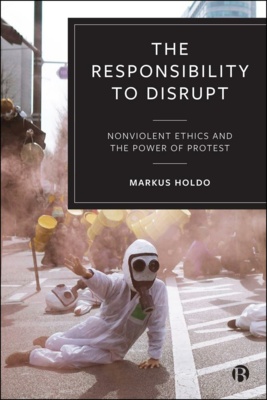 The Responsibility to Disrupt by Markus Holdo is available on the Bristol University Press website. Order here for £14.99.
Bristol University Press/Policy Press newsletter subscribers receive a 25% discount – sign up here.
Follow Transforming Society so we can let you know when new articles publish.
The views and opinions expressed on this blog site are solely those of the original blog post authors and other contributors.
These views and opinions do not necessarily represent those of the Policy Press and/or any/all contributors to this site.
Image credit: Nathan Kuczmarski via Unsplash