


In an age of climate change, war, economic instability and mounting global crises, has humanity ever felt more uncertain about its future? Hartley Dean, author of Human Narratives and Social Mindsets, explores why recognising our fundamental interdependence may be key to rethinking what it means to be human.
In a previous Transforming Society article in 2020, I alluded to the ‘dehumanisation’ of the human species, to the sense in which essential human needs are systemically obscured or denied. Since then, our species may have survived both the latest of its recurrent self-induced financial crises and a global pandemic.
Nevertheless, in 2026, outgoing UN Secretary-General António Guterres eloquently reminded us of the existential threats the species faces from the amplified consequences of climate change and a confluence of humanitarian crises fuelled by violent geopolitical disruptions, the increasing global grip of autocratic governance, and the potentially unconstrained development of Artificial Intelligence.
Is there perhaps a case for reframing the narrative account that Homo sapiens gives of itself? The stories it tells – mythological, religious, philosophical, ideological – have fuelled contradictory tendencies towards both human development and self-destruction.
It has been suggested that our species should never have described itself as Homo sapiens, but as Homo narrans. What distinguished our species from others in Nature was the development, around 70,000 years ago, of fictive language. Other species have developed means of practical communication, and early hominid species certainly communicated with one another orally. But even before the development of written language, humans had begun through storytelling to articulate and share their understandings and imaginings.
This is the way in which a plurality of human communities synthesised their understanding of their relationships with Nature and with each other. That process incorporated a spectrum of creation stories and folklore, later institutionalised through the beginnings of recorded history. History has since accorded greater global dominance to certain cosmogonical accounts, allegorical tropes and scientia (forms of collective knowledge) than to others.
How historical narratives have shaped our relationship with Nature
Among the stories that human beings have for millennia been telling themselves, two in particular – despite the existence of equally profound and similarly ancient indigenous belief systems around the world – have become dominant.
One, the ‘biblical’ Genesis narrative, grants humanity effective licence to take from Nature. The other, to be found in ‘classical’ Greek mythology, is the story of Gaia, the primordial Earth Mother, whose name has come to encapsulate the idea of the Earth as a living organism struggling to sustain herself against her invasion by the human species, to whom Prometheus had, in defiance of Zeus, bestowed the gift of fire.
The Genesis narrative informs all three Abrahamic religions and has insinuated itself into the consciousness of believers and non-believers throughout much of the world. The Gaia narrative in recent times has found support, and a significant measure of scientific validation, within the contemporary environmentalist movement and more generally within political discourse.
The contest between these ancient narratives remains one of several that are central to the crossroads at which the species finds itself.
Our species, which originated as long as 300,000 years ago in Africa, nomadically propagated to populate the Earth and in due course to develop diverse peoples and parallel civilisations with little or no knowledge of each other, yet with the capacity in recent millennia for contest and conquest when it came not only to territory and the arbitration of boundaries, but also to cosmogonical understandings or ‘truths’.
So it was that the peoples of Europe extended their power in the first instance through the Roman and Byzantine Empires, which encompassed parts of Asia and North Africa.
This was followed in the 15th century of the ‘Common Era’ by the classical ‘Renaissance’, when European elites cultivated an understanding of a universal human ideal distinctively conceived in the image of White, literate European Man – Homo politicus.
This consolidated mythology amounted to the ‘invention’ of the idealised individual human subject. European Man began to set out, ‘discover’ and colonise long-existent yet (to them) unknown peoples in sub-Saharan Africa, East Asia, the Americas and the Antipodes. In the process, they instituted systems of international trade, including trade in slaves captured in sub-Saharan Africa.
How capitalism created the myth of the autonomous individual
The ‘Renaissance’ was followed in 17th century Europe by the ‘Enlightenment’ and the scientific revolution that portended the 18th century Industrial Revolution. The advent of manufacturing brought new meaning to ‘work’ and to wage labour as its dominant form, tied not to the land or crafts, but to factories and finance capital.
The associated infrastructural development and the production and circulation of manufactured goods all required the commodification of labour power. The species was enjoined to remodel its image of itself, and of the goods it was collaboratively drawing from the natural resources of the Earth.
Human beings were mythically instituted as sovereign individuals between whom products may ‘freely’ be traded not as ‘goods’, but as commodities, the perceived ‘value’ of which rested not primarily in their usefulness, but abstractly on the amount of work by distant others entailed in their production and distribution.
Labour itself became a commodity ‘freely’ traded, by unenslaved workers in return for their own means of subsistence. In this way, the socially collaborative essence of humanity’s engagement with Nature and the material relations of power within which such collaboration may occur were concealed.
People’s work was valued not as purposeful human interactivity, but as a source of outputs for the purposes of capital accumulation. The land on which people live, work and belong was valued for its productive potential. Money was valued not as a mere medium of exchange but as a medium for accumulation and the creation of abstracted value, or financial capital, which appeared to function, not passively, but as a substantive instrument affording power to those who held it.
The ideal universal human subject crystallised into what may be characterised as Homo oeconomicus.
The new mythology presented the human being as a supposedly autonomous, socially disconnected economic actor dominated by an unaccountable power exercised through the magic or ‘hidden hand’ of market forces, yet instituted through illusory stores of monetary value. It is a mythology that distorts or can at least inhibit understanding of human existence, its complexities and fundamental vulnerability. Capital assumes a mythical form that, like a sovereign God, rules the peoples of the Earth.
Human interdependency: A conceptual challenge to individualist and nationalist methodological thinking
The counternarrative here might be one that holds to a conceptualisation of our ‘species being’.
The story of our species may be told from the perspective not of the human being as a sovereign individual, nor indeed as a citizen of a mythically sovereign state, but methodologically as a member of a species: the human species, in all its pluriversality and vulnerability. The inescapable reality of the human story is that of its essential interdependency. The species’ survival depends on evolving conceptions of the ways in which we collaborate as a global species at a multiplicity of sites and levels; of our essential interdependency with the planet and with each other.
We might recognise and rehumanise ourselves, not as Homo sapiens, nor simply as Homo narrans, but as Homo interdependens. To embrace this alternative narrative, I argue, is not utopian, but social scientifically realistic.
Hartley Dean is Emeritus Professor of Social Policy at the London School of Economics and Political Science.
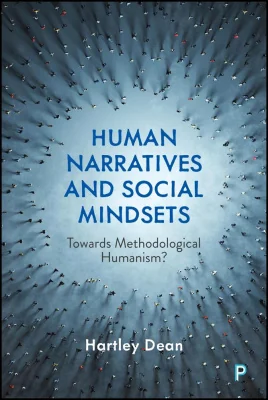 Human Narratives and Social Mindsets by Hartley Dean is available to pre-order on Policy Press for £85.00 here.
Bristol University Press/Policy Press newsletter subscribers receive a 25% discount – sign up here.
Follow Transforming Society so we can let you know when new articles publish.
The views and opinions expressed on this blog site are solely those of the original blog post authors and other contributors. These views and opinions do not necessarily represent those of the Policy Press and/or any/all contributors to this site.
Image credit: