


In January and February 2026, the UK government confirmed that prison education delivery across England and Wales would be reduced by approximately 20–25 per cent, citing rising operational costs as the primary cause. However, Independent Monitoring Boards (IMBs) reported that real‑term reductions were far deeper in many establishments, ranging between 36 and 65 per cent. This discrepancy between government narrative and independent data has sparked nationwide concern about the future of rehabilitation, public safety and the role of education within the criminal justice system.
The UK government’s justification for prison education cuts
The government asserts that although the prison education budget has increased slightly in cash terms, inflation has eroded its purchasing power, meaning prisons now get less value for money. Ministers claim that a reduction in teaching hours is a necessary response to rising costs rather than a deliberate budget cut. However, data from IMBs contradicts this position, revealing extreme cuts across the estate totalling up to 65 per cent in some prisons. Such evidence suggests that the government’s explanation does not reflect the true scale of the reductions faced by providers and learners.
Scale of cuts
The University and College Union reported that more than 300 educators have already been made redundant as a consequence of the new funding landscape. The curriculum has narrowed significantly, with reductions to functional skills, literacy, numeracy, English for speakers of other languages, digital skills and vocational training – all essential components for employability. His Majesty’s Inspectorate of Prisons (HMIP) has confirmed that many prisons anticipate cuts of between 20 and 50 per cent in available provision, leading to fewer class hours and cancelled programmes. The result is a fragmented and diminished education offer at precisely the moment when prisons need stability and constructive activity.
The impact on prisoners’ learning and rehabilitation
The human consequences of these cuts are immense. Many prisoners begin their sentences with literacy or numeracy levels far below national averages, and for some, prison education provides their first stable opportunity for learning. Reducing these opportunities restricts their ability to progress through sentence plans or develop skills essential for work on release. Prisoners with additional learning needs will be disproportionately affected due to the loss of specialist staff. Criminal justice experts have described the cuts as catastrophic, warning that prisoners will be released without the basic skills required to rebuild their lives.
Evidence supporting prison education to reduce reoffending
Prison education remains one of the most evidence‑based interventions for reducing reoffending. The Chief Inspector of Prisons has stressed the importance of purposeful activity, particularly education, in creating safer environments and supporting desistance. Ministry of Justice (MoJ) data shows only 31 per cent of prisoners find employment within six months of release, and limiting education will further decrease these already worrying figures. Experts have repeatedly argued that investment in prison education reduces long‑term costs by £18 billion annually.
Impact on safety
Prisons across the UK are experiencing intense pressure due to overcrowding, staff shortages and deteriorating infrastructure. HMIP has highlighted the crisis, noting that many prisons struggle to provide even the basic minimum of purposeful activity. With education cuts, prisoners are spending more time locked in their cells, which will increase tensions and instability. Teachers, prison officers and inspectors fear higher violence due to lack of productive activity as a result of the cuts. Cuts to prison education will negatively affect rehabilitation and contribute to reoffending.
Regional disparities in prison education access
Some prisons will lose large portions of their budgets while others will gain modest increases. Reductions to funding will vary drastically from 5 to 65 per cent depending on the prison. This inconsistency creates a ‘postcode lottery’ of rehabilitation, where a prisoner’s access to education depends more on prison allocation than on their personal needs or risk factors. Such disparities undermine fairness and national consistency, potentially widening gaps in outcomes and perpetuating cycles of reoffending.
Increasing pressure on prisons
The prison system is facing a profound impact from overcrowding and staffing shortages, which significantly restrict rehabilitation. Prisons have been forced to rely on early‑release schemes simply to manage population pressures. Against this backdrop, cuts to education remove one of the few stabilising forces within the estate. Reducing opportunities for progression increases frustration, prolongs stagnation and undermines sentence planning, while contradicting the MoJ’s acknowledgement that education is central to rehabilitation.
The urgent case for sustaining prison education in the UK
Several organisations have urged the government to restore and prioritise prison education. Investment in education is an investment in public safety and long‑term economic stability. The government’s cuts to prison education are both counterproductive and dangerous. While the MoJ insists that the overall budget has not been reduced, the reality inside prisons shows devastating reductions in provision, staffing and opportunities. These cuts will likely increase reoffending, harm prison safety and undermine rehabilitation. Prison education is not optional; it is essential to public safety, economic stability and justice. If the government is committed to rehabilitation, reducing reoffending and increasing economic productivity, it cannot afford to take this step.
Scott Thomas is a higher education student and an independent researcher. He has published in leading academic journals and his expertise focuses on the lived experiences of prisoners, LGBTQ+ and prison education. Scott is currently a serving prisoner and is writing under a pseudonym.
Jonathan Glazzard is the Rosalind Hollis Professor of Education for Social Justice at the University of Hull. He has published widely on mental health, sexuality and inclusion in educational contexts. He holds visiting professorships at three UK institutions.
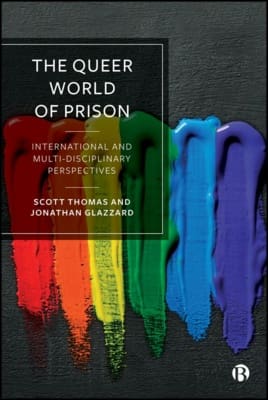 The Queer World of Prison by Scott Thomas and Jonathan Glazzard is available for £85.00 on the Bristol University Press website here.
Bristol University Press/Policy Press newsletter subscribers receive a 25% discount – sign up here.
Follow Transforming Society so we can let you know when new articles publish.
The views and opinions expressed on this blog site are solely those of the original blog post authors and other contributors. These views and opinions do not necessarily represent those of the Policy Press and/or any/all contributors to this site.
Image credit: CHUTTERSNAP via Unsplash