


We often think of vulnerability as weakness – but what if it’s the very thing that connects us all?
In this Transforming Business episode, Martin Parker speaks with Melissa Tyler, author of Organizing Vulnerability, about why we need to rethink vulnerability as a shared, deeply social condition shaped by inequality and interdependence.
From workplaces to the climate crisis, Tyler offers a powerful reimagining of vulnerability that opens pathways to solidarity, dignity and more just forms of organization.
Available to listen here, or on your favourite podcast platform:



Melissa Tyler is Professor of Work and Organization Studies at the University of Essex.
Scroll down for shownotes and transcript.
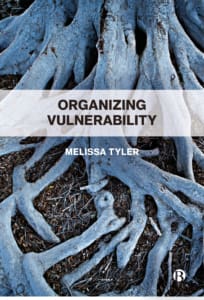 Organizing Vulnerability by Melissa Tyler is available for £27.99 on the Bristol University Press website.
Bristol University Press/Policy Press newsletter subscribers receive a 25% discount – sign up here.
Follow Transforming Society so we can let you know when new articles publish.
The views and opinions expressed on this blog site are solely those of the original blog post authors and other contributors. These views and opinions do not necessarily represent those of the Policy Press and/or any/all contributors to this site.
Image credit: Saad Chaudhry on Unsplash
SHOWNOTES
Timestamps:
0:47 – Can you tell us about the book that you’ve written?
4:38 – How is vulnerability unequally distributed?
5:47 – How do these ideas intersect with the world of work and organisations?
7:51 – How does vulnerability relate to your interest in artistic and creative work?
11:16 – What is the chapter ‘Existing: The Social Relations of Breathing’ about?
16:06 – What is the chapter ‘Enduring: The Social Relations of Grieving’ about?
20:57 – What is the chapter ‘Enacting: The Social Relations of Appearing’ about?
28:08 – How does this help us make workable lives?
Transcript:
(Please note this transcript is autogenerated and may have minor inaccuracies.)
Martin Parker: Hello. My name is Martin Parker, and I’m a professor at the University of Bristol Business School. And it’s my huge pleasure today to be interviewing Professor Melissa Tyler, who’s written a beautiful book for Bristol University Press called ‘Organizing Vulnerability’. Melissa is a professor at the business school at the University of Essex, and her research focuses largely on gender, feminist theory and the body in work and organisational settings.
She’s also written a lot of really interesting books before this on performing artists, on Soho, Judith Butler and everyday life, and I’ve been following Melissa’s work for many, many years and really happy to be talking to her about her latest book. So, Melissa, can we start with a cup of tea question really, which is could you tell our listeners a little bit about the book that you’ve written?
Melissa Tyler: Of course, thanks, Martin. It’s great to be here. Thank you. So there are more and more displaced people across the world. The rights and the resources that people need are becoming more and more inaccessible, especially for people who need them most, I’m thinking, you know, trans people, disabled people and gender nonconforming people. And the obligations that we have to each other as human beings, under the natural environment, are being increasingly threatened or undermined.
And so it just felt like a good time to be thinking about why it is that even in the wake of a global pandemic that you’ve written about, of course, and the moment of potential togetherness that COVID provided, and in the midst of an ongoing climate crisis and humanitarian crises and emergencies across the world, I’ve been trying to think about why it is that we can’t see our interdependence, but instead we kind of… We seem to be so fixated on shoring up the rights and resources and the recognition on which they depend that we can’t fully recognise how much we need each other in order to survive.
And so I wanted to sort of think about how and why it is that we live in the kind of world that teaches us to understand and to experience something like vulnerability, that we all share in common, entirely negatively. Our world is almost kind of vulnera-phobic, like we’ve come to fear vulnerability so much that we continually strive to overcome it.
And I try to reimagine what the world might be like if that wasn’t the case, and if vulnerability was actually something that, whether it’s how we live together, how we organise, or how we work together, that we actually embrace.
MP: The concept of vulnerability, for many people would be associated with a certain kind of softness, a kind of weakness or something like that. Wouldn’t it? Very often associated with, I mean, obviously in children and so on, but people who somehow don’t have enough fiber or spine or something like that, but you’re really trying to flip that in a sense, aren’t you? Trying to say that vulnerability is a social condition, not a pathology?
MT: I think that’s absolutely right on both of those points. So I think we’re absolutely surrounded by political language, by ideals, that frame vulnerability as a weakness, as a problem. It’s a kind of aberration. Something has gone wrong if we’re vulnerable. So it’s something we have to keep working to try and overcome. But the kind of interdependency of vulnerability is something that actually we all share in common.
It’s part of what it means to be human. Part of what it means to be actually not just human, but any kind of living being. We’re most vulnerable, obviously, at the very beginning and the very end of our lives. But that doesn’t mean that at that point in between, we’re completely invulnerable. We are dependent upon each other for our survival throughout our life course.
And at any point we could be more or less vulnerable. So we’re all vulnerable, but we’re not vulnerable in the same ways, of course, or to the same extent. So to say that vulnerability is ubiquitous, it’s something that we all share. It’s not, that’s not the same as arguing that it’s homogenous. We’re not vulnerable in the same way.
So if it’s part of what makes us human or makes us living beings, then it’s also of course, it’s also so socially situated and we need to sort of recognise that. And that means we need to recognise it reflexively that we are all vulnerable, but we’re not ever vulnerable in the same way or to the same extent.
MP: Could you talk a little bit more about the kind of unequal distribution of vulnerability, just to kind of clarify for our listeners what you mean by that? What are the dimensions of that inequality?
MT: If we share vulnerability as part of the human condition, as a kind of what we might broadly think of as an existential condition, we’re all vulnerable. But depending upon where we live, how we’re positioned, what kind of background we’re from, what kind of rights, resources and representation we have access to, then the degree and the nature and the extent of vulnerability that we experience is likely to be different.
So and that also, of course, evolves through the life course and Kat Riach in her book on working through aging, has written beautifully about this, about how vulnerability is something which evolves across the life course and is marked by different points and stages across the life course. So vulnerability is something that we share in common, but it’s also something which is shaped by how we are socially situated or positioned.
MP: And I guess this also intersects with organisation, which is you know a concept that both of us have had a lot of interest in over the years. So putting it very crudely, your argument would also be that people are, if you like, differentially vulnerable at work or in organised contexts. Could you talk a little bit more about that, about how these ideas intersect with the world of work and organisations?
MT: I think that’s absolutely right. I mean, of course, the degree of vulnerability that someone experiences depends very much on the degree to which they’re able to sustain their living to, to sustain a living, the extent to which their lives are workable. Are they able to have a relatively secure position within a labour market? And then within organisational life, are they protected by relevant employment rights?
Do they have a degree of representation, for example, through a trade union or depending upon, you know, what their role is within an organisation? Organisations play a really important part, I think, in shaping vulnerability. And we could think of vulnerability itself as the outcome of a process of organisation, which is partly how I’ve tried to think about it in the book.
So organisations, we could say, are the way in which vulnerability comes to be framed, but they also play a key role in perpetuating or accentuating, just making people’s vulnerable circumstances much worse, especially if they’re not able to earn enough through a secure income stream to sustain a living. But organisations also, let’s flip that around a bit. Organisations might also be, and organising, might also be a really valuable mechanism for tackling some of the worst excesses or extremes of vulnerability.
So vulnerability can also be the basis for solidarity and for political organising. So organisation, I think, plays a really interesting, complex role in how vulnerability is shaped and experienced.
MP: Yeah. So just very quickly explore one area, that I know you’ve been very interested in in the past, which is basically artistic and creative work of different kinds, which as you’ve documented, is very often shot through with all sorts of inequalities and precarities. Presumably your interest in vulnerability is either reflected in or comes from some of that interest in workers who, if you like, are very often floating in very vulnerable contexts.
MT: Yeah, I hadn’t really made that connection, actually with the work that we’re doing on freelance people and creative workers. That’s a really interesting connection. I hadn’t really started to think about how a lens of vulnerability might help us to sort of make sense of the way in which, say, people who work as artists, creative workers like musicians, performers, experience their work.
And actually, that’s a really interesting illustration of what I’m trying to think about in relation to vulnerability. So on the one hand, they are very… this group of workers are very socio economically precarious. You know, they work long hours, they earn, many of them – large proportions of them earn, below minimum wage in the UK.
They’re not protected by relevant legislation. While the new UK Employment Rights Bill is going to be really important to protecting some of the economy’s most precarious workers, anybody who’s self-employed or freelance won’t be covered by it. So actually, that gap will, if anything, widen. And people, people in the sort of self-employed and freelance group will become even more precarious.
Not less, relatively speaking. At the same time, people who work in something like performance or any kind of arts based area of work, they’re precarious in a range of other ways that relate to their socioeconomic vulnerability. So if you perform to an audience, you want your work to be recognised as entertaining, as artistically credible. So you also have this kind of what we might think of as a recognition based form of precarity, and that can make people feel very vulnerable in their work, especially when that’s compounded by them not being able to make a viable living from it.
So these things are all interconnected. And then, of course, if you work in an area in which, a sector of work in which, everybody knows everybody and you’re only as good as your last job, you don’t want to be the person who speaks up about the pay not being fair, or the hours being too long, or no one having access to sick pay when they’re ill and having to come into work when they’re ill or injured.
And so there’s also compounding the kind of socioeconomic vulnerability and the recognition based precarity, there’s also a reputational issue that makes people also feel very vulnerable. So actually, in that sense, vulnerability as it comes to be organised and experienced in the workplace is perhaps a useful lens to make sense of what people working say in the arts and the performing arts, especially experience in their work.
I hadn’t really thought about making those connections, but I think I will, I’ll explore that further. So thank you.
MP: That’s quite alright. That’s interesting, isn’t it? Because quite often when somebody else is looking at the kind of trajectory of your work, maybe they see connections that you don’t necessarily see when you’re in the middle of it. I’ve had other people do that to me in a variety of ways. Lets get onto the kind of the core of the book, because the kind of the center of it is explorations of three different relations, I suppose.
And you talk, you write a chapter on breathing, one on grieving and one on appearing. So can we fairly, can we sort of move through those in terms of the, the fertility of those metaphors, those ideas, but hopefully also give the reader some, some of the listeners, some idea of the kind of the richness of this text.
So let’s start off with the chapter that you called ‘Existing: The Social Relations of Breathing’. Can you just do a couple of minutes on that, what’s in that chapter?
MT: Yeah of course. Thank you. So breathing is clearly absolute fundamental to human life. We need access to breathable air for our cells to reproduce, for our vital organs to function and all of that. But, of course, as we became acutely aware during the COVID pandemic, and as we are now increasingly thinking about and recognising in relation to the climate crisis, when we breathe in, others breathe out. Now, whether that’s us as individuals or whether that’s us as actually whole nations producing huge amounts of toxic waste.
So sharing breath is what makes us vulnerable. But it’s both what, to go back to our earlier discussion. It’s what makes us mutually vulnerable, but it’s also what makes us vulnerable in different ways. So we all need to breathe and we need to breathe clean air. But if the COVID pandemic, ecological crises, racial and gendered violence, these things have all shown us that access to the right to breathable air isn’t evenly spread.
It’s organised. And this, again, is where organisation comes into play. It’s organised around axes of race, gender, social class, geography. So where a person lives and works shapes their access to clean air, obviously. So respiratory poverty has got a very long history. It remains, I think, the highest cause of preventable death in so many parts of the world.
The world’s most polluted country at the moment is Chad. And so in somewhere like Chad, we can see how the kind of intersections of the climate crisis and precarity and exposure all kind of intersect, these all connect, as we were talking about a few minutes ago. So, so breathing, I felt, was a very helpful way to think about how vulnerability is something that we share, but it’s something which we also share very differently.
But recognising this, and this is one of the things I try to talk about in the chapter. So recognising that we need access to clean air to breathe, but that we don’t share that need in common, we’re differentially situated in relation to that need, helps us, I think, to make sense of what vulnerability means as something which is shared but situated.
But it also potentially, once we start to recognise that can be the basis of political connection and action. And we saw much of that happening not just during the COVID pandemic, but since. So in India, for example, when the Indian health care system was on the point of collapse, there were kind of community banks that made oxygen tanks available to people, as many as they could, with what resources they had.
In Poland there were a couple, Jakub Kwiecinski and Dawid Mycek, who made and distributed rainbow face masks in a country which is, you know, extremely hostile to LGBTQ people. So we can also see this extreme precarity and vulnerability being recognised and mobilised as the basis of solidarity and community and connection, which I think is really interesting. And that’s what I try to write about in this chapter on breathing.
MP: It’s beautifully done, Melissa. And just in the kind of 2 or 3 minutes you were doing that, you were kind of moving from something which sounds like it’s about me and my body and my relationship to oxygen or something, to a really much more complicated relational account of both shared collective human embodiment and all of the inequalities that produces.
So you’ve kind of demonstrated there just the fertility of the way in which you’re using some of these concepts. Can we just spin to another one just to kind of see the process move in a different way? The next one was, you called the chapter ‘Enduring’, and it’s about social relations and grieving. So can you do a similar kind of line on that one?
MT: Of course I can, thank you. So grieving in commemoration is probably a theme that I’ve been interested in for much longer. And it’s, I’m working on another project at the moment with Daniela Pianezzi, who’s another Bristol University Press author, who’s written a beautiful book on ethics and embodiment. And her and I are both really interested in how vulnerability is played out in the relations of grieving and commemoration.
So on the one hand, the question of who gets to be grieved, who gets to be commemorated, and on what basis, really brings to the fore the process of organising. The question of who and what matters, like who is deemed to be somebody who has a life that counts, that you know that’s worth remembering, worth commemorating, and it might not be.
Again, going back to that discussion about breathing, we might be talking about individuals here, but we might also be talking about whole communities or even whole nations of people. It’s the key question of who has the right to endure, and on what basis, that I was trying to explore in this chapter. So, I mean, an obvious way of thinking about this, I guess, is if we sort of compare in our own minds mass unmarked graves in conflict zones or in the grounds of old Victorian asylums in the UK, or areas of real extreme poverty where there are no burial grounds for certain communities of people, for instance, to the kind of imposing, really monumental kind of mausoleum of historically significant, particularly military figures, but also cultural or political leaders.
In your mind, you can get this stark illustration of this comparison. So I was really interested in this chapter in thinking about the social relations of grievability, a little bit like breathing to help us make sense of how our shared but always also socially situated vulnerability plays out in ways that both completely negate the value, the existence of individuals or communities or nations of people.
But at the same time, it kind of opens up scope for actually reflecting on that and reaffirming, particularly retrospectively, that individuals or groups of people matter. And I think there are some lovely examples of that with kind of cemeteries and burial spaces and commemorative spaces where individuals or communities that have been forgotten, negated, almost, you know, attempts to completely erase their existence from history have actually been reclaimed.
In Colchester, actually near where I live, I didn’t write about this in the book, but there’s a beautiful rose garden, which is a memorial garden for witches, women and men, but predominantly women, who were accused of witchcraft during the notorious witch trials in this part of the country in Essex and Matthew Hopkins, the witch finder general was based in Manningtree, very near where we live and work.
So actually, to see a space like that, which is very much about a retrospective recognition that people’s lives mattered and that what happened to them was unethical and needs in some way to be acknowledged and somehow atoned for. I think it’s an interesting, again, an interesting way of exploring how these relations of vulnerability play out in, on the one hand, marginalisation and negation, and on the other hand, in actually recognising, affirming and atoning for what happens to people when they are, or their families are told that their lives just don’t matter.
MP: Yeah. It’s nice. I mean, again, I was just thinking about the kind of the structure of the argument really, in terms of this idea that if we begin with vulnerability, with, you know, our inevitable mortality or something like that, which is a kind of a sort of collective human condition assertion, isn’t that? But then, as with the previous example, you kind of demonstrate and talk very beautifully about the way in which those forms of memory or commemoration are very unequally distributed, again, aren’t they?
So we’re starting with something which appears to be universal and ending up with something which is very divided, very particular. Just spin on and do the last one, if we may, the last of the kind of the sort of the triptych that is at the heart of the book and you call this one ‘Enacting: The Social Relations of Appearing’.
And this is primarily about vision, about being seen in different ways. So could you talk a little bit about that, Melissa?
MT: Yeah, of course, thank you. So this is the one that was probably, I think in the book, the most speculative. And for that reason, it’s probably the one that I enjoyed working on the most because I was exploring the ideas. I was writing them on paper, which, you know, is always fun, especially if you’re working on a book and it’s the one would like to try and go on and do more with.
So I think basically I’ve tried to think about staring and looking and appearing as three distinct and kind of related aspects of what we might very broadly call an ocular centric, like a vision dominated condition that shapes our social landscape, I suppose, our social and cultural landscape, but of course, also our economic landscape, because this is I’m talking about ideas here that very much dominate the labour market and people’s experiences of employability, for instance.
So what I’ve been trying to think about, particularly in relation to appearing, is that part of the human condition, part of our shared vulnerability, is that we need to appear to one another in public space, and that need is shaped by certain ideals and expectations that make people more or less vulnerable. So that’s the basic premise of the chapter, I guess.
So I was drawing from political philosopher Hannah Arendt, and one of the things that she’s written about that I find really intriguing in her book, ‘The Human Condition’, is that, as she puts it, and I’m paraphrasing here very badly, but she says, basically, we appear in the world we appear to each other when we’re born. There is the naked fact of our appearance.
We come to exist, and that means that we need something from other people. We need other people to sustain us. So we make our entrance into the world. But Arendt doesn’t argue that we then somehow just grow out of that, her point is precisely that we need one another actually throughout our whole lives, to be able to continue with our existence, to make our lives workable.
So to borrow from Arendt, and if this won’t, this mental image won’t upset listeners too much. We are all always naked to one another, and that’s a kind of political position that we occupy. So I try to think about what that means for vulnerability and for how vulnerability comes to be organised, I guess. So I thought about it first of all, in relation to staring.
So staring organises our need to be kind of recognised as a valid, viable person who has the right to be treated with dignity, respect, to access, resources and so on. So staring organises that need in ways that make some people obviously much more vulnerable than others. Some people’s agency, their ability to kind of lead an independent, not an independent life, but lead a livable life, let’s say, is completely undermined, they become subject to kind of a process of objectification.
And so in this sense, I try to think about staring in the chapter as a form of intersubjective violence. And then I explored, I think a bit more tentatively to be fair, looking. And so I thought about looking not as the inverse of staring, but as a kind of parallel or corollary form of control. So one that almost commands or compels attention.
So whereas staring is kind of an objectification process directed at other people, I always thought about looking as an objectification process which is directed at the self. So I was thinking about like selfie culture and things like that, that I thought about almost as a kind of ethical disposition. And then that led me to explore a third way of occupying public space and of appearing to one another and to think this idea through
I drew much more directly from Hannah Arendt, and she writes about what she calls the space of appearance. By this she means the public sphere that we occupy, in which we all appear to one another in ways that we can recognise one another, treat one another with dignity and respect. And she sees this very much as the basis for, on the one hand, our vulnerability and exposure but also, because we are all vulnerable and exposed to one another and need to find ways to live together, as the basis for solidarity.
So that led me to look at, what I think anyway are, some lovely examples in the chapter, not my work, other people’s work that they’ve been kind and generous enough to let me draw from, but particularly work by disability activist and artist, Alison Lapper. And she collaborated with sculptor Mark Quinn on a piece of work that was displayed in Trafalgar Square on the fourth plinth there in 2005, called Alison Lapper Pregnant.
And it’s just the most beautiful image of disability, maternity, natality and what actually Hannah Arendt writes about, which is the political hope attached to new beginnings. And I don’t mean this in an existential way in the sense that she was pregnant. But what Alison Lapper was trying to say was, here I am proudly existing and being in my disabled body as a pregnant woman, in my determination to have and care for this person, and displaying that in public in a way that she really hoped would inspire a sense of connection, commonality and solidarity in others.
An incredibly brave and beautiful piece of work, and there’s some more recent work which does similar things that’s on the fourth plinth at the moment by Mexican artist Teresa Margolles. So I was sort of led really to look at other people’s work, where I think they’ve started to pave the way for what I was trying to explore as a relationship between vulnerability and appearance in the public sphere.
MP: Yeah, beautiful. I mean, as ever you’re demonstrating just the sheer variety of resources that you’re pulling together in order to make these kinds of arguments. And that, for me, is quite inspiring. I think, you know, you’ve always had this fantastic ability to go to interesting things and say interesting things about them. And I think that’s marvellous.
MT: That’s so kind, thank you. For someone who’s made their entire career out of doing just that, that’s very kind, thank you.
MP: No, but it might confuse some of our listeners, I guess because you’re a business school professor. Right. So, you know, how does this dizzying fireworks variety of different arguments then apply to the world of work, to what you call making workable lives? Could you say a little bit about and almost kind of try and bring this home to the sort of the context that you and I work and teach in?
MT: Yeah. Of course. I mean, I think we’ve both been extremely lucky in the sense that we work in business school environments that are very social scientific. They draw from the arts, the humanities, philosophy and so on. So there is a wonderful and very eclectic set of ideas, resources that we can draw from in making sense of the world of work and organisation.
But the kinds of examples that I’ve tried to look at in this book for me demonstrate how vulnerability is both about understanding and organising our lives for and not in opposition to our shared, but always socially situated interdependency at the same time as trying to maintain in ourselves as researchers and nurturing others, as educators, as colleagues, collaborators, activists.
A reflexive awareness that while we are all vulnerable, we are never equally so. So I’ve been trying to think about vulnerability, and I try to do this a bit more towards the end of the book as the basis of solidarity. And I see work and organisation very much as part of that, and that helps us to explore how we might think about what it means to lead a workable life beyond daily struggles for existence, which we might say, might think of as the kind of extreme of vulnerability where your entire life, everything you do, how you organise yourself and your family, the work that you do is just about trying to live from day to day.
How can we get beyond that, recognising that we are all, we all share vulnerability, but we do that in a very situated way, with some being more vulnerable than others. In a way, how can we move towards modes of work and organisation that help more people, more of the time to produce things which have lasting value beyond their immediate survival, not just in the form of tangible things like goods and services, but also networks of solidarity, relationality, and so on.
And so I think that the work that we do in business schools has a really important role to play in trying to build capacity and remember, the word vulnerability comes from the Latin term for our capacity to be wounded. We all share a capacity to be wounded. But that is a capacity. It’s an ability. And if we recognise that we share a capacity to be wounded, that we are vulnerable in perpetuity, but also in different social situations, then thinking about how that might be translated into making lives more workable for more people, more of the time, i.e. more doable, more malleable, more functional, able to adapt to extreme changes like natural disasters or changes in the economy or circumstances.
That seems to me to be a really key element of the work that we’re doing in business schools right now. Amidst a global climate crisis, multiple and ongoing humanitarian crises. The question becomes not just how can we understand these, but what can we do about them? That’s actually a meaningful contribution.
And there is so much that we can pinpoint to and learn from. There’s a fabulous example of actually the work that just one woman started, a trans refugee from Myanmar, a woman called Tanya, who set up a beauty salon in Cox’s Bazar, Kutupalong in Bangladesh. It’s the world’s largest refugee camp. And she set up a beauty salon, a gender inclusive beauty salon where people come to get their hair washed and trimmed, their nails done.
But it’s much more than that. It’s about people connecting in and through their body, but it’s a point of contact. It’s a way to get information, to learn how to access resources, legal advice. It’s a way to share child care. It’s a way to share basic health care for one another. It’s just the most incredible setting. And this is what she does.
It’s her work. She employs and trains other people. It’s a mode of organisation. And so for me, it’s a way of thinking about what role organisations can and arguably should play and what role we can play working in business schools as researchers and teachers and so on, to learn from, support, feed into these kinds of modes of organising for and with vulnerability as acts of solidarity.
So I think there’s so much that we can learn, so much that we can contribute.
MP: That’s great. And that’s a really nice place to end. Thanks ever so much, Melissa. And I think you just demonstrated well, a couple of things. One about just what an interesting thinker you are in terms of the ways that you pull together a whole range of different stuff, but also towards the end, something about the kind of the possibilities for, you know, a school of business and for talking about the ways in which we might organise differently and so on.
So it’s been my huge pleasure to be talking to Melissa Tyler from the University of Essex about her book ‘Organizing Vulnerability’, published by Bristol University Press, in our Transforming Business series. Thanks ever so much, Melissa, for spending some time with us, and I hope our listeners got something from the conversation. Thank you very much.
MT: Thank you so much, Martin. Thank you so much. It’s been a real pleasure to be in conversation with you. Thank you.
MP: Thank you.
Richard Kemp: Thanks so much for listening to this episode of the Transforming Society podcast. If you’d like to buy a copy of this book or any other book published by Bristol University Press or Policy Press, we have a 50% discount code valid until the 30th of June. Just go to bristoluniversitypress.co.uk, select your book and then enter POD02 at checkout. That’s POD02 at checkout.