


The digital revolution was supposed to make everyone’s lives better. Smart, networked technologies were going to supersede dirty, fossil-fuelled ones while massively boosting productivity, democracy and creativity. Yet over 25 years into the 21st century, this isn’t the digital society we inhabit.
Digital technologies require immense volumes of ecologically damaging mineral extraction, a plethora of energetically and chemically intensive manufacturing processes and enormous volumes of electricity to operate, while creating mountains of toxic waste throughout every stage in their lifecycles.
Moreover, although digital technologies were expected to strengthen democracy and broaden prosperity, their popularisation has been accompanied by burgeoning right-wing populism and authoritarianism, alongside ever-accelerating transfers of wealth towards the global rich. Meanwhile, despite decades of knowledge about climate change, global fossil fuel use keeps rising.
This direction of travel was not and is not inevitable.
Digital technologies reflect the capitalist socioeconomic systems under which they have developed. They enrich billionaires while promoting competitive individualism and quantified selves, and relentlessly conduct dataveillance to accelerate a production/consumption cycle whose scale and speed generates ecological crises and systematically externalises harm onto ecosystems and populations left out of financial calculations.
Capitalism and toxic abundance
Capitalism fundamentally requires growth. Historically, the liberal justification for this has centred on social problems that relate to scarcity of food, water, healthcare, education and infrastructure. Importantly, many of the problems we face today don’t relate to scarcity.
Climate change doesn’t arise from burning too few fossil fuels. There isn’t a scarcity of species extinctions, or a lack of microplastics, pollution or deforestation. Neither are we struggling with too little spam, not enough misinformation, online fraud or anxiety inducing digital advertising.
Abundant harms aren’t desirable, but we have a capitalist socioeconomic system which materially rewards ecocidal overproduction, while generating such spectacular levels of inequality that billions can’t meet their basic needs; it’s a fundamentally broken system.
This is why insights from postgrowth and degrowth approaches are so important for constructing equitable and sustainable futures.
Reorienting technology
A postgrowth future centres redistribution, building equitable and resilient communities while enhancing human wellbeing and ecological sustainability. Applied to digital technology, this means questioning the assumption that more devices, more data, bigger AI models, faster networks and constant hardware upgrades equate to progress.
Mainstream digital solutions are designed for growth; they stimulate overconsumption among the global rich, lock users into predatory subscription systems and manufacture disposable and toxic devices.
Even so-called ‘green’ digital solutions frequently fall prey to rebound effects. While corporations celebrate efficiency as an environmental achievement, it spurs greater consumption and ultimately increases total resource and energy use alongside corporate profits.
Similarly, ‘circular economy’ strategies based on growth fail to recognise that ecosystems are sustainable precisely because they don’t require compound growth. Indeed a ‘circle’ that grows is a spiral, not a circle, which invokes a very different geometrical metaphor.
Convivial computing and digital decommodification
A postgrowth digital future means enacting a series of principles drawn from postgrowth and degrowth approaches around conviviality, limits, decommodification and radical abundance. This means detoxifying production, legislating for longevity and enforcing interoperability. It means prioritising durability over disposability, repairability over replacement, and modularity over closed corporate ecosystems. Energy and material use must be minimised by design.
This would mean limiting some of the most obviously harmful digital tools and strategies we have now – things like bitcoin, planned obsolescence, NFTs and much of the current AI boom that will use more electricity than Japan does within a few years’ time.
While a postgrowth digital future means reducing ecological harms to live within planetary boundaries, it also needs a vision for social flourishing based on radical digital abundance, conviviality and decommodification.
This means leveraging the affordances of software to provide universal access to tools for communication, creativity and social organising, using the successful model of Free, Libre and Open Source Software (FLOSS) as a template that builds commons and empowers communities while respecting data sovereignty.
Digital infrastructures should be decommodified, so they serve public needs rather than shareholder returns. Digital technologies should strengthen local autonomy and democratic control, not centralise power in monopolistic platforms.
Currently, most attention goes towards hyperscale corporate practices, with the remainder focused on individualistic models around self-hosting. A postgrowth future instead asks what community-centred tech would involve, and how this could bring people together instead of atomising them or fostering dependencies on Big Tech.
Commons, cooperatives and community tech
These practices are present in a nascent form in various projects, from platform cooperative alternatives to Uber, to federated social media such as Mastodon, local repair cafés, and the employment of FLOSS in community tech projects across the world.
However, a postgrowth future involves these projects going from the margins of digital culture to replacing the model of venture capital–funded Big Tech.
This requires support from states that harness economic power to construct a public service internet with universal broadband access, publicly owned transmission networks and localised, detoxified production processes, and community-operated solar powered micro-datacentres based in schools, libraries and other existing public infrastructures.
Towards a postgrowth digital future
A postgrowth future isn’t anti-technology, anti-digital or anti-progress. It asks us to take seriously the scientific evidence that seven of nine planetary boundaries have been overshot, and to recognise that this will have catastrophic societal impacts if radical action isn’t taken.
Whereas business-as-usual approaches hope technological solutions will allow globalised capitalism to endure while little meaningfully changes, a postgrowth digital future demands changing social and technological relationships to make people’s lives fairer, more enjoyable, more equitable and more sustainable.
Sy Taffel is Senior Lecturer in Media Studies and co-director of the Political Ecology Research Centre at Massey University, Aotearoa-New Zealand.
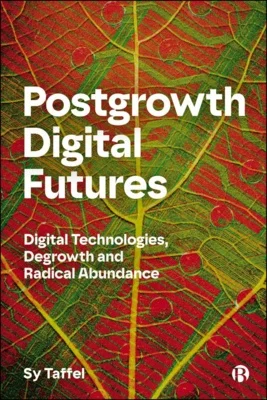 Postgrowth Digital Futures by Sy Taffel is available on Bristol University Press for £22.99. You can also request access to the eBook on Bristol University Press Digital via your institution’s library.
Bristol University Press/Policy Press newsletter subscribers receive a 25% discount – sign up here.
Follow Transforming Society so we can let you know when new articles publish.
The views and opinions expressed on this blog site are solely those of the original blog post authors and other contributors. These views and opinions do not necessarily represent those of the Policy Press and/or any/all contributors to this site.
Image credit: Stacy via Unsplash