


Aaron Martin, author of The Trust Gap, argues that the perceived “crisis of trust” is overstated: while public trust in politicians is often low, survey data shows that many people continue to have confidence in institutions such as universities, the courts, the police, and scientific experts.
Some ideas become so familiar that we rarely stop to question them.
One of these is the belief that established democracies are facing a “crisis of trust”. But what is the nature of this crisis, and how deep does it run?
This question lies at the heart of my recent book, The Trust Gap: Where Distrust Is a Problem, Where It’s Not, and Why That Matters. Drawing on decades of survey data collected around the world, I examine the precise nature of the trust crisis. In doing so, I discovered a far more nuanced (and hopeful) story than the headlines suggest.
It is certainly true that politicians are not trusted. They never really have been. But the focus on politicians can be deceiving. What if we broadened our focus to look at trust in other institutions – the media, universities, the police, the courts, and the armed forces?
First, the bad news. Citizens across established democracies tend to have low levels of trust in the media, churches and major companies. This is perhaps not so surprising given how these institutions have been mired in scandal in recent years.
But what about the good news? While there are institutions that citizens don’t trust, there are many that they do. We just don’t tend to pay much attention to them.
Overwhelming majorities in almost every country trust institutions such as universities, the police, the courts and the armed forces. Crucially, the best over-time data we have shows that confidence in these institutions has remained broadly stable, and in some cases risen. Furthermore, the data continues to show that most people in most countries trust not only scientists, but experts – ranging from engineers to doctors – as well.
One of the problems with the “crisis of trust” narrative is that everything is lumped together. In the process, we are led to believe that trust is declining everywhere, and in everything. Citizens may distrust politicians, but it does not mean they distrust all institutions and forms of expertise. The gap between political and institutional trust – one of several ‘trust gaps’ I examine in my book – helps us understand this.
Why does this matter? Democracy depends on politicians acting honestly and competently. But they are not the only game in town. Democracy also relies on law and order being maintained by the police, the courts punishing crime, and universities producing both skilled graduates and essential knowledge in a variety of fields.
While commentators tend to focus on the negative side of the equation, they miss some essential parts of the story. Examining data not only on trust in politicians, but institutions more generally, reveals that many citizens continue to trust many institutions and forms of expertise. And we should not forget how essential these institutions and expertise are to the daily functioning of democratic societies.
All of this might strike readers as a slightly odd argument to make, given our times. But I am neither the only, nor the first, to make this point. One of the leading scholars of public opinion, Professor Larry Bartels, has written about how conventional wisdom is starkly at odds with survey data on trust. Professor Pippa Norris from Harvard University has suggested that ‘the crisis myth, while fashionable, exaggerates the extent of political disaffection and too often falls into the dangers of fact-free hyperbole’.
Distrust is often depicted as a slow-moving wave that is washing across established democracies. But this is not a particularly helpful way to think about trust. It is far more nuanced than this. In fact, a more fine-grained reading of the data shows that the “crisis of trust” narrative rests on surprisingly weak empirical foundations.
Aaron Martin is an Associate Professor in the School of Social and Political Sciences, University of Melbourne.
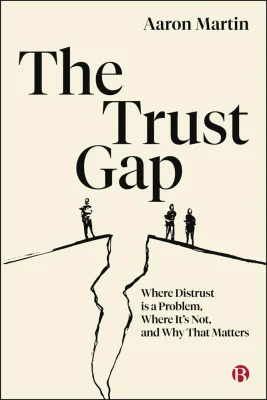 The Trust Gap by Aaron Martin is available on Bristol University Press for £19.99 here.
Image credit: The Mountain Bird Studio