


On the eve of the deadline for EU Member States to incorporate the Right to Repair Directive into national law, Declan Murray, author of The Repair Mindset, asks whether legislation is necessary for repairing electrical and electronic devices to flourish.
Wilson fixes electrical and electronic devices in Kenya. He started out in the early 2000s repairing cathode-ray tube televisions (TVs) – the ones with the curved screens and bulbous backs – and radios with extendable aerials. Over time, the TVs got flatter and digital video disc (DVD) players came in. When I spent three months training under Wilson as an apprentice, we received an increasing number of portable solar-powered lanterns and home systems.
Small-scale, standalone solar products to light homes and charge mobile phones have boomed across Africa and parts of South Asia over the last couple of decades. This surge, due in large part to a World Bank project called Lighting Global – which sought to support manufacturers with market-sensitisation activities and reassure investors with a quality assurance programme – has seen some 260 million of these products introduced globally, mostly to rural areas.
The question that drove the research which became my book, The Repair Mindset, was: what happens to these products when they break?
It was this question that led me to Wilson’s two-by-two-metre squared repair shop in Kenya’s Rift Valley.
The repair mindset
During my apprenticeship with Wilson, I came to appreciate some core principles in his work: he rarely uses new spare parts. Wilson and his colleague, Hesbon, have a steady stream of products coming into their shop so there is always another radio/mobile phone/woofer within arm’s reach that can be used as a source of a replacement part.
Wilson and Hesbon never consult repair manuals, at least not written or published ones. Instead, they refer to their experience, and work in a process of trial and error to diagnose and resolve the issue in tandem. If information is sought, it is from a colleague over the phone or in person.
Finally, Wilson and Hesbon, unlike the manufacturers I also observed during my research, do not particularly care what a product looks like. Function, even if reduced, is prioritised over form.
In my book, I refer to these principles as ‘the repair mindset’.
Meanwhile in Europe
Two years ago, in Brussels, the European Council approved Directive 1779 on ‘common rules promoting the repair of goods’. At the end of this month, the Directive comes into force: by 31 July all member states are obliged to have transposed the Right to Repair Directive into national law.
The Directive requires that manufacturers of common household products, such as washing machines, vacuum cleaners and smartphones, repair products within a reasonable time and at a reasonable price and provide repair information to consumers. Member States have to take at least one measure promoting repair in their country, in addition to managing an online portal of repair providers for consumers to find repair services. Finally, the Directive extends the legal guarantee on products for an additional year, should a consumer choose to repair a product rather than replace it.
Although many of the solar products I handled in Wilson’s shop are made by European companies, they are not covered by the Right to Repair Directive; solar products do not appear in the annex of goods to which the Directive applies. My question here is if they should be. Does Kenya also need a right to repair?
Whose right?
The Right to Repair Directive, and the wider civil movement which has contributed to this move by the EU, is motivated by a desire for more sustainable consumption: less waste, less resource use, less energy demand, fewer greenhouse gas emissions. These are, of course, important things to aim for.
However, extending right-to-repair legislation to solar products or introducing similar rules to the African Union or East African Community could actually make Wilson’s job harder. Facilitating the repair sector, as the Directive aims to do, could create more jobs like Wilson’s, perhaps creating new competition for his services. Or it could mean that more people pursue official, manufacturer-performed, repair – again, Wilson’s customer base could fall.
The right to repair, as modelled by the European Union, is a consumer right. The Directive, implemented nationally by Member States, looks promising for consumer budgets and also for environmental indicators. It might also benefit the professional repair industry with greater custom and better recognition.
The key message from my research is that regardless of the design of products, the availability of spare parts or indeed the legislative context, repair will persist. There has always been, in all societies, a practice of taking something, doing something to it and returning it to use. The logic of repair is antithetical to that of consumption. Yes, repair can be a business, but first of all, it is a mindset.
Declan Murray is a Research Associate in the Department of Social Anthropology at the University of Manchester. He previously worked as a consultant in the off-grid solar industry.
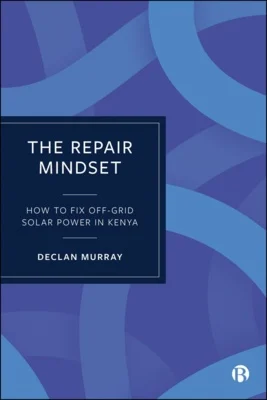 The Repair Mindset by Declan Murray is available to read open access on Bristol University Press Digital here or available to buy on Bristol University Press for £27.99 here.
Image credit: Samsung Memory via Unsplash