


Luke Moffett, author of Algorithms of War, discusses how the growing use of AI on the battlefield is reshaping the way life-and-death decisions are made, risking dehumanising civilians by reducing them to data points.
On the 6th July 2026 Ukrainian civilians were running to take shelter from another incoming Russian drone attack. Unknown to the civilians in Zaporizhzhia, this group of drones was completely beyond the control of its operators, using instead newly developed AI algorithms to guide it to its target.
The drones were trained on data to target fuel canisters, which had been identified near a petrol station. However, one drone miscalculated its flight path and exploded near where Tetiana Bubynets (19), Oleksiy Svirin (41) and Roman Karpiy (48) were running for shelter, killing them all. This is the first reported case of lethal autonomous weapons systems or killer robots being used against civilians.
While the civilians were not the target, treating all fuel canisters as targets likely amounts to a war crime. The drone strike comes as the United Nations and International Committee of the Red Cross warned that we are ‘now dangerously close to crossing a moral red line: the autonomous targeting of humans by machines.’ At the start of September 2026 over 70 states indicated their support to move forward negotiations on a treaty to prohibit killer robots ahead of the Convention on Certain Conventional Weapons review conference in Geneva this November.
Warnings of the threat of AI are not new. Yet this month, developers and leaders of leading AI companies have been sounding the warning bells on the threats that AI poses to humanity.
AI developer Jacob Coxon resigned from Anthropic, having previously worked for the other AI giant OpenAI (ChatGPT), warning that neither ‘company is acting responsibility…[and are] gambling with our lives… The people building AI earnestly believe that it could kills us all by the end of the decade.’
This was followed by the head of Anthropic Dario Amodei, calling for AI development to slow down, to be monitored independently and better regulated globally, with Sam Altman of OpenAI and Elon Musk of Grok agreeing with him.
Though others like Meta CEO Mark Zuckerberg and NVidia CEO Jensen Huang have played down such risks, and suggested that AI companies are best placed to regulate the dangers and ensure trust.
The threat of AI is no longer the stuff of science fiction or theoretical. AI is increasingly being integrated into military operations, and something that companies or states cannot be trusted to self-govern.
In Gaza, the Israeli Defence Forces used an AI-assisted targeting system known as Lavender, which reportedly generated a database of some 37,000 potential human targets and, according to Israeli intelligence sources, operated under “collateral damage” ratios that tolerated significant civilian deaths for a single strike on a senior militant.
The United States has likewise integrated AI into its own military operations using it to identify targets faster, fuse intelligence feeds, and support logistics such as supply chains and vehicle maintenance scheduling. It has also used one of its AI systems, Maven Smart Systems, to help generate targets (over 1,000 per day), resulting in more targets being bombed in the first 100 hours than the US-led coalition against ISIS did in more than six months.
Rather than the emerging risk of killer robots, it is the use of AI in decision-making on strikes that has proved the most controversial and deadly for civilians. The strike on a girls’ school in Minab, Iran, on 28 February 2026, which killed more than 156 people, most of them children, in the opening hours of the US-Israeli operation against Iran, underscored how AI-accelerated targeting is only as good as the intelligence data feeding it. A subsequent US inquiry found the school had been struck because it remained flagged as part of an adjacent military compound it had in fact been separated from years earlier, with officials citing outdated targeting data rather than a fault in the technology itself.
The United Nations Fact-Finding Mission on Iran has recently found that such target of the Minab school likely amounts to a war crime, on the basis that the US did not do everything feasible to verify it was a lawful military objective it could target. Using AI in military operations to provide greater perception and certainty of the battlefield at speed and scale, does not mean that sufficient human judgment and understanding of legal obligations is complied with. An AI system is just a tool, it is up to humans how they legally and morally use it.
This is not the first time the US has used AI in military operations. At the start of the year saw Anthropic’s own Claude model used in the brief US war against Venezuela, resulting in the capture of former Venezuelan president Nicolás Maduro in Caracas in January 2026. This was despite Anthropic’s usage policies explicitly prohibiting Claude’s use to facilitate violence or develop weapons.
In early September Anthropic released its latest AI misuse report a range of examples over the past year on how its AI platforms have been maliciously used. This report is intended to highlight the risks of AI and the need for states to regulate it to prevent worse future misuse.
Beyond the headlines of AI will ‘kill us all’ in the next decade, the Anthropic report outlines a range of examples of state and private individuals weaponising large language models like Claude to violate human rights – whether from Chinese efforts to improve surveillance, Iranian actors using it to develop a target list of US naval bases in the Middle East, private individuals trying to make viruses more deadly, to Yemeni Houthi rebels designing advanced missile technology and testing it – all point to the danger of AI in uplifting the scale and devastating effects of violence by malicious actors.
Anthropic said it disrupted every operation described in the report. Although there are likely similar experiences occurring with other AI providers, they are not being as transparent or monitoring malicious usage.
These developments point to a broader question: how the growing use of AI on the battlefield is reshaping the way life-and-death decisions are made. It is a question I examine in my forthcoming book, Algorithms of War. Yet AI use in attacks risks dehumanising civilians and other protected persons by reducing them to data points and part of calculations in algorithms that cannot abide by rules or is not being sufficiently regulated.
As states gather in Geneva this November to decide whether over a decade of talk on a treaty to prohibit autonomous weapons finally becomes binding law, the question is no longer whether machines are making life-and-death decisions in war. It is whether states can agree to outlaw and regulate the clear and present danger AI has on the battlefield before it is too late.
Luke Moffett is Professor of Human Rights and International Humanitarian Law at the School of Law, Queen’s University, Belfast.
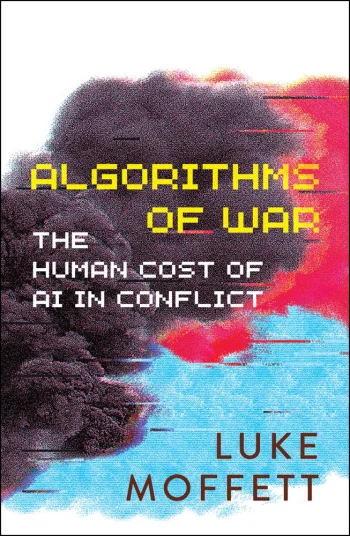 Algorithms of War by Luke Moffett is available to buy on Bristol University Press or £19.99 here.
Bristol University Press/Policy Press newsletter subscribers receive a 25% discount – sign up here.
Follow Transforming Society so we can let you know when new articles publish.
The views and opinions expressed on this blog site are solely those of the original blog post authors and other contributors.
These views and opinions do not necessarily represent those of the Policy Press and/or any/all contributors to this site.
Image credit: Nathan Kuczmarski via Unsplash