


What if effective leadership were not only about developing better leaders, but also about designing organisations that make collaboration possible? The authors of How to Succeed at Collaborative Research explore how ‘collaboration by design’ can help organisations harness distributed expertise to address complex challenges.
As we enter a world of thorny problems such as climate change and globally relevant healthcare, we see a shift towards collaborative teams that are often distributed over geography, disciplines and institutions. Leadership in these environments is more complex. It requires collaboration among leaders, administrators, legal counsel and others whose expertise and authority shape what is possible.
So how might we define leadership for today’s changing world?
For over 125 years, academic literature on leadership has emphasised what leaders do. Early descriptions of authority evolved towards influence, motivation and trust. Assertive decision making was tempered by attention to vision, inclusion and social transformation strategies. More recently, flexibility, self-awareness and authenticity are receiving focus.
Perhaps the next evolution of leadership will be less about developing another set of leader behaviours or key characteristics, and more about enabling collaboration. That is, creating the conditions in which people can contribute their knowledge, capabilities and perspectives to collective work.
This idea is not new.
Taken together, these bodies of work suggest that collective action depends on both the capabilities of individuals and the conditions that permit those capabilities to surface and be integrated.
Yet the implications for how we design organisations for effective collaboration remain less fully explored. We have become increasingly sophisticated about individual leader behaviours. Perhaps we need to become equally sophisticated about the environments in which leadership is not concentrated in a single person.
The challenge is not to replace individual leadership. Instead, it is to expand our understanding of where leadership resides and to make it possible for many team members to exercise it.
The question therefore becomes: how might leaders intentionally design organisational structures that surface, integrate and strengthen human capability so that collaborative efforts can solve society’s most complex challenges?
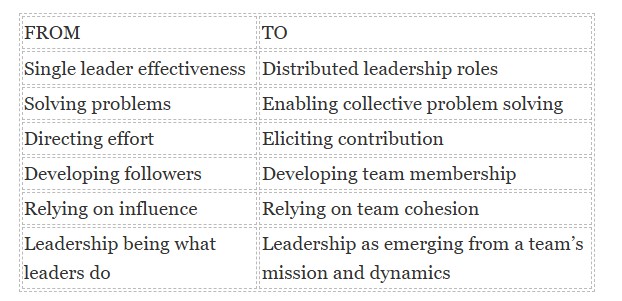
One way to think about this shift is as a move from individual-focused leadership to collaboration by design:
Intentionally designing a collaborative culture at the organisational level permits it to evolve with the institution and endure beyond the life of a single project.
In a global era of constrained resources, there is every advantage in developing initiatives that are impactful and sustainable. Leadership in this context designs for the long term and represents a shift from focus on the individual to focus on the collective.
This adjustment from individual-focused leadership to collaboration by design has implications for how leaders build and sustain collaborative cultures.
What does collaboration by design look like in practice? It means creating organisational conditions in which people can contribute, connect, learn and adapt. Seven principles can help shape those conditions:
- Enabling contribution is paramount, supported by governance and by structures such as a collaboration agreement
- Capability and talent are valued, varied and distributed
- Relationships are intentionally built at all levels
- Shared understanding is established before action is taken
- Categories of failure are permitted, discussed and recorded
- Decisions are contextualised, and leadership remains dynamic
- AI use is transparent and evolving
Putting these principles into practice requires more than simply asking people to work together better. It necessitates active listening and attention to individual strengths in order to provide opportunities for team integration and continued development. It means creating cross-disciplinary opportunities for people to build relationships, identify common interests and make new connections.
Through dialogue and governance (including policies on the use of collaboration agreements), organisations can develop and sustain conditions for knowledge production that extend beyond what any individual leader could do alone.
People are more likely to contribute meaningfully when they feel heard, and their offers are accepted, or at least discussed in a safe knowledge-sharing environment. Feedback, iteration and recognition strengthen willingness to contribute. Over time, these practices become embedded in organisational culture, enabling reflection, revision and continued learning.
This does not mean that individual leadership, authority or decisive action are no longer important. There will always be a need for someone to make a decision, take responsibility, delegate or provide guidance.
In complex, distributed environments, these behaviours are only part of the picture. The greater leadership challenge may be to design the conditions in which people can thrive collaboratively, and exercise their expertise, judgement, creativity and responsibility together.
The opportunity before us is to design organisations that make better leadership possible. This will surface and strengthen the distributed human capability needed to address the complex challenges before us today.
L. Michelle Bennett empowers teams and organizations through collaborative experiences that transform ideas into impact at L.M. Bennett Consulting.
Howard Gadlin is currently Consulting Ombudsman to Harvard Medical School, having previously served as Ombudsman and Director of the Center for Cooperative Resolution at the National Institutes of Health, US.
Sawsan Khuri creates synergies and catalyses collaborative innovation at Collaborative Capacities and is a Senior Lecturer at the University of Exeter Medical School.
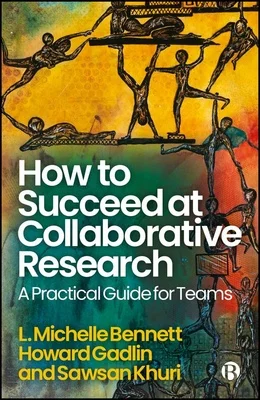 How to Succeed at Collaborative Research by L. Michelle Bennett, Howard Gadlin and Sawsan Khuri is available to buy on Bristol University Press for £22.99 here.
Bristol University Press/Policy Press newsletter subscribers receive a 25% discount – sign up here.
Follow Transforming Society so we can let you know when new articles publish.
The views and opinions expressed on this blog site are solely those of the original blog post authors and other contributors.
These views and opinions do not necessarily represent those of the Policy Press and/or any/all contributors to this site.
Image credit: Alina Grubnyak via Unsplash