


Sally Wyatt, editor of Hostility by Design, explores how technologies designed to solve problems can also reinforce inequalities, undermine local knowledge and create lasting harm to people and the environment.
Benches with armrests, spikes in doorways and under bridges, sloping windowsills. These increasingly common features of the built environment are placed deliberately by local councils, property developers or public transport authorities to prevent people, particularly people without homes, from lying down or getting too comfortable.
Once aware of these efforts to use design and architecture to make life difficult for some people, you see them everywhere. These are not the only examples of technologies purposefully developed and used to exclude people. Carefully placed rocks are used to deter people from skateboarding, sleeping and parking their cars. Spikes on buildings prevent birds from nesting. Nor is this particularly new. Gates, fences and walls, with or without barbed or electrified wire, have long been used to mark which people and animals are allowed in and which not.
Many other things are hostile by design, most obviously weapons of all shapes and sizes, whether they are handguns or atomic bombs. Other objects and systems may become dangerous, through lack of repair and maintenance, such as frayed electricity wires and potholes in streets. And others are more or less inadvertently hostile, such as the dosages of medicines only tested on young men which could result in dangerous outcomes for children, older people, trans people and women.
Our forthcoming edited collection explores less obvious forms of ‘hostility by design’, including those embedded in fences, hearing aids, high-heeled shoes and trans-exclusionary classification systems. It also considers how technologies can be hostile to the environment. This is evident in the growing use of digital infrastructures in agriculture. In Switzerland, two competing agricultural data-sharing initiatives illustrate the political stakes involved. One is a centralised platform, the other a distributed, peer-to-peer design. Research by Léa Stiefel and Alain Sandoz shows that the centralised platform enables data capture and creates dependency, undermining farmers’ practical knowledge. The technical design of data infrastructures is a key site of political contestation with consequences for the sustainability of farmers’ livelihoods and the land.
A similar tension between technological promises and their wider consequences is apparent in the energy sector. Civil nuclear power is increasingly framed as a ‘clean and green’ solution to the growing energy demands of artificial intelligence (AI). The current AI boom has brought a wave of corporate investment in nuclear energy technologies. As Annika Richterich argues, this obscures AI’s ecological hostility and positions nuclear energy as a technical fix, despite ongoing public and political concerns regarding its long-term environmental impact.
Despite its enormous size, Mexico City’s drainage system is often unable to drain the entire metropolis at once. The challenges are not only environmental but also deeply political. Research by Dean Chahim into Mexico City’s drainage system reveals how the state engineers operating the system’s floodgates and pumps are forced to make difficult choices, often sacrificing the poor urban periphery to protect the wealthier urban core from flooding. This is clearly an example of hostility, but it is not truly by design. By channelling water underground at high speeds, the system’s design prevents residents from monitoring anything about the flows of water. This limits their ability to hold the state accountable for the floods it claims are ‘natural’ and ‘inevitable’. This channelisation all but requires centralised, autocratic control, in which the ultimate authority for its operations must be delegated to a single individual (or computer), with little possibility of oversight or deliberation by non-experts.
The relationship between technology, power and exclusion also has a longer history. In colonial India, spinning yarn by hand from diverse cottons was an important source of income for many artisan families. Technological changes imposed by the British on cotton farming and spinning transformed their conditions of life and work. Vivek Oak’s research highlights how colonial systems of production were hostile to both ecological and epistemic diversity, while also showing how technological arrangements can be resisted and subverted.
Hostility by design can also be understood in relation to the non-human world. Ultrasonic pest repellents, examined by Joeri Bruyninckx, offer a revealing example. Promoted as a non-lethal and imperceptible means of control, these devices rely on high-frequency sound to target non-human animals while remaining largely outside human sensory perception. Empirical evidence suggests that their effects on animals are inconsistent and often negligible, while their assumed imperceptibility to humans proves unstable. As such, the technology’s promise of precise and contained intervention breaks down.
Taken together, these examples serve as a reminder that technologies are never innocent, and that it remains important to pay attention to the ways in which technologies can become hostile to people, the environment and democracy itself.
Sally Wyatt is a Professor Emerita with the Maastricht University Science, Technology and Society Research Programme in the Netherlands.
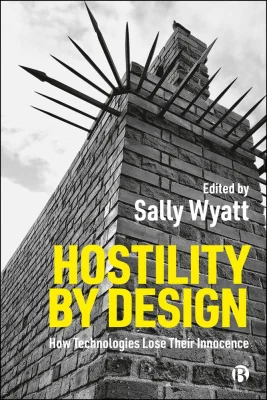 Hostility by Design edited by Sally Wyatt is available on Bristol University Press for £29.99 here and publishing open access in December.
Bristol University Press/Policy Press newsletter subscribers receive a 25% discount – sign up here.
Follow Transforming Society so we can let you know when new articles publish.
The views and opinions expressed on this blog site are solely those of the original blog post authors and other contributors. These views and opinions do not necessarily represent those of the Policy Press and/or any/all contributors to this site.
Image credit: Parker Nate via Unsplash