


Social justice and equal opportunity

Tom Bewick, author of 'Skills Policy in Britain and the Future of Work', argues that Britain’s long-running skills crisis reflects a recurring pattern of under investment, social inequality, and an over relianc on market-led, voluntary training systems that have repeatedly failed to keep pace with economic change.…Read more

George Miller discusses the What Is It For? book series, inspired by Gauguin’s existential questions, arguing that in an age of global “polycrisis,” critically examining the purpose of institutions can help us imagine better alternatives, even if it cannot solve problems outright.…Read more

Scott Thomas and Jonathan Glazzard, authors of 'The Queer World of Prison', argue that despite government claims of modest reductions, prison education across England and Wales faces deep cuts—up to 65% in some prisons—threatening rehabilitation, prison safety and efforts to reduce reoffending.…Read more

Natalie Rutter and Sarah Waite, editors of 'Women, Relationships & Criminal Justice', argue that nearly two decades after the Corston Report, progress on reforming the criminalisation of women remains slow, and real change requires shifting the justice system from risk-based punishment to relationship-centred care and structural reform.…Read more

Gurminder K. Bhambra, editor of 'The Modern World After Colonialism', draws on Chinua Achebe’s insight to argue that dominant social-science narratives overlook colonial histories, and that re-centering empire is essential to rethinking modernity.…Read more

Pushkala Prasad, author of 'Capitalism’s Dark Complexion', argues that capitalism has always been deeply racialised, exploiting Black and Brown bodies, from chattel slavery to modern e-waste labour, while disproportionately enriching White populations.…Read more

Samantha Parsley, author of 'Minor Keys', argues that gender-based digital violence forces women and gender-expansive electronic music artists to undertake exhausting, unpaid “ameliorative work” that harms their wellbeing, visibility and career progression, and calls for collective responsibility and allyship to address it.…Read more
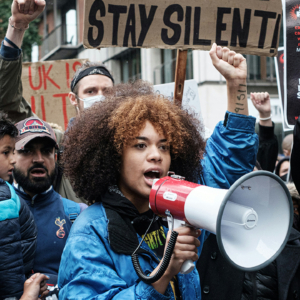
Akwugo Emejulu, Marlies Kustatscher and Callum McGregor editors of 'Ambivalent Activism', argue that while the far right is legitimised to mobilise anger and fear, left activism is constrained by compulsory “hope,” weakening its ability to harness powerful emotions like anger, grief and discomfort for social change.…Read more

From Bristol University Press and Policy Press, Transforming Society shares the powerful stories rooted in our research, showing how ideas can shape a fairer, better society.…Read more

This year on the Transforming Society podcast, we’ve highlighted the stories behind research that tackles society’s biggest challenges and sparks meaningful change.…Read more