


The world we have inherited is approaching what seems likely to be its human-induced terminal phase. We know what the problems are, and we know what needs to be done for humanity to survive and progress. But we aren’t doing it.
Instead, we are allowing ourselves to be ruled by a set of beliefs, based on a 19th century maths-based economic theory that has been shown many times to be disastrously false. The theory has been rejected, but its underlying messages, as expressed in simplistic terms by Liz Truss and her assistant, have been promoted as a set of beliefs for those who stand to gain most from it. While the Sunak government may appear more measured in its approach, the reality is not much different. The pursuit of gain for the rich and their dodging of taxation is endemic.
This current classical economics-driven age started in the 1980s, and has been retitled as Reaganomics, Thatcherism, neoliberalism etc., as though it were a new approach rather than the return of classical economics with a few amendments.
In due course that led, inevitably, to the 2007–2008 financial crash followed by the classically imposed decade of austerity. Nothing had been learned from the 20th-century realities of the Wall St Crash and Great Depression. We are clearly still stuck in that classical economic bind.
However, we appear to be approaching another tipping point where consideration of economic realities might replace the application of theory.
That theory is based on catastrophic oversimplifications such as the idea that cutting taxes leads automatically to economic growth. Tax – another theoretical oversimplification – is not a deduction from the economy, but a reallocation within it. Its effect is dependent on the whole transaction: what is taxed and, as Keynes pointed out, how that tax income is allocated.
Similarly, the effect of tax cuts is dependent on who gains and how those gains are allocated. If taxes are reduced on the rich, it is unlikely to cause economic growth, because they are more likely to put the money where they, or their financial advisors, advocate it will achieve the maximum return. That is now most likely to be in some section of the shadow finance sector of hedge funds, including offshore financial markets where taxes can readily be dodged. But if taxes are cut on the poor, the gains will immediately be spent, thereby contributing to growth of the domestic economy, simply because they have no option but to spend all they have in order to survive.
Taxes should therefore be levied on a progressive basis. As Adam Smith pointed out, it is ‘not very unreasonable that the rich should contribute to the public expense, not only in proportion to their revenue, but something more than in that proportion’. [This quote is from The Wealth of Nations, Book V, Chapter 2, Part 2, Of Taxes. It is excluded from some current editions. His argument for progressive taxation doesn’t fit current renditions of Adam Smith by influential think tanks such as the Institute of Economic Affairs and Adam Smith Institute.]
The most destructive example of economic theory oversimplification is the real economy itself. It is not the singularity classical economics pretends it to be. It is a complex of very different entities. And it is not measurable by GDP which is itself a monstrous oversimplification, full of contradictions, anomalies and misconceptions.
A broad classification of the real economy identifies three separate and quite different layers: infrastructural, entrepreneurial and revolutionary. Each requires totally different regulation and support, as outlined in Remaking the Real Economy. Their only common ground is that all three must include commitments to the environmental sustainability of their operations which is the moral responsibility of all governments.
At base is the infrastructural layer which provides the products and services which people use or consume as part of ‘the infrastructure of everyday life’ in a civilised society. That includes health and social care, education, water, energy, housing, a transportation system, the internet, the commons, defence, security and systems of justice.
Such provisions are the essentials of civilised society. Their users do not have choice; the rules of competition simply do not apply. Therefore, they need to be provided by dedicated, not-for-profit public organisations. Privatisation and outsourcing to for-profit operators has repeatedly led to providers exploiting their users in order to maximise profits and shareholder take. Infrastructural provision is a public responsibility and should not involve any private-for-profit engagement.
The for-profit entrepreneurial layer of the real economy comprises a wide variety of non-mandatory products and services intended to be provided via competitive markets. The natural tendency of such unregulated markets is for the most successful providers to gain market share and ultimately to become more or less monopolistic and to take advantage of that market power to increase their profitability and shareholder take. Such markets, therefore, need to be controlled and regulated to ensure the protection of competition.
The revolutionary layer achieves the fundamental technological innovations which require investment beyond the scope of competitive business and is best served by a combination of both public and private organisational systems, working in collaboration with each other. Engagement of the ‘entrepreneurial state’ on scaled technological innovation has achieved rapid change, including, for example, the US government’s DARPA (Defense Advance Research Project Agency), SBIR (Small Business Innovation Research), the Orphan Drug Act and the National Nanotechnology Initiative, as well as progression of solid-state chemistry and silicon-based semi-conductors, including such products as Apple’s iPhone, iPod and iPad. Much of the technology on which the current generation of tech titans rely originated from the work of people in state systems in the US and UK. The revolutionary layer’s public–private collaboration will necessarily be the prime source of development of sustainability technologies, on which human survival and progression will depend.
The gross oversimplifications of political–economic theory have put us where we are today, confronting so many threats to our survival and progression. Our future depends on our facing up to realities and taking the essential actions which have long been identified. That way we might overcome problems such as climate destruction, finite resource depletion, mass species extinction, unsustainable human population growth, ocean acidification and fresh-water pollution.
All it will require is for governments across the globe to confront humane realities rather than continuing the simplistic pursuit of their own self-interest.
Gordon Pearson, formerly Head of Department of Management and Director of MBA programmes at Keele University, has extensive experience in strategic business development, and is the author of eight books in the areas of strategic management, competition and co-operation.
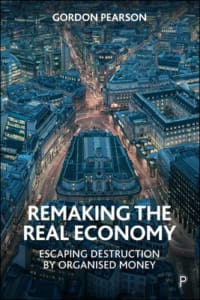 Remaking the Real Economy by Gordon Pearson is available on the Bristol University Press website. Order here for £24.99.
Bristol University Press/Policy Press newsletter subscribers receive a 25% discount – sign up here.
Follow Transforming Society so we can let you know when new articles publish.
The views and opinions expressed on this blog site are solely those of the original blog post authors and other contributors. These views and opinions do not necessarily represent those of the Policy Press and/or any/all contributors to this site.
Image Ehud Neuhaus via Unsplash