


In the UK and elsewhere, for example, Canada, Hungary, Poland, Sweden and the USA, there has recently been a spate of populist counter-movements against existing climate change policies at a national and local level. This ‘anti-net zero populism’ has often been driven by right-wing politicians, and more recently in the UK, the ‘cost-of-living crisis’ has also been used by the government as a rationale to row back on what are seen as ‘expensive’ and ‘unfair’ net zero policies, and to attack ‘eco zealots’ and ‘luxury beliefs’.
Inevitably the focus of public demonstrations against climate change policies has focused on cities, where most people live, and local outrage (certainly in the UK) has often been directed towards policies or schemes which are seen as infringing public rights or freedoms. Examples of schemes include Zero Emission Zones (ZEZs), which are geographically defined areas within a city that restrict access to petrol and diesel cars; low traffic neighbourhoods (LTNs), which are designed to remove traffic from residential areas using filters such as bollards, planters and cameras, while encouraging cycling and walking; speed restrictions, such as reducing maximum speeds to 20mph in urban areas to reduce pollution and improve health; and the ‘15 Minute City’, an idea developed by Carlos Moreno (an urbanist) based on the earlier work of Clarence Perry and Jane Jacobs, which envisages all basic facilities (for example, shops, healthcare and education) as being within a 15-minute walk or bike ride from home.
Advocates of these schemes argue that they are necessary to reduce carbon emissions and improve quality of life at a local level to tackle climate change and that, for example, an improved environment and better air quality are worth the inconvenience and additional cost to polluting road users. On the other hand, critics point to the negative impact of lengthier and more costly journeys for businesses, and restrictions on local travel for existing residents. In Oxford, no stranger to controversy over the impact of physical barriers (for example, in a very different context, the infamous Cutteslowe Walls of 1934), there has been a huge amount of local, national and international media coverage of the debate.
Essentially then, we are seeing the increased ‘politicisation’ of net zero policy as politicians seek to influence opinion and carve out opportunities to win over voters, perhaps in some instances even to dismantle or loosen existing policy, which was originally designed to help tackle emissions and climate change (e.g. the recent UK government review of LTNs and other sustainable travel interventions, and the changes to UK net zero policy). Short termism, or ‘presentist bias’, has been recognised as pervasive in local or national politics, but this myopia is now seemingly even more engrained when it comes to net zero and climate change, exacerbated at a local level by misinformation and distrust of ‘experts’ pedalled by conspiracy theorists, often through social media; poor explanation of the benefits of net zero policies to people; lack of proper consultation with the public; and the lack of resources in local government, all of which were also impacted by the COVID-19 crisis.
The net zero controversy comes, ironically, at a time when there has been increased focus on how ‘deliberative democracy’ can and should play a greater role in local decision making and take account of diverse and often hidden voices set against the white noise of social media and ‘vox pop’ politics. The concept of citizen engagement in public policy discourse is not new and recently there have been many examples of ‘deliberative mini publics’, not only in relation to climate change issues (for example, citizens’ juries and citizens’ assemblies) but also capital budgets (participatory budgeting). In these cases, members of the public do not need to be ‘experts’ but rather they, local authorities and others are seen as equal partners in co-creating policies which transcend local and national politics. What’s more, deliberative democracy processes are not restricted to short-term and localised matters but can be framed to encourage discussion about more ‘strategic’ issues that could change in the long term.
Overcoming the disconnection between short-term planning and longer-term environmental change is also at the heart of how a long-term ‘city vision’, a good example of deliberative democracy in action, can be developed, looking beyond the next 20 years, and giving people a real choice in how they want the future to be shaped. A vision, or a shared achievable and desirable course for the future of a city, can offer real benefits; the vision can provide a sense of purpose, create new ideas and perspectives, and help mobilise resources around a shared understanding of the future, as well as helping to improve confidence in long-term decision making and partnership working. But this also means using participatory foresight-based or futures techniques, to help co-create and co-produce visions, as has been the case in a number of cities in the UK and internationally (for example Newcastle and Reading), and more recently we have seen the emergence of other city visions which are taking a holistic and integrated view of the future (for example, Portsmouth).
Developing a vision does not suggest some ideological blueprint that is imposed on people, but rather acts as a roadmap for everyone to know where a place is heading and what a desirable future looks like. This sense of direction and purpose has been seemingly absent from UK debates for well over a decade. The time might be ripe to consider how city visioning could harness the passionate voices that exist in places on a whole host of issues, but which are currently disparate, noisy, factually spurious, and outside more traditional democratic arenas. That is not to say that city visioning would be any easier than current systems of engagement in an era of short termism and political cynicism. But it could provide an important way of tapping into the informal, virtual world and popular consciousness more directly than any ‘open’ government system. It might even become a more effective way to platform minority voices, and to understand how different ethnic groups see and use the city, how gendered our existing built environment has become, and how we often overlook places as spaces for all demographic groups.
City visioning therefore provides a powerful opportunity to transcend short-term net zero politics. However, cities with visions in place should not be complacent. No vision is ever complete and those groups that lead or co-lead city visions must now surely revisit and refresh their city visions to meet fresh challenges and opportunities (for example, Oxford, Reading and Newcastle). Nonetheless, challenges would remain, especially as to how a digital debate mixes with in-person forums and traditional consultations. Questions of power, who wields it, who is disadvantaged by it, whether it is imbalanced, will also persist, although the key issue is that the questions become more transparent through a co-created visioning process.
At some point, the UK government will need to mirror other national governments and become more proactive in shaping everyone’s future for the better. That must mean enabling city visions, especially if that strengthens, not loosens, net zero policy. Work in Australian cities has shown the importance of developing and funding new national networks and platforms for shared learning in cities, and it is also interesting to see the RSA’s Urban Futures Commission‘s focus on deliberative democracy in UK ‘core cities’ in its recent report.
Ultimately, the test of a successful city vision will be the extent to which it brings people together and develops clear strategies for action which transcend short-term thinking and create clear consensus for long-term change. Only then can we better understand how we reach net zero and tackle climate change together, rather than in conflict, in our towns and cities.
Timothy J. Dixon is Emeritus Professor at the University of Reading and Visiting Fellow/Research Associate, Kellogg College/Global Centre on Healthcare and Urbanisation (GCHU), University of Oxford (Twitter: @UniRdg_SustBE)
Mark Tewdwr-Jones is Professor of Cities and Regions at the Bartlett Centre for Advanced Spatial Analysis at University College London. (Twitter: @MTJProf)
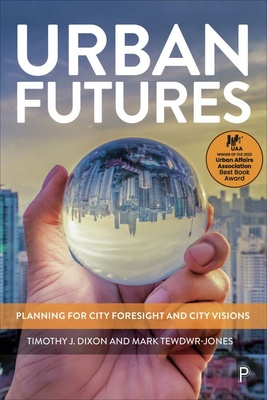 Urban Futures by Timothy J. Dixon and Mark Tewdwr-Jones, is available to order on Bristol University Press for £26.99 here.
Bristol University Press/Policy Press newsletter subscribers receive a 25% discount – sign up here.
Follow Transforming Society so we can let you know when new articles publish.
The views and opinions expressed on this blog site are solely those of the original blog post authors and other contributors. These views and opinions do not necessarily represent those of the Bristol University Press and/or any/all contributors to this site.
Image credit: Benjamin Elliott via Unsplash