


It’s that time of year when people around the world are being asked to focus their attention on the plight of the ocean. The UN officially designates 8 June as ‘World Oceans Day’. Since there is only one ocean on this planet, others drop the ‘s’ and call it ‘Ocean Day’ (or ‘Ocean Week’ in Canada). But regardless of pluralisation or length of celebration, everyone organising an event this year seems to agree that humanity is screwing things up.
We need to radically change our relationship with the ocean. We need to do this before the ocean radically changes our ability to live on this planet. We need ocean-saving – and therefore life-saving – innovation. And we cannot continue delegating that innovation to the private sector.
Let me describe a policy disaster that unfolded here on Canada’s Atlantic Coast, over a decade ago. Conservative Prime Minister Stephen Harper directed his government to slash and stifle its capacity for ocean and environmental science. Whichever government scientists could not be dismissed were muzzled. (Chris Turner called this ‘The War on Science’). These moves deeply affected places like the Bedford Institute of Oceanography – once lauded as one of North America’s leading oceanographic research institutions. But while Canada’s capacity for understanding and protecting the ocean was being decimated and denigrated, other arms of government were beginning to invest heavily in a new oceans-focused industrial policy. The ocean was a bigger policy priority than ever – but Canadians were meant to only understand it as a place for building economic wealth.
People working in the ‘blue economy’ knew this was a mistake. I was just beginning the research for my PhD, and an industry leader suggested I focus my work on defending places like the Bedford Institute. I was told that the best thing I could do to support an ocean technology industry in my part of the world would be to demonstrate the irreplaceable value of the public sector’s capacity for ocean research and development. In other words, I needed to tackle the assumption that government should be hands off (or at most, supportive/facilitative of business). I needed to tackle the assumption that the private sector could do ocean innovation better on its own.
This became the subject of my PhD research and the empirical context for my new book. I quickly learned that the world is full of strong beliefs about public- versus private-sector innovation. For example, I was shocked to see a leading academic book on public-sector innovation claim that ‘innovation in goods is the exclusive domain of the private sector’. In other words, government can innovate, but not when it comes to making new physical things/technologies. The authors were trying to focus readers on innovation in public services. Like most people, they seemed to believe that other kinds of innovation are best left to the private sector. And yet, that book unwittingly undermined its own argument by providing multiple examples of important new technologies that were developed within the United States government.
I’ve had no trouble finding my own examples of physical technologies developed within the Canadian public sector – technologies designed to help us understand and protect the ocean. One of my favourites is a device used to measure salinity. Developed at the Bedford Institute, the design was later licensed to the company, Guildline Instruments. The Autosal salinometer would quickly become a standard instrument in nearly every oceanographic laboratory in the world. This device was such an important innovation that it has a permanent home at the Canadian Museum of Science and Technology. It has helped scientists understand the role of salinity in the physical and biological processes of the ocean. Based on that knowledge, scientists have been sounding the alarm about shifts in salinity – a life-threatening consequence of human-induced climate change.
Examples of public-sector ocean innovation – like the salinometer – are easy to find when you start looking. But surfacing them is not always easy (pardon the pun). It is taboo to suggest that the public sector is a good place for innovation. The examples are written off as abnormal. (Some people think ‘normal’ innovation only happens when there is a profit motive). The argument is written off as anti-business. (Some people think that any argument for public-sector innovation must somehow be an argument against private-sector innovation). All sorts of logical fallacies and rhetorical flourishes are used to uphold the false and deeply political belief that innovation is best left to private interests.
Don’t get me wrong. I applaud the many business leaders who will commit to World Ocean Day this year. I appreciate the many social entrepreneurs who are building ocean-focused impact-oriented businesses. But there is no doubt that protecting the ocean, indeed protecting life on this planet, is in our common or public interest. And there is no doubt that many people who are already working in the public interest – people employed in government, and in civil society – have proven themselves capable of engaging in ocean-protecting (and planet-protecting) innovation. They have been successfully developing many of the new tools and techniques that we need to save this planet. They must be given further social license to innovate – even when there is no profitable market value in sight.
We must stop assuming that the private sector is the best place for all innovation. Sometimes, like on World Ocean Day, we need to focus our attention on innovation for the common good.
Ryan MacNeil is an Associate Professor of Entrepreneurship and Innovation at Acadia University, where he also holds the Rath Professorship in Entrepreneurship. His research on ocean science technology innovation was funded by a Joseph Armand Bombardier Doctoral Scholarship from the Social Sciences and Humanities Research Council of Canada.
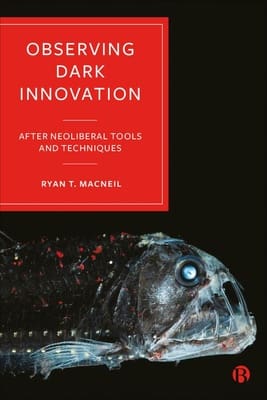 Observing Dark Innovation By Ryan T. MacNeil is available to read open access on Bristol University Press Digital here.
Follow Transforming Society so we can let you know when new articles publish.
The views and opinions expressed on this blog site are solely those of the original blog post authors and other contributors. These views and opinions do not necessarily represent those of Bristol University Press and/or any/all contributors to this site.
Image credit Francesco Ungaro via Unsplash