


Walk into pretty much any law school classroom, bar association meeting or legal tech conference these days and you will hear the same anxious refrain: Will artificial intelligence replace lawyers? It’s an understandable question.
Technology already reads contracts, predicts litigation outcomes, prepares basic legal filings and offers rudimentary legal guidance at a fraction of the cost of a human attorney. It also often gets things wrong.
Still, because tens of millions of Americans face their legal problems without a lawyer – because they can’t afford one, don’t know how to access one or don’t even know they have a legal problem that needs solving – there is a dramatic gap between what potential consumers of legal services need and want from the legal system and what lawyers provide.
For that reason, interrogating what it is that consumers actually want from the legal system might help the profession deploy technology in effective ways: to run with the machines and not against them.
Clients don’t hire lawyers – they hire solutions to legal problems
The late Harvard Business School legal Clayton Christensen, who identified the phenomenon of disruptive innovation in the business cycle, offered a useful framework the legal profession could apply to try to figure out how to approach the introduction of emerging technologies into the practice of law. Christensen posed the following question: What job does a customer want a product or service to perform for them?
Christensen’s ‘jobs-to-be-done’ (JTBD) framework helps businesses understand customer need. The legal profession could learn a lot from such an approach. For Christensen, customers don’t buy a product because of its features; they ‘hire’ it to solve a problem in their lives. The power drill isn’t purchased for its torque; it’s hired because someone needs a hole.
Legal services are no different. Clients don’t hire lawyers; when they can, they hire solutions to legal problems. And the profession has been remarkably slow to grasp this.
For generations, lawyers have defined themselves by what they do: interpret the law, draft documents, negotiate, litigate, advise. Those are real skills. They matter. But they are not necessarily the ‘job’ from the client’s perspective, nor do they capture the values the profession may promote when providing legal services.
The multifaceted role of a lawyer
Consider three dimensions or values of the job a client may hire a lawyer to fulfil.
First, what is the instrumental or functional aspects of that job? Sometimes a client needs a contract drafted, a patent filed or a criminal charge contested. These are technical, functional tasks.
More and more, artificial intelligence is proving that it can do at least some of these tasks quickly, accurately and cheaply. If lawyers – and consumers of legal services – see the lawyer as fulfilling this one-dimensional role, there probably won’t be much left for lawyers to do once the technology gets better at the practical functions the lawyer satisfies in any given setting. But there is more to lawyering than filling out forms and filing applications.
A second value a lawyer often fulfils has an affective or emotional aspect to it. This is where artificial intelligence may be incapable of replacing at least some of what lawyers do and why clients hire them.
No algorithm can replicate what it feels like to sit across from a lawyer who is going to defend you when your home or liberty, or when the company you have built, is on the line.
In the hardest moments of life, clients hire lawyers for something far deeper than a document: They hire reassurance, stability, trust. It is hard to automate these feelings away.
Lastly, the lawyer has a political value. Not in terms of electoral politics, but in the ways in which we relate to each other and to the state. Indeed, lawyers often serve a mediating role between individuals, and between individuals and the state.
When the power imbalance is extreme – immigration hearings, housing court, criminal arraignments – the role the lawyer plays is not a luxury; it is essential to the legitimacy of the system itself. This is another value technology will have a hard time meeting.
Is the traditional legal model working?
What emerges from taking a hard look at the job the lawyer provides along these dimensions reveals the value – and the values – lawyers provide. But the exact shape and scope of the job to be done will vary. Sometimes the emotional or political dimensions overshadow the functional. Sometimes they don’t.
Maybe not today, but someday, computers will be able to fill many of these roles and satisfy at least some of these values. But what is lost when some of these essential values can never be satisfied by a digital companion?
The legal profession has long insisted on a single delivery model: full-service, bespoke, lawyer-intensive. This model works well for complex matters but fails dramatically across much of the justice system.
For millions of Americans, the result is often no lawyer to help them address even the most basic needs, like to defend against eviction, to prevent against the loss of health insurance or to secure unpaid wages.
How emerging technologies could expand access to justice
Christensen’s framework pushes us towards a different understanding of what the lawyer not only can do, but should do, and what we can leave to emerging technologies.
At the same time, when one analyses the services that such technologies will be able to provide in the near future in light of the fact that tens of millions of Americans face their legal problems without a lawyer, the failure to look for opportunities where these technologies could close this justice gap means we will continue to leave far too many with no services at all.
The challenge for the profession is to identify those places where new technologies may meet enough of the values consumers need from a lawyer, assuming they have access to one.
Such technological tools can help advance the promise of access to justice, while serving more people, and doing so in an effective, accessible and affordable way, and at scale. Deploying technology in this way will make lawyers’ jobs more efficient generally, will free up their time for complex matters, and probably bring down the overall cost of legal services.
Lawyer 3.0: blending human judgement with intelligent tools
Some jobs require the full package: expertise, empathy, advocacy and political navigation. Others require something far more modest.
When we force every client into the same high-cost model, we don’t just make legal help unaffordable; we make it inaccessible to far too many individuals in need of legal assistance.
At the turn of the 20th century, the American legal profession faced an inflection point similar to the one it faces today. In response, it made dramatic changes to how it operates and built many of the institutions that we still think of today as forming the backbone of the profession: law firms, bar associations, law schools, bar exams and legal codes of ethics.
Many of these institutions were built in response to changes to technology that altered not just what lawyers worked on but how they worked. This period marked the beginning of what I call ‘Lawyer 2.0’.
We are at a similar inflection point today. What it will require from the profession is a shift in mindset and approach, what I call ‘Lawyer 3.0’. This new ‘version’ of the profession will blend human judgement and technology in ways that expand, rather than constrict, access to justice.
When we centre the needs of the client, and find the right service, at the right time, using the most efficient service-delivery tools in each instance, we may find that we can facilitate greater access to justice, and fulfil the promise that our legal system will make sure everyone with a legal problem can get it solved.
Sometimes lawyers forget that the point of the profession is not to ensure a job for every lawyer, but rather, that every potential consumer of legal services gets their legal job done.
Raymond H. Brescia is Associate Dean for Research and Intellectual Life and Hon. Harold R. Tyler Chair in Law and Technology at Albany Law School.
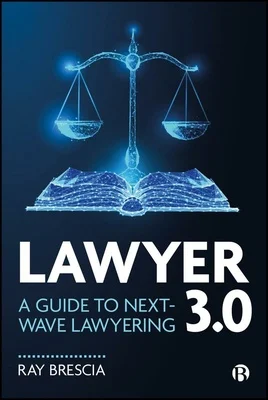 Lawyer 3.0 by Ray Brescia is available on Bristol University Press for £19.99 here.
Bristol University Press/Policy Press newsletter subscribers receive a 25% discount – sign up here.
Follow Transforming Society so we can let you know when new articles publish.
The views and opinions expressed on this blog site are solely those of the original blog post authors and other contributors. These views and opinions do not necessarily represent those of the Policy Press and/or any/all contributors to this site.
Image credit: Sander Weeteling via Unsplash