


2026 is gearing up to be another nail-biting electoral year in Europe. France, Germany, Spain and Italy will see a host of local and regional elections, while Hungary and Sweden are preparing for general polls to elect new governments.
Many analyses of these electoral events focus on what is often known as the ‘populist challenge’ – up-and-coming challengers to the status quo, often from the right. At the risk of sounding like a broken record, these populist radical right parties, as they are known in the literature, are said to offer a different type of politics to their mainstream counterparts. They argue that they represent ‘the People’, the ordinary man on the street. However, most of these parties also exhibit strong authoritarian tendencies.
Increasingly, however, this story is becoming not only tedious and repetitive but also inaccurate. While the populist radical right remains seriously committed to xenophobia and authoritarianism, so do their mainstream colleagues.
One need only take a quick look at the Social Democratic government in Denmark, led by Mette Frederiksen, to see how a mainstream party has implemented a textbook case of harsh migration policies, including confiscating jewellery from migrants and forcing their children into mandated childcare. Or, the upcoming European Common System of Returns, an EU-wide policy to encourage remigration, owas nce a brainchild of the far-right.
Many argue that this is a case of mainstreaming: Political parties are scared to lose voters to the populist right and therefore mimic their policies in order to stem the flow. Such strategies, however, have time and again proved to have the opposite effect. Instead of stemming the flow, centrist parties are legitimising the politics of the populist right.
So, the question remains, why are centrist parties still so committed to moving to the right, when this is a crowded electoral space and unlikely to produce any major gains in the polls?
Most analyses still maintain a categorial difference between the mainstream and its populist counterparts. This difference, I argue, is only a chimera.
If we look at a longer-term perspective, it becomes obvious that what we today blame populists for are, in fact, standard ways of doing politics in Europe. Liberal democracy in Europe has, from its inception, been influenced by an assumption that there are some people who are better suited to politics than others. Centuries ago, this meant that women and ethnic and religious minorities could not vote. Today, while we may have universal suffrage, barriers to political participation and representation still remain.
The fantasy of European superiority
Crucially, I argue that there is a lingering conviction in mainstream European politics that Europeans are better and cleverer than the rest of the world. While this is normally not said outright, it seeps through the cracks.
Take the instance when the EU’s Higher Representative for Foreign Affairs, Josep Borrell, argued that ‘Europe is a garden… The rest of the world is a jungle, and the jungle could invade the garden’. Or consider the highly militarised environment on Europe’s outer borders, all to keep the ‘jungle’ at bay. Think of the criminalisation of support for Gaza, while there is an outpouring of support for Ukraine.
Europe, the birthplace of democracy and Western civilisation, is intertwined with the assumption that other cultures, due to their inferior nature, struggle to uphold democratic institutions.
When we start considering that mainstream politicians in Europe are quite keen to implement what are normally called ‘populist’ policies, things start to crumble quite quickly. It becomes evident that they have been doing it for a long time, and that they do it willingly.
Facing Europe’s populist condition
Is it possible, then, that we are populists at heart? Could Europe be struggling with a ‘populist condition’ that cannot be ignored?
The question then becomes why the term populism is so ubiquitous, especially in its derogatory and dismissive form. Populism has come to mean everything that we are not, and everything that is a threat to our own world order.
But why, if the policies suggested by the populist right are not so unpalatable to the mainstream, do we maintain that the two are incompatible?
By using the concept of fantasy, we can better understand the motivations of European politicians. European superiority also includes a belief that Europeans are benevolent and morally good; even during colonial times, Europeans were essentially doing the savages a favour by introducing good governance and the oft-mentioned railways.
Today, this belief that Europe is essentially representing the moral good is equally important but takes a different shape. The ills of European liberal democracies – rising xenophobia, inequality and authoritarian leanings – are not who we are but the fault of the populist right. So strong is the fantasy of the European moral superiority that it becomes impossible to see how these ills are of our own making and are rarely implemented or actioned by ‘populists’.
In essence, Europe is facing an uncertain future. Just as in other countries – perhaps most notably and recently in the United States – European institutions are not immune to authoritarian takeover.
However, to constantly point the finger at the populist right without reckoning with Europe’s own problematic institutions and ideologies is unlikely to change the course of action. Before Europe recognises its populist condition, the remedy will be out of reach.
Emmy Eklundh is Senior Lecturer in Politics at Cardiff University.
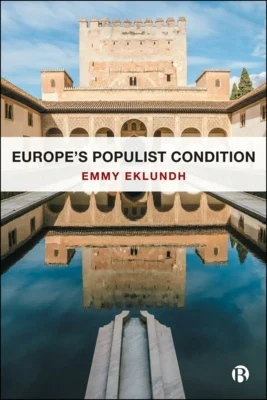 Europe’s Populist Condition by Emmy Eklundh is available for £27.99 on the Bristol University Press website here.
Bristol University Press/Policy Press newsletter subscribers receive a 25% discount – sign up here.
Follow Transforming Society so we can let you know when new articles publish.
The views and opinions expressed on this blog site are solely those of the original blog post authors and other contributors. These views and opinions do not necessarily represent those of the Policy Press and/or any/all contributors to this site.
Image credit: Fer Troulik via Unsplash