


As Earth Day approaches each year, attention turns to the role of major powers in addressing climate change, making recent shifts in US policy particularly consequential.
Shortly after his inauguration, President Trump issued Executive Order 14162, which withdrew the US from the Paris Agreement of 2015. Following provisions of the agreement to reduce greenhouse gases implemented under the United Nations Framework Convention on Climate Change (UNFCCC), the UN Secretary General formally issued a notification of the US withdrawal effective from 27 January 2026.
Trump’s justification for his order was brief: “It is the policy of my Administration to put the interests of the United States and the American people first in the development and negotiation of any international agreements with the potential to damage or stifle the American economy. These agreements must not unduly or unfairly burden the United States.”
Despite overwhelming international scientific evidence for global warming, Trump offered no meaningful arguments to support his first withdrawal from the Paris Agreement in 2017. After President Biden rejoined the Paris accord in 2021, Trump continued to dismiss climate change, variously calling it a leftist conspiracy or a Chinese effort to divert US energy policy.
In his withdrawals, Trump effectively positioned the United States in opposition to the 195 nations that ratified the agreement.
From bipartisan environmentalism to political divide
The US was the world leader in environmental policy in the 1970s and, though lagging behind European leaders, has continued to pursue research in all aspects of climate change. Presidents Obama and Biden launched vigorous programmes to curb fossil fuel emissions and support renewable energy development.
This abrupt reversal in US policy stunned scientific and policy communities worldwide. How did such a shift become politically possible? My recent book, American Environmental History and Policy: A Troubled Journey to Reform, includes little-known background for Trump’s actions.
His political evolution reveals skills and devious strategies that have often been underestimated by media and political experts. Before 2010, Trump supported Democratic politicians and policies. In 2009, together with other business leaders, he was a signatory to a full-page ad in the New York Times that advocated green energy policies.
However, in 2010, Trump apparently saw political opportunity in polarisation around environmental policy and a growing conservative movement against Democratic policies. His 2011 book, Crippled America: How to Make America Great Again, signalled an abrupt change in policy.
Two years later, Trump claimed in a tweet that climate change was a green scam. In 2015, he launched his campaign as a candidate for the Republican nomination in the presidential election of 2016.
The 1970s environmental revolution
Trump’s ascent to power was arguably made possible because of decades of increasing domestic discord with roots in conflict over the environmental regulatory system enacted in the 1970s.
These laws, beginning with the National Environmental Policy Act of 1969 (NEPA) and the precedent-setting Clean Air Act Amendments of 1970 (CAA) were triggered by an event in January 1969.
A blowout in an offshore platform off Santa Barbara, California created a spill that oiled ducks and inundated the white sands of Santa Barbara’s beaches with black crude oil. Seen on nightly television news widely watched in the 1970s, the images created a sense of environmental crisis and scepticism about the federal government’s stewardship of the environment.
Spearheaded by a bipartisan group of senators on the Senate Subcommittee for Air and Water Pollution, the CAA was unanimously approved by the Senate, en route to overwhelming approval by Congress and signature by President Nixon. Subsequent environmental laws collectively added to an environmental revolution in the 1970s.
Polarisation and the road to Trump
The laws made rapid progress against environmental pollution. However, their rigorous provisions especially affected manufacturing and industry, prime sources of pollution. This led to unexpected economic decline and antagonism in the business community.
Ronald Reagan defeated Jimmy Carter in the election of 1980. His administration emphasised recovery from stagflation by legitimising business and profit and reducing the impact of environmental regulations.
Overreaction in rolling back regulatory enforcement by zealous officials brought backlash from Congress. Reagan reversed policies, but it was too late. Conflict over environmental regulations widened to political polarisation. Democrats became the party of the environment, and Republicans became the party of industry.
Dramatic testimony by climate scientist James Hansen (1988) that global warming was happening galvanised the environmental community. However, the issue became controversial among Republicans.
In his campaign for the election of 2000, Republican candidate George W. Bush supported the control of fossil fuel emissions. However, once in office, under the influence of Vice President Dick Cheney, this commitment was abandoned. Gridlock in Congress meant that legislation on critical national issues could not be enacted. Presidents from both parties increasingly resorted to executive policies.
The Clean Power Plan initiated by President Obama was dismantled by President Trump, whose policies were rescinded in turn by President Biden.
Deterioration took place in many societal indices, and public confidence in government declined from a peak of 74 per cent in 1965 to 18 per cent in 2024. Public disillusionment, combined with perceived weaknesses in Democratic Party strategy, allowed Trump to gain the presidency and control of both houses of Congress in 2024.
Can US climate policy recover after 2028?
Trump’s actions have led to widespread concern that he has attempted to exercise power beyond that authorised by the Constitution. Executive orders and initiatives have been vigorously challenged by courts.
While Trump achieved border control and has taken vigorous action in other areas, his popularity has steadily declined. Under new leadership, the Democratic party is making efforts to overcome its weaknesses.
Much of Trump’s power derives from his powerful persona, resourcefulness in exploiting imbalances in past American policies, and ruthlessness in suppressing dissent in the Republican party. These qualities will be difficult to match by future Republican candidates for the presidency.
My book concludes that national discord and erosion of governmental function have roots in conflict over environmental regulations – with subsequent political polarisation.
Reduction in polarisation is a necessary step in regaining effective governance. If return to more accountable government is achieved in the 2028 election, the restoration and revitalisation of climate change policies should be a central priority. A groundbreaking book, Abundance, by liberal authors Klein and Thompson (2025), highlights the reality that while the regulatory system of the 1970s was created to safeguard environmental values, it has increasingly impeded infrastructure, housing and energy development while generating continual conflict.
Yet, reform need not mean retreat. European environmental policies adopted in the 1990s show that regulation can be both strong and more workable. European experience should provide useful guidance for updating America’s environmental framework while preserving core goals. The European system allowed major European nations to occupy the first 22 ranks in the Yale-Columbia Environmental Performance Index (EPI) for 2024 whereas the US occupied the 35th position.
US climate policy can recover after 2028, but not quickly or automatically. Much will depend on whether the history and complex developments since the 1970s are assimilated in reform deliberations.
Frank T. Manheim is Affiliate Professor and Distinguished Senior Fellow at the Schar School of Policy and Government, George Mason University.
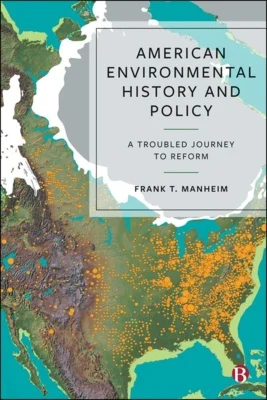 American Environmental History and Policy by Frank T. Manheim is available for £29.99 on the Bristol University Press website here, or available to read on Bristol University Press Digital here.
Bristol University Press/Policy Press newsletter subscribers receive a 25% discount – sign up here.
Follow Transforming Society so we can let you know when new articles publish.
The views and opinions expressed on this blog site are solely those of the original blog post authors and other contributors. These views and opinions do not necessarily represent those of the Policy Press and/or any/all contributors to this site.
Image credit: Christian Lue via Unsplash