


When theatres shuttered during the COVID-19 lockdowns, performing arts institutions that had resisted digital programming for decades suddenly pivoted overnight, livestreaming productions, releasing archival recordings and experimenting with hybrid and transmedial performances that blurred the line between stage and screen.
For many disabled, elderly, chronically ill, economically disadvantaged and geographically distant audiences, this experience was transformative. They could finally access theatre and performing arts events that had effectively excluded them for years.
Then, when the world declared a ‘return to normal’, most theatres reopened their buildings while promptly shutting down their streaming programmes. The audiences who had finally found a way in were once again locked out.
The numbers tell a striking story
I’ve spent the past several years examining what happened during and after the pandemic. In 2023, my colleagues and I launched the Digital Access Research Project at metaLAB (at) Harvard, housed at the Berkman Klein Center for Internet and Society at Harvard Law School.
Our team of international experts in disability law, copyright law, digital technology and performing arts management conducted a comparative study across the United States, United Kingdom, European Union and Australia. The findings, published in our new book Digital Access to the Performing Arts: Comparative Study of Legal and Structural Challenges, reveal a troubling pattern: increased digital programming expanded participation among disabled, elderly and diverse audiences, and yet institutions abandoned these offerings as soon as they could. The data, however, challenges assumptions that audiences don’t want digital theatre.
In the US, National Endowment for the Arts surveys found that 75 per cent of adults participated in arts through digital media in 2022, compared to just 48 per cent who attended in person. The digital audience was also more diverse: 65 per cent of Black/African American respondents watched livestreamed performances, compared to 39 per cent of white respondents.
In the UK, researchers found that online participants were younger and more ethnically diverse than in-person visitors. European theatres saw a 772 per cent increase in digital programming between 2019 and 2020, with 83 per cent reporting they reached new audiences. In Australia, 88 per cent of the population engaged with arts online in 2022.
These weren’t pandemic-specific anomalies. Many audiences continued to seek digital access even after venues reopened and theatres stopped streaming their shows.
So why did theatres retreat from streaming?
Theatre leaders argued that digital offerings failed to generate expected revenue. While in-person programming receives substantial subsidies from governments and foundations, digital programming was expected to be self-sustaining.
By requiring digital access to fund itself while live performance enjoyed subsidies, institutions effectively decided that disabled and marginalised audiences weren’t worth the investment. The broader message was clear: the people who had finally found their way into the cultural conversation during the pandemic could be abandoned without consequence.
Ironically, even as theatres across the US and UK face unprecedented layoffs and financial crises because in-person audiences have not returned to pre-pandemic levels, most of them continue to disregard digital programming that would include the very audiences who sustained them during the lockdowns.
Artistic directors often worry that digital offerings replace in-person attendance, the so-called ‘substation effect’, but research indicates the opposite: streaming invites new audiences who subsequently become more likely to attend live events.
Access to culture is a human right
Article 27 of the Universal Declaration of Human Rights guarantees everyone the right to participate in cultural life. Access to culture is essential not only to individual health and wellbeing but also for social cohesion and the functioning of democracy itself.
The UN Convention on the Rights of Persons with Disabilities specifically calls on states to ensure that intellectual property laws don’t create unreasonable barriers to cultural access for people with disabilities.
Yet approximately one billion disabled people worldwide, the world’s largest minority, remain largely excluded from live performing arts. For many others who also cannot travel to venues due to a variety of reasons, including chronic illness, caregiving responsibilities, economic hardship or geographic isolation, live performing arts might as well not exist.
The legal framework breakdown
The existing international treaties are outdated and ineffective. The Marrakesh Treaty, adopted in 2013, facilitates access to published works for people who are visually challenged or print-disabled, but it focuses exclusively on text. A broader provision that would have covered people with any disability needing accessible formats was blocked during negotiations by entertainment industry lobbyists.
The result is a legal landscape in which a visually impaired person has the right to an accessible book, but a person in a wheelchair who cannot access a theatre venue has no equivalent right to a recorded performance. If we recognise that some people need alternative formats to access written culture, why wouldn’t the same principle apply to performed culture?
As legal scholar Blake Reid has argued, copyright law’s ableist tradition consistently subordinates the interests of people with disabilities to access copyrighted works to the hypothetical interests of copyright holders.
Existing models show what is possible
As explained by my colleague, Kasia Lech, Poland, with its long tradition of state-supported theatre broadcasting, offers an instructive example. Its Television Theatre programming has run since 1953, and when the musical 1989 was livestreamed in May 2024, 824,000 viewers watched, demonstrating both the interest in accessible theatre and the viability of models that serve artists and audiences alike.
In the US, the National Library Service’s BARD system provides a working model for disability access to copyrighted material. Through stringent individual authentication and eligibility verification, it offers broad digital access to patrons with disabilities while maintaining copyright compliance. Similar approaches could work for performing arts archives.
The television industry’s initial resistance to captions offers a poignant precedent: what was once fought as a costly disability accommodation has now become a standard feature on every streaming platform, benefitting not only hearing-impaired viewers but also language learners, non-native speakers and anyone watching the shows in a noisy environment.
What needs to change
Funding bodies must recognise digital access as essential accessibility infrastructure, not an optional extra. Just as we expect buildings to have wheelchair ramps, we should expect performing arts institutions to provide digital access for those who cannot attend in person.
International treaties need updating to expand copyright exceptions beyond print disabilities, recognising that physical barriers to attendance deserve the same accommodation as barriers to reading.
And theatres themselves need to rethink their relationship with digital programming – not as a threat to live performance, but as a way to fulfil their mission of bringing their repertoire to everyone who wants to see it.
Moreover, with the emergence of AI and new digital research practices, the content of an archive is no longer just a site of national identity and cultural memory – it is also a site of future epistemologies that might potentially encompass all aspects of our lives. Recent research indicates that AI models experience ‘model collapse’ when fed recursively AI-generated content, making human-generated creative output increasingly valuable for training datasets. Establishing long-term partnerships between theatres and technology companies to digitise historical and current performances would not only ensure that future AI models remain functional and culturally and socially relevant, but would also expand access to culture for currently excluded audiences while fairly remunerating artists for their work.
The pandemic showed us what’s possible
COVID-19 forced a natural experiment in accessibility. For a brief moment, disabled audiences, elderly viewers, people in rural areas, carers and those with chronic illnesses could participate in theatrical culture alongside everyone else.
Then, claiming a return to ‘normal’, theatres chose to exclude them again.
Throughout human history, storytelling has been essential to who we are, secondary only to food, shelter, health and love. It is through stories that nations construct their identities and it is through stories that communities establish and maintain their social ties.
The question now is whether we believe that need – and right – to participate in collective storytelling belongs to everyone, or only to those who can show up in person.
The answer reveals what we truly value.
Magda Romanska is Professor of Performing Arts at Emerson College and Faculty Associate at Berkman Klein Center for Internet and Society at Harvard University. Her book Digital Access to the Performing Arts: Comparative Study of Legal and Structural Challenges is published by Bristol University Press (2026).
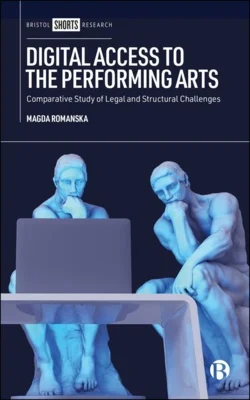 Digital Access to the Performing Arts by Magda Romanska is available to read open access on Bristol University Press Digital here.
Bristol University Press/Policy Press newsletter subscribers receive a 25% discount – sign up here.
Follow Transforming Society so we can let you know when new articles publish.
The views and opinions expressed on this blog site are solely those of the original blog post authors and other contributors. These views and opinions do not necessarily represent those of the Policy Press and/or any/all contributors to this site.
Image credit: Pinho via Unsplash