


Janine Ewen’s mother endured ten years of domestic abuse, which resulted in severe health complications, culminating in disability and terminal cancer. Now a prominent global specialist in public health, safety and childhood vulnerability, Ewen argues that survivors and their families all too often lack access to timely, effective and lifelong care. As the 16 Days of Activism for the Elimination of Violence Against Women campaign moves into December, Ewen calls for an urgent need to recognise domestic abuse as a lifelong public health issue.
I recall the day my mum was preparing to share the news with me. After several weeks apart, my friend and I were heading over to visit her. My mum seemed relieved that I was bringing my friend along, and later I understood why.
After our lunch, my mum looked at me and said, “I have something to share with you, Jan.” From the look on her face, I knew it was something awful. Before she said a word, my intuition had already disclosed the truth to me.
“I’m truly sorry to tell you that I have terminal cancer, pet.”
I had become increasingly used to receiving distressing updates about my mum’s health. She had long lived with severe pain, especially in her back, which eventually made it difficult for her to walk. Unfortunately, I failed to join the dots to recognise that her chronic pain was caused by the physical injuries inflicted on her by my father during the ten years they lived together. As she gradually lost her independence and love for life (in fact, suffering from severe depression), I put my own career on hold to provide her with support.
Domestic abuse seldom occurs as an isolated event; rather, it typically consists of a series of interconnected incidents involving physical, psychological, sexual, emotional or financial abuse. While there are no definitive global statistics, the scientific evidence is sufficient to confirm that domestic abuse is a major public health crisis and the cause of a substantial, often hidden, number of chronic illnesses and disabilities worldwide.
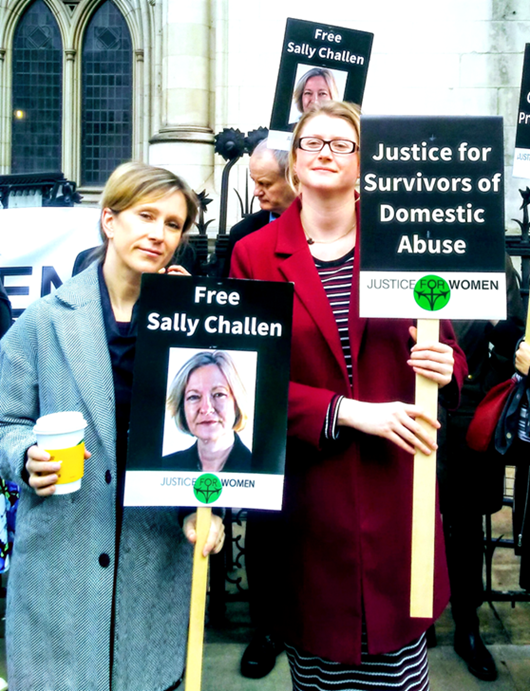
Ewen (right) at the High Court in London to offer support to the Free Sally Challen campaign in 2019
I was heartbroken to see her attempts to conceal her suffering. Chronic conditions are just that: chronic. They’re not short-term, passing issues and there’s no getting better soon, maybe not even ever. All we can request is assistance in managing the symptoms along with support to meet any additional requirements. However, the services must be there for that to take place.
There were successive rounds of corrective surgery, spinal nerve root block injections and various medications – all of which failed to alleviate my mother’s pain. She was informed that there were no further treatment options available and had to come to terms with the reality that her situation had deteriorated rather than improved. And then, finally, she was diagnosed with terminal bone cancer. How many negative circumstances can an individual reasonably be expected to endure?
The reality is that I had observed my mother’s significant deterioration and already braced myself against the likelihood that she might not experience the extended life I had hoped for her. I had dreamed of our being happy and overcoming these challenges. I had envisioned her ageing tranquilly, enveloped by loved ones, with me clasping her hand as we exchanged glances, both reflecting on how we’d triumphed over everything together.
The sorrow I felt is beyond expression. For an extended period, I experienced constant stress, my days filled with brain-fog and forgetfulness, followed each night by persistent insomnia and increasingly frequent panic attacks. People had unrealistic expectations of how I should behave and experience emotions in a ‘normal’ way. Yet obtaining help proved to be impossible. Faced with long waiting lists for counselling and even for complementary therapies, I felt isolated and withdrawn from the outside world. I was quickly losing hope, and I felt unable to take the necessary steps to care for myself to be fully capable of supporting my mum.
My mum was herself on a waiting list for her cancer treatment, which left her with little choice but to pay for a proportion of private scans outside the NHS. Her background as a victim of domestic abuse did not result in prompt intervention. However, I would not settle for inadequate care. She had experienced failure in the past, and I was determined to prevent that from occurring again. I advocated on her behalf to the consultants, but became bitter about having to push for the care she was entitled to receive.
You frequently encounter discussions about ‘bucket lists’, which represent a chance to create numerous enchanting plans, especially when ‘this is it’. However, health challenges like those my mum experienced preclude the hasty pursuit of activities like swimming with dolphins.
Before my mother was diagnosed with cancer, her activities were already limited. A person who once enjoyed taking the dog for walks and dining out for Sunday lunch had become restricted to either her bed or a chair. She no longer cut her grass and was unable to carry out simple household tasks, enduring so many different types of pain. Yet throughout it all she still managed to smile at me.
If my mother had not experienced domestic abuse, resulting in physical limitations because of the chronic pain resulting from the earlier injuries, we would have had a brief opportunity after her cancer diagnosis to create and enjoy additional happy memories. The domestic abuse robbed even more of our time when we needed those months, weeks, days, hours and minutes the most.
Our existence is not dictated by our history; however, the past (including trauma) has a troubling tendency to resurface, triggering other bad events in our lives. While I don’t want to foster a notion that all situations will culminate in failure, or that individuals cannot fully recuperate, it is important to acknowledge that some may not have a fairytale ending. I have conversed with others who have experienced my circumstances, particularly in relation to both providing care for and losing a loved one due to a disability and other illnesses associated with domestic abuse.
We might consider confronting this reality openly and honestly to ensure that timely assistance, particularly in terms of health and wellbeing, is always available for survivors when they require it.
Janine Ewen has dedicated 20 years to the domains of safety, protection and vulnerability across local, national and international contexts. Currently, she is concentrating on advancing her academic career through research, teaching and guest lecturing. Her writing includes blogs, articles and book chapters focused on innovative methodologies, childhood domestic abuse / vulnerability, child-centred policing, and public health topics related to inequality.
Bristol University Press/Policy Press newsletter subscribers receive a 25% discount – sign up here.
Follow Transforming Society so we can let you know when new articles publish.
The views and opinions expressed on this blog site are solely those of the original blog post authors and other contributors. These views and opinions do not necessarily represent those of the Policy Press and/or any/all contributors to this site.
Image credit: Alicia Petresc via Unsplash