


Looking up from his Lego, Mystical*, a seven-year-old boy in my research stares at me and says, “Yes, I want you to tell my story because teachers say they want to listen but when things get hard, they tell you to ‘Shut up’”.
I was reminded of Mystical when, a few months ago, the UK government repealed the legal presumption of parental contact in England and Wales. This means that family court judges no longer start from the position that it is always in the best interests of a child to have contact with both parents, disrupting the ‘pro-contact’ culture in the family courts where the rights of abusive fathers are placed above the needs of children.
This legal change made me wonder whether we, as a society, were finally moving towards listening more to children, especially when it came to domestic abuse. Like Mystical, many children who have experienced domestic abuse are inadvertently told to ‘Shut up’ when it comes to telling their stories.
The repeal of the presumption of parental contact: Why it matters
The government’s repeal of the legal presumption is in part due to the Child First campaign led by Claire Throssell and Women’s Aid.
In 2014, Claire Throssell’s two sons, Jack and Paul (aged 9 and 12 at the time), were murdered by their father and her ex-partner, Darren Sykes. The courts had ordered that the boys needed to continue to see their father unsupervised, even though Paul had described how their father had abused the family, and both boys did not want to see their father alone. Sadly, it was on a contact visit in October 2014 that their father set the house on fire and killed Jack, Paul and himself.
The family court system had overridden Jack and Paul’s wishes and knowledge in favour of their father’s rights.
The Child First campaign focused on 19 other homicides involving unsafe contact. As both a practitioner and a researcher, I have known children who were forced against their will to see their abusive fathers by family courts and social workers. The very system that is supposed to protect women and children can work against them.
Living with abuse after separation
Research shows how women are affected by domestic abuse even when they leave a relationship. Navigating post-separation parenting is a minefield.
Women must build a new life away from their ex-partners, manage finance and childcare with limited support, and for some, facilitate the children’s unsupervised contact with their fathers even if the children do not want to see them.
They can struggle to navigate co-parenting while defending themselves against accusations of parental alienation and child neglect made by ex-partners and professionals.
Often there is little attention given to how coercive control can still affect their capacity to parent and are told that the ‘domestic abuse’ is in the past and they should ‘move on’ – despite evidence showing that abusive partners can continue to use children to control women.
Why are fathers’ rights still prioritised over children’s wellbeing?
So why with all this evidence and research are we prioritising fathers’ rights over children’s wellbeing? In simple terms the answer is ‘patriarchy’ – the sociopolitical and cultural system that values a heterosexual, cisgender and dominating form of masculinity over anything and anyone else.
Therefore, it is unsurprising that when it comes to domestic abuse, the words of victims/survivors – predominantly (but not solely) women and children – are still not believed or acted upon because our judicial, political, economic and social systems and structures prioritise supporting the patriarchal status quo.
An aspect of patriarchy is the belief that children cannot make meaning and knowledge about their own lives. There is an assumption that children are too vulnerable and easily manipulated and therefore are not reliable sources of knowledge and judgement about their situation. Is it little surprise then that Macdonald’s research shows that in cases of domestic abuse and contact, when children want to see their fathers, their views are considered, but when they do not, then it is these views that need to be changed rather than the action of their fathers. Another issue is not wanting to ‘retraumatise’ children, thus not allowing them to be part of decisions and reviews concerning their abuse and lives.
This then allows an epistemic injustice – where children’s knowledge is continuously ignored under the guise of protection. In the case of Paul and Jack, this proved fatal.
Protecting children or silencing them?
While children do not know everything, and at times decisions and actions must be made on their behalf, there are still many more times where they can still contribute to these decisions, especially in questions of abuse and welfare. Ultimately, we need to stop viewing children as the property of parents. We need to see them in their own personhood, as well as in relation to people and things.
This means also taking into consideration their views about abuse and contact with their fathers. We need to be curious about how domestic abuse can still be affecting their lives even after separation.
In keeping children in a passive and unknowing role, we continue to see them through the eyes of their abuser. We continue to keep them silent, even to the detriment of their safety.
We need to evaluate how patriarchal values obscure our judgements. So, when things get tough, we don’t, like Mystical’s teacher, tell them to ‘Shut up’.
- Mystical’ is a pseudonym used to protect the research participant’s privacy and anonymity.
Brenda Herbert is Research Fellow at University College London and, for 15 years, has worked as a counsellor with children who have experienced domestic abuse.
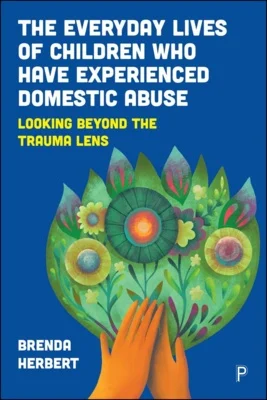 The Everyday Lives of Children Who Have Experienced Domestic Abuse by Brenda Herbert is available for £24.99 on the Bristol University Press website here.
Bristol University Press/Policy Press newsletter subscribers receive a 25% discount – sign up here.
Follow Transforming Society so we can let you know when new articles publish.
The views and opinions expressed on this blog site are solely those of the original blog post authors and other contributors. These views and opinions do not necessarily represent those of the Policy Press and/or any/all contributors to this site.
Image credit: Artem Maltsev via Unsplash