


Democracy is in crisis, and our schools may hold the key to saving it. Across the world, education is being reshaped by competition and performance metrics, yet the roots of democracy begin in the classroom.
Consider this example: A new primary school in a suburban area has recently opened its doors to pupils from year one to year ten. Together with the principal, the members of staff have carefully designed the school’s organisation and everyday teaching practices to allow for the pupils’ participation in decision making.
Their conviction is that to facilitate the development of active, informed citizens capable of independent and critical thinking, the school should be practised as a democracy. Pupils are expected to participate in decisions on the content and methods of teaching as well as to be part of the school democracy through class councils, a school magazine, different communities and the pupils’ school council.
Democracy, they believe, must be lived and practised daily. The teachers argue: “An abundance of fancy words about tolerability and care for others are not worth much, if we, in our organisation of the everyday of the school and in our own attitudes to pupils, are not guided by these views. There is no need to lecture about human rights; instead, pupils shall experience the truths found in these.”
In a world where democracy is challenged by populism, state-sanctioned violence and fake news, this example speaks eloquently about relationships between education and democracy and the importance of democracy being experienced by children and young people in their everyday life.
It is powerful in relation to the contemporary condition, but interestingly, the example stems from the early 1960s and now belongs to the history of education rather than the present.
Policy erasure: When the past is forgotten
It is tempting to think about history as progress, a forward march towards greater levels of development. The last decades of education policy have supported this conjecture by always valuing the new over what already exists.
The legitimacy of new policy initiatives is often established by narratives of how existing teaching practices are outdated, inadequate and not evidence-based. Particularly, over the last 20 years and with the emergence of international policy actors such as the OECD, education policy has disregarded what is now seen as an outdated past and focused on education performance, casting national school systems as means to achieve a competitive labour market rather than a thriving democracy.
Education systems have been reformed and reshaped numerous times to adapt to this purpose. Such new policies often relegate certain values, concerns and practices to the past and deprive them of a place in language and knowledge.
In my recent book, Inherited time. A Hauntological History of Work in Educational Vocations, I call this ‘policy erasure’. Policy erasure denotes the way in which policy forgets and disavows the past through a linear construction of time that problematises and delegitimises what came before – installing new epistemic regimes that mark the boundaries of what can count as knowledge and as professional practice.
Listening to ghosts of education
The history of education is rich with knowledge, practices and reflections upon the important relationships between education and democratic societies. Particularly, in the years to follow both of the two world wars, educational thinkers and practitioners across Europe were deeply engaged in questions about how to build education systems and practices that could protect societies against fascism and the rise of dictatorships.
Numerous experiments with democracy in schooling were conducted and carefully documented and evaluated. Today, however, this knowledge and these experiences are largely forgotten – overshadowed by performance metrics, international rankings and market-driven reforms.
However, perhaps ideas about education as the foundation of a thriving democracy might not be entirely lost. In my book, I explore how these rich pasts still live in educators and education today – sometimes as pronounced concerns and aspirations of teachers, but often also as less articulate intuitions or sudden affective realisations of the costs of contemporary policy.
Amid the pressures to conform to policy demands, long forgotten ideals of education as a pillar stone of democracy can suddenly resurface, leaving teachers and educational leaders to wonder about possibilities of alternative teaching practices. I call such incidents ‘ghostly moments’ and argue that it is important to learn to listen to such ghosts even if the message they bring can be complicated to act on.
Remembering alternative futures
As we celebrate the International Day of Education in January, it is crucial to consider the important role education plays in ensuring a thriving democracy. Robust democracies evolve from the everyday life in public institutions, such as schools. In a global context where democracy seems less solid than it has for decades, these ghostly voices from the past remind us that education and democracy are inseparable.
They whisper about alternative futures for democracy – reimagining schooling as lived democracy. The ghosts from the past remind us that democracy must be experienced, felt and practised; that it can begin in the meeting between a child and a teacher; and that the everyday rituals of schooling offer countless opportunities to practise democratic values.
The contemporary situation calls upon us all to listen to past concerns for how to keep democracy alive and to remember other possible futures than those offered by education policy today.
Justine Grønbæk Pors is Associate Professor at Copenhagen Business School. Her work concerns changes to public policy and to the welfare state.
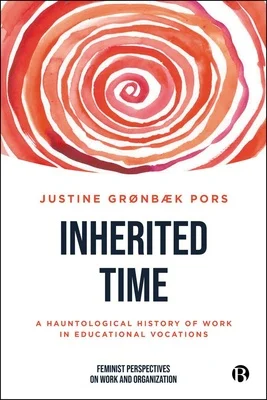 Inherited Time by Justine Grønbæk Pors is available for £80.00 on the Bristol University Press website here.
Bristol University Press/Policy Press newsletter subscribers receive a 25% discount – sign up here.
Follow Transforming Society so we can let you know when new articles publish.
The views and opinions expressed on this blog site are solely those of the original blog post authors and other contributors. These views and opinions do not necessarily represent those of the Policy Press and/or any/all contributors to this site.
Image credit: Sigmund via Unsplash