


You can see it from space. A blue green algal bloom that, at the height of summer, covers most of the largest freshwater lake in Britain and Ireland – Lough Neagh.
It stinks, dogs have died from the toxic bloom and what was being developed as a leisure facility can no longer be accessed. The long-established eel fishing industry is on its knees. Even more worrying are the genes found that can produce antibiotic-resistant superbugs, in a water source that supplies 40 per cent of the drinking water in Northern Ireland.
The potential collapse of this delicate ecosystem is a canary in the coalmine, illustrating how global warming, combined with our current modes of organising, is threatening key cycles that sustain life on our planet.
A system under strain
The water cycle is central to food production and public health, and sustains biodiversity. It is also at the heart of the current technological revolution. Its cooling properties are central to AI data centres, already raising concerns in water-stressed areas such as Texas, where they are being built at scale. Indeed, some estimates suggest that 10–50 enquiries on ChatGPT require half a litre of water for cooling the servers that generate the responses.
Water is key to societal stability. In Iran, Tehran is nearing ‘day zero’ when water will run out due to climate change and poor water management. A city of 10 million will likely need to move the coast where desalination plants can respond to basic human needs.
These are not isolated cases, but signals of wider systemic strain.
Rethinking how we organise
But let’s return to Lough Neagh. What can be done?
Lough Neagh offers a stark lens through which to examine a deeper problem: the way we organise economic and social life.
One way to approach this is through a framework that foregrounds a planetary mindset and focuses on four organising dynamics: purposing, democratising, commoning and cooperating. The framework provides a scaffolding that enables us to navigate towards socioecological system living within Earth’s boundaries. It also invites a more fundamental question: whether current institutional structures are fit for a world of ecological limits.
I use the verb ‘organising’ advisedly, as I recognise that there is no one ‘best’ way to address complex systems at the edge of chaos. Learning and adaptation is a necessity. It is robust enough to challenge existing assumptions, but flexible enough to leave room for learning, imagination and innovation.
A planetary mindset
So, what is a planetary mindset? Put simply, it is moving beyond dualistic thinking that sees humans as separate from nature. Rather, it recognises the deep interdependencies and co-constitution of humans and the natural world.
If the water I drink is contaminated by the tails and run-off from mining, I will develop more serious illness than if it were drawn from a pristine well or river watershed.
Rare earths, copper and silver are all at the heart of the electrification of economies, but this comes at a cost to nature and communities.
For organisations, this presents a fundamental challenge. Many remain trapped in an instrumental view of Earth’s resources, abetted by an economic system that sees these resources as ‘free’ and to be exploited for profit.
The cost of a species, a water table or a rich forest ecosystem never appears on corporate balance sheets. Pollution and CO2 emissions remain closely tied to GDP growth, despite claims of decoupling.
From principles to practice
We need to move beyond the separation fallacy, of humans and nature, and rethink what a planetary mindset means for organising within Earth’s boundaries. This leads us to the first of the organising dynamics: purposing. Such a mindset means building in accountability to the natural world in our strategic goals and aims – the purpose of the organisation.
This goes beyond Environmental, Social and Governance (ESG) metrics. It means giving a meaningful voice to nature. It can mean having nature on the board, as the UK cosmetics company Faith in Nature is doing; or creating ‘purpose locks’ such as that designed by Patagonia to ensure there is no mission drift. It means designing governance structures that protect the future commons such as water, as has been achieved by the municipality of Terrassa, in Spain.
This is where the link with democratising comes in. Organisations need to reflect the full set of stakeholders and not just shareholders. Shareholder primacy has been an aberration, and the ruthless pursuit of profit maximisation (super profits in particular) has generated multiple problems, from inequality to environmental disaster.
We need to rebalance this skewed power configuration and enable organisations to restore their legitimacy, serve humans as well as nature and provide the context to unleash new modes of organising.
Here we bring in commoning, or rather how organisational life can decommodify. Decommodification of the natural world involves removing, as far as possible, nature, land, water and resources from market-driven, profit-seeking exchange, to protect it as a future commons. It challenges the view of nature as a mere commodity with a price tag, advocating instead for intrinsic value, environmental stewardship and living within Earth’s boundaries.
Similar principles can be applied to humans in organisations – how can organisations enable the flourishing of their employees? Who has a claim on the resources of the organisation and how these are deployed?
An energy commons enabled by wind and solar technology is emerging, with citizens owning the means of production and distribution of green energy. This reduces inequality and energy poverty but can also speed up the adoption of these technologies.
But getting things done is not the work of lone organisations. It is a cooperative venture. Delivering a sustainable future means bringing together parties that may not realise that they have interests in common. One role of governance is to consider how new models can be designed to make these associations.
However, we must ask who might benefit from orchestrating cooperative networks – who captures the value? This is where the democratising dynamic is critical, as well as the importance of governance models anchored in a planetary mindset.
Lough Neagh as a case of organisational failure
So, what does this look like in practice?
Lough Neagh’s governance is a tangle of private rights and fragmented responsibilities. The Earl of Shaftesbury owns the lakebed and soil. A fishing cooperative holds commercial rights. Surrounding farmland, mostly dairy and beef enterprise, discharges nutrients into the watershed. The National Trust has limited influence.
No single actor has overall responsibility, and the government has long avoided confronting the powerful farming lobby. The result is predictable: an ecological catastrophe produced by organisational failure.
No structure exists for the full range of stakeholders – human and non-human – to have a voice. The Lough itself has no representation as a complex, life-sustaining ecosystem. Governance is grounded in private rights, not shared stewardship. The different actors operate in silos, incentivised by short-term economic gains rather than long-term ecological viability.
But there are alternative possibilities. One is to grant the Lough legal rights in the same way the Whanganui River watershed in New Zealand has rights. It is possible for the Lough to be framed as a living ecosystem with not only intrinsic value, but also mutual value for humankind. These can become a set of principles on which stakeholders can align. If the purpose is recast in this way, competition between current interests can be translated into cooperation as mutual interdependence is embedded. This can then be enshrined in policy and metrics on watershed health, community wellbeing and ecological regeneration.
All this requires trade-offs. However, a new governance structure can make these trade-offs and commitments public and transparent, with transgressions manifest.
Here, the move from a dependence on beef and dairy farming to more diverse modes of food production will be a key challenge, and transitional tools such as payments for ecosystem services to restore the health of the Lough could be considered.
The Lough could become a future commons with shared ownership, supported by a data commons that monitors its ecological health and resilience.
Holding the tension
Many of these ideas are not new. What matters is how they are brought together.
The value of the ‘generative dynamics’ framework lies in its ability to hold tensions – between economy and ecology, short- and long-term, private and collective interests. It is through these tensions that innate structural contradictions can be articulated and addressed through new modes of organising.
Critically, this framework succeeds or fails if it is not anchored in a planetary mindset. The challenge is not only in identifying solutions, but also in creating the conditions in which they can take hold.
Marc Thompson is Senior Fellow in Strategy and Organisation, Said Business School, University of Oxford.
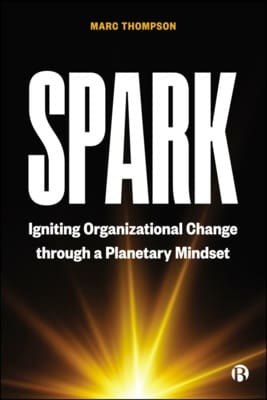 Spark by Marc Thompson is available on the Bristol University Press website. Order here for £19.99.
Bristol University Press/Policy Press newsletter subscribers receive a 25% discount – sign up here.
Follow Transforming Society so we can let you know when new articles publish.
The views and opinions expressed on this blog site are solely those of the original blog post authors and other contributors. These views and opinions do not necessarily represent those of the Policy Press and/or any/all contributors to this site.
Image credit: Ian via Unsplash