


Nick Bisley, author of Asian Crucible, examines how geopolitical tensions, particularly between the US and China, are reshaping globalisation by redirecting trade, supply chains and investment, while increasing economic friction and risk across Asia.
In 2024, the People’s Republic of China (PRC) supplied nearly two thirds of smartphones imported into the US. One year later, in 2025, it accounted for only a quarter. A more visible example of decoupling – in which the economic ties of interdependence are deliberately unpicked – is hard to come by.
This has occurred because politics is reconfiguring how trade works.
In the past, firms based their productive processes purely on considerations of efficiency, price and profit. What was made where and under what circumstances was the result of their calculations. Geopolitics is intruding on this process, recasting how and where things are made all over the world.
Globalisation is not disappearing; rather, the turbocharging of geopolitical competition and the sharper set of political forces at work globally are changing where and how it happens.
The most prominent of the forces reshaping trade relations is the mercantilism of Asia’s two biggest powers. In his first term, President Trump erected large tariff barriers against a range of Chinese imports. These were retained and then expanded by the Biden administration.
In his second term, Trump has escalated things further. At one point, China was on the receiving end of nearly 150 per cent tariffs. These extreme levels did not last, as the US and China struck a deal on the sidelines of the APEC summit in October 2025 after Beijing had returned fire by cutting off the US from rare earth magnets and other critical mineral products.
But it is not just Sino-American tensions that have redounded on the region. The ‘liberation day’ tariff regime launched on 2 April 2025 had a significant impact on countries that ran large trade surpluses with the US, many of which were in Asia.
These surpluses had partly come about because these countries export goods that the US wants, but they either do not want or cannot afford what the US sells. In the past, the logic of the market was allowed room to work, and imbalances were of little concern. For the Trump administration, however, surpluses are an urgent problem that must be fixed through tariffs.
The surpluses had also grown due to the ways firms had responded to Washington’s trade war with China. This involved moving productive facilities out of the PRC and into countries like Vietnam, Cambodia and Indonesia, as well as changing production chains more generally to avoid the tariff net.
The Trump administration appears to believe that the blunt instrument of tariffs will reduce trade imbalances and lead to manufacturing revival in the US. That this has not occurred after many years of higher tariff regimes does not appear to have registered, but its impact on trade patterns is clear.
For its part, China is also playing politics with trade policy, and not just in its tit-for-tat response to the US. In the lead-up to the pandemic, the PRC had sought to drive economic reform, with the aim of moving away from its dependence on exports to achieve growth, towards domestic sources of consumption and demand.
The lockdown years plus the crisis in its domestic real-estate market meant that the country has had to continue to depend on export promotion to achieve necessary growth levels. As a result, developing Asia is struggling in the face of Chinese imports that are supported by subsidies, tax breaks and other advantages offered by the PRC government. These are causing economic downturn in many countries in the region.
Added to this already complex map, trade is also being reconstituted by overtly geopolitical considerations. Here there are two major forces at play.
First, states are trying to pre-empt political tensions and making decisions to avoid getting caught up in trade conflict or worse. This has led to many firms developing a ‘China+1’ strategy, in which companies find ways of producing and distributing goods outside China (the +1), and having a separate plan for the PRC market. This is part of what lies behind the changes to smartphone production noted above.
The other force relates to the ways in which governments see economic matters as a direct zone of contestation, and as such are intervening to maximise their advantages and reduce their weaknesses.
The old policy settings of letting globalisation grow untrammelled have led to market dominance in a number of areas of high technology. The two most prominent examples are semiconductors and rare earth mineral products such as magnets.
Taiwan produces 70 per cent of the world’s semiconductors and 90 per cent of the highest performance chips. The PRC, meanwhile, has more than 90 per cent market share of most rare earth mineral products.
Governments now see these concentrations as a problem because they create vulnerabilities in areas that are key either to military matters directly – rare earth products are vital in many defence platforms – or because they could be weaponised. Consequently, states are developing a whole slew of policies from investments to subsidies, tax breaks to outright trade bans to create new industries and reduce their vulnerabilities.
Prior to the COVID-19 years, markets were the dominant force in Asia’s economic development. They were powerful engines that had created a remarkable period of prosperity. Since 2022, however, geopolitics has scrambled globalisation and is creating a much more politicised regional economy. Consequently, Asia is experiencing lower levels of growth, greater friction and increased geopolitical risk.
This pattern looks set to remain, and the challenge facing the region and the world is how to manage this risk and achieve growth for the hundreds of millions in Asia who remain outside the middle class.
Globalisation is not being dismantled; rather geopolitics is wrenching it into a new shape. This makes the task of driving growth and keeping the peace extremely hard.
Nick Bisley is Pro Vice Chancellor for Research and Professor of International Relations at La Trobe University and the author of Asian Crucible: Globalization, Geopolitics and the Contest for the Future.
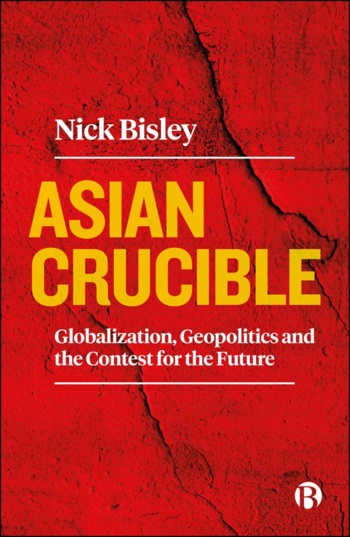 Asian Crucible by Nick Bisley is available to buy on Bristol University Press or £14.99 here.
Bristol University Press/Policy Press newsletter subscribers receive a 25% discount – sign up here.
Follow Transforming Society so we can let you know when new articles publish.
The views and opinions expressed on this blog site are solely those of the original blog post authors and other contributors.
These views and opinions do not necessarily represent those of the Policy Press and/or any/all contributors to this site.
Image credit: futureatlas.com via Flickr