


Hallvard Moe and Brita Ytre-Arne, authors of Too Much News, suggest that news saturation is rising as the constant mix of distressing and trivial content in attention-driven digital feeds overwhelms audiences, highlighting the need for journalism that informs without exhausting people.
Do you find the news important and exhausting? You are not alone.
The Reuters Institute’s Digital News Report 2026 reveals that 42 per cent of people across global markets say they often or sometimes avoid the news – up from 29 per cent in 2017, when the survey began asking. We call this saturation, and we think it is part of how people relate to news, not evidence that they have stopped caring about it.
What is happening in Ukraine? Will AI take my job? And what was that about Meghan’s new outfit?
Many of us recognise the experience of feeling overwhelmed, scrolling through catastrophic headlines that mix with silly videos on the phone. News saturation is a tipping point where news no longer seems valuable, where people need a break and cannot take in more – at least for a while.
Instead of advising audiences on how to cope with relentless information, it is worth asking why news feels this way. The feeling indicates a fundamental tension in what news means in a digital society: is it a democratic necessity, or just part of a problematic information environment?
Between democracy and doomscrolling
News is a media genre in a strained sociocultural position. On the one hand, it is often held up as more significant than other types of media: news is about real events, about issues and processes people need to know about. The ideal of news as crucial to fostering an informed citizenry can be questioned, but it continues to shape how politicians, journalists and many citizens think about news.
On the other hand, it is now difficult to separate news from whatever else goes on in the digital environment, which is currently facing a backlash against social media and screen use. There, news journalism mixes with other kinds of content, some news-like and some not, in the same feeds and platforms. News is part of an attention economy in which many actors compete to monetise audience attention and user data.
With push notifications, captivating headlines and constant updates, news can easily feel overwhelming and intrusive. But format is only part of the problem. News content can also be extremely distressing, as news informs and reminds people of wicked problems, dangers and suffering, and of big and small threats to ways of life.
Doomscrolling is a practice and concept that integrates both these aspects: the content of unsettling news meets attention-economy news provision, creating an emotional drain that users find it hard to get out of.
The ‘war and celebrity’ problem
And what about everything that is not doom and gloom? Too much triviality can also add to the feeling of having had enough, and make it easier to justify turning away from news.
In our research on people’s news experiences for our forthcoming book, Too Much News, we encountered what we call the ‘war and celebrity’ problem. Both wars and celebrities are mentioned as topics people have had enough of, but that is not all. Our participants stressed it is the mix that is challenging to deal with.
One headline warns that AI is an existential threat to humanity; the next reports that an influencer has a new haircut. People have interests in, and reasons to follow, both kinds of news. It is the combination that can feel absurd, as it appears in algorithmic feeds and on news sites, adding to the cognitive toll of navigating a chaotic information environment.
Is it possible to extricate news from the attention economy?
News is deeply ingrained in the attention economy. Many news organisations understand the challenges of intrusive news, overload and saturation. Yet the changes that would help most are also the ones hardest to make, because they run against the competition for attention.
In Too Much News, we explore some practical ways forward: avoiding clickbait headlines, severely limiting the use of push notifications, and designing news interfaces that make it easy to take a break and meaningful to return. None of this is radical. All of it is possible tomorrow.
News saturation is not a permanent state, nor an indication that people do not care about news. It is what happens when a democratic good is delivered through an economic machine built to never let go. The question is not whether audiences should switch off, but whether journalism will give them a reason to switch back on.
Hallvard Moe is Professor of Media Studies at the University of Bergen.
Brita Ytre-Arne is Professor of Media Studies at the University of Bergen.
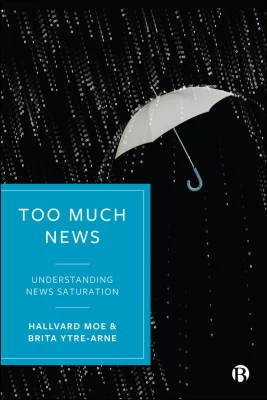 Too Much News by Hallvard Moe and Brita Ytre-Arne is available to read open access on Bristol University Press Digital, or available to order here for £29.99.
Bristol University Press/Policy Press newsletter subscribers receive a 25% discount – sign up here.
Follow Transforming Society so we can let you know when new articles publish.
The views and opinions expressed on this blog site are solely those of the original blog post authors and other contributors.
These views and opinions do not necessarily represent those of the Policy Press and/or any/all contributors to this site.
Image credit: Marija Zaric via Unsplash