


Climate change is creating new forms of harm, exposing existing institutional vulnerabilities and raising questions about the capacity of criminal justice systems to protect people equitably. As world leaders gather for COP31, Rob White, author of Climate Harms and Criminal Justice, examines the implications for policing, prisons, courts, harm prevention and human rights.
Global warming impacts the institutions of criminal justice in myriad ways and is changing how officials and agencies carry out their varied tasks depending on circumstance and context. It is also fundamentally transforming how we do justice and, indeed, whether justice is being done or is even possible.
Consider this.
Antiquated prisons, many without air conditioning, are cooking inmates, yet continue to be used, continue to be filled and continue to be overcrowded. Heat kills. Especially those with no escape, those with no respite. Human rights are ignored and human deaths deemed simply part of the carceral costs. Meanwhile, prisoners are increasingly relied upon to fight the fires and clean-up after the floods, regardless of lack of training, safety or pay. Where is the justice in this?
Floods, wildfires, droughts, rising seas and cyclones: extreme weather events and the slow crisis consequences of climate change are creating ever more disasters. Police, firefighters, ambulance officers and other first responders are tasked with longer periods of disaster response, taking them away from other parts of their mission. People need to be evacuated, rescue operations demand priority choices, and nursing homes and prisons require extra special care and security requirements. Who can do justice to this?
Courts are preoccupied with climate litigation in the same moment that environmental and climate-justice activists front up on anti-protest charges. Judicial officers come to grips with asserting the rights of nature and personhood for rivers while the planet burns, species diminish and pollution contaminates air, land and water. Law is a site of contestation at the centre of which are increasingly contradictory and paradoxical legal actions. Is justice under these circumstances possible?
The community is asked to do more, with less, in the face of climate calamities that are growing in significance and impact. “Adapt”, they say. Put mist sprays in your bus stops; reduce heat in your houses; plant shade trees and find ways to cool down. Anticipate the harm and prepare for the worst. Yet the fossil fuel companies continue to receive public subsidies, with coal and gas considered more valuable than ecological health and species biodiversity. And the planet continues to heat up at alarming rates. Whose justice is this?
We, the people, are expected to cop it. How is that just?
The perils of global warming have been known for over a century. Governments officially confirmed the human contribution to the climate crisis in the early 1990s. Yet, our leaders continue to fail to lead when and where it counts most. This is evident in the abject failure of mitigation strategies – the abrogation of duties to prevent the causes of climate change. The result? We will not achieve even baseline Paris targets. Glaciers melt, ice fields shatter and oceans rise. The consequences are catastrophic, as recent events in Nepal demonstrate.
However, the emphasis now is on adaptation strategies – how to respond to climate consequences, given that action around causes appears to be a lost cause.
Adaptation costs money. It demands people, resources, finances and planning. But who is going to pay for this climate adaptation? Countries around the world have been cutting taxes, especially for the wealthy. They have been pruning public services and cutting back on education, health and welfare while increasing military spending. And polluting industries continue to receive their tax breaks and public monies, all for the sake of ‘the economy’. Who profits from this?
As the latest COP talkfest unfolds, the climate transition favours AI entrepreneurs and the expansionary contours of green capitalism. The people are excluded and left behind. And as the streets fill, so do the courtrooms and the prisons. But these, too, are victims of and hostages to the climate crisis and the bewildering decisions of governments to fund the rich rather than cater to the vulnerable and marginalised.
Thus, crisis of governance and irretractable climate consequence merge in perversions of justice that permeate our state institutions. Rights are hotly contested in those forums that still allow for it. For others, hidden from view, rights are subject to a different kind of heat, one that is direct and immediate.
As the planetary triple crises of climate change, biodiversity loss and pollution deepen, matters of justice continue to be revised and transformed. This includes the basic institutions of criminal justice themselves.
Climate change is reshaping every part of society, and criminal justice is no exception. It is transforming policing, courts, corrections and communities, from disaster responses and harm prevention to prison design and the criminalisation of protest. In this, it is simultaneously presenting major challenges to the foundations of justice, its basic conceptions and who is likely to be its most favoured recipients.
Justice is not blind, and neither is climate justice nor criminal justice. At present, it is wilfully skewed in favour of the powerful. It is not socially neutral and this makes it a site of contestation as well as humiliation. The struggle for human rights and democracy forms an essential part of the adaptations needed to face the future. And to change it for the better.
Rob White is Emeritus Distinguished Professor of Criminology at the University of Tasmania, Australia and author of Climate Harms and Criminal Justice published by Bristol University Press.
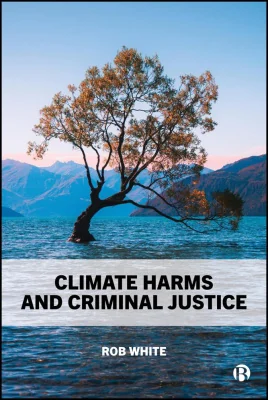 Climate Harms and Criminal Justice by Rob White is available to order on Bristol University Press for £24.99 here.
Bristol University Press/Policy Press newsletter subscribers receive a 25% discount – sign up here.
Follow Transforming Society so we can let you know when new articles publish.
The views and opinions expressed on this blog site are solely those of the original blog post authors and other contributors.
These views and opinions do not necessarily represent those of the Policy Press and/or any/all contributors to this site.
Image credit: Tania Malréchauffé via Unsplash